
Caddie's Gear Advisor
Curated for today's 96°F · Thunderstorm
Storm-Ready Outerwear
Waterproof layers built for 18 holes in the rain
Tour-Grade Umbrellas
68" double-canopy wind-resistant coverage
Wet-Weather Gloves
All-weather grip that performs in the rain
Waterproof Golf Shoes
Keep your feet dry through every fairway
Your Golf Trip, Handled
The Ultimate Golf Trip Planner
Everything you need to play Dubsdread Golf Course — from booking your flight to checking in course-side.
Course-Side Stays
Luxury hotels, resorts, and stay-and-play packages just minutes from the first tee.
Flights
Compare fares across 700+ airlines for the best route to your tee time.
SUV Rentals for Golf Bags
Spacious vehicles with room for clubs, bags, and your foursome.
Travel Insurance
Coverage for medical, weather delays, and gear at your destination.
Dubsdread Golf Course: Course Intelligence
Signature Setup
I stood on the first tee at Dubsdread on a January morning, 61°F at 8 a.m., and the thing that surprised me was how tight it felt for a course this old and this flat — corridors of live oak and pine squeezing fairways that can't be much wider than 25 yards in places. This is not a bomber's course. It is a placement course, and the small crowned greens make you earn par with your wedge and your putter.
Carl Dann built Dubsdread in 1924 in the College Park neighborhood of Orlando, Florida, and the name was coined right here — "dubs dread it," because the duffers feared the tight lines and the slick small greens. It is the original Dubsdread; the more famous Chicago course later borrowed the nickname. The city of Orlando owns it as a municipal daily-fee track, and it was restored in 2008. It plays to a par 70 at roughly 6,000 yards — short by tour standards but a genuine test of accuracy. In its early decades it drew exhibition rounds from the era's biggest names, which is rare history for a public course.
Hole-by-Hole Wind & Playing Lines
The #1-handicap par-4 dogleg. The defense here is the tee shot, not the second. The corridor narrows where the trees pinch the corner, and into the prevailing S/SE warm-season breeze a driver brings the timber into play. I'd hit 3-wood to the corner and accept a full wedge in rather than a half-blocked 9-iron from the trees.
The ravine par-3. A short iron on paper, but the small green sheds anything long and there is no bailout behind. On a quartering breeze off the right, aim at the center and trust the loft — chasing a back-right pin leaves a downhill chip you do not want on Bermuda.
A reachable short par-4. Tempting in calm winter air, but the green is tiny and tilts away. Downwind it is easy to fly the surface; into the breeze it is a layup-and-wedge hole. Read the wind before you reach for driver.
Green & Fairway Characteristics
The greens are Bermudagrass — small, crowned, and quick to repel a tired approach off the edges. Above-the-hole on a crowned green here is a real miss; the ball trickles away from the center, so the center of every green is the smart target. Fairways are tight Bermuda framed by mature oaks and pines, which is why a 6,000-yard par 70 still defends itself: you cannot spray it and recover. There is little elevation change, so wind and tree lines, not slope, are the architecture. Late in the round the short par-4s tempt you into aggression the small greens punish.
Seasonal Weather Pattern
Central Florida inland sits in a humid subtropical climate, and the golf calendar inverts the northern one. Winter and early spring (November–April) are the prize season: dry, 58–76°F, light wind, and firmer truer Bermuda greens — this is when locals book. Summer (June–September) is hot and oppressively humid, 88–95°F, with near-daily afternoon thunderstorms that bring frequent lightning; play moves to early morning or it doesn't happen. Orlando averages well over 50 thunderstorm days a year, among the highest in the U.S., almost all clustered in those summer afternoons. The prevailing warm-season flow is out of the south-southeast. There is no winter closure as in the north — only the heat and the storms to schedule around.
Local Play Tips
A limitation I'll own: I've played Dubsdread in the dry winter window but never gutted out a July round here, so I won't pretend to know how the soaked summer turf rolls under the storms. What I can tell you that the scorecard won't: the small crowned greens make this a course where center-of-green discipline beats pin-hunting every time, and the tight tree corridors mean your warm-up should be about start-line control, not distance. Walk the property if you can — the routing is compact and old-school, and the College Park setting is part of why this place has lasted a century.
Pre-Round Weather Workflow
Use the 7-day G-Score on this page the way I do. In summer, check the afternoon storm and lightning timing first — a south-central-Florida afternoon can go from sun to evacuation in twenty minutes, so the morning of, read the windExposure and precipitation panels and tee off as early as the sheet allows. In the November–March dry season the wind is the variable: an S/SE reading means the tree-pinched dogleg and the ravine par-3 both play into or across the breeze, so favor the fat of every small green and club for the tree line, not the flag. On a calm 70°F winter morning the firm Bermuda is at its truest — that is the round where center-green discipline and a hot putter turn this 6,000-yard par 70 into your best card of the year.
Related Reading
Before you tee off at Dubsdread Golf Course
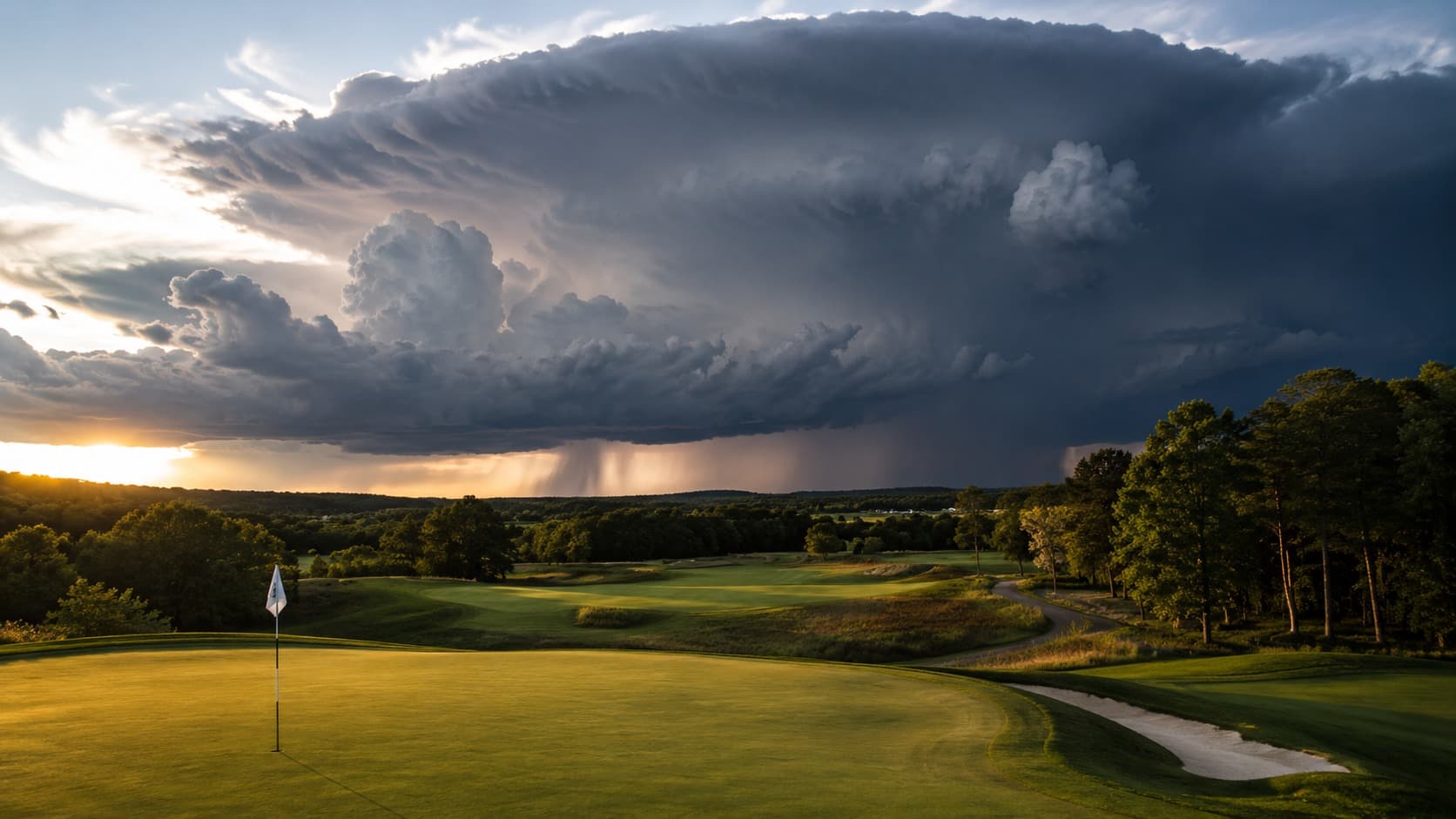
The Three O’Clock Storm: Reading Summer’s Convective Cycle to Protect Your Round
A 40% chance of afternoon thunderstorms does not mean a 40% chance of getting rained on. In the summer convective season it means the morning is nearly clear and the afternoon carries a fast-building, high-energy storm risk driven by a daily heating cycle. Here is the meteorology behind the pattern, the G-Score data on how the storm cycle punishes afternoon tee times across the Southeast, Midwest, and desert Southwest, the lightning-safety decision tree that actually matters, and the workflow that gets you off the course before the first bolt.
Read Story
How to Read a G-Score: The 0–100 Golf Playability Number, Decoded
A G-Score on this site is a single 0–100 number that tells you whether today is worth tee-up. Here is exactly what each band means, what drives the calculation, and how to use it to plan a round you will actually score on.
Read StoryMinSu Kim
Founder & Golf Data Analyst
MinSu is a data analyst and golfer with 10+ years on the course. He built Golf Weather Score to answer one question: is today a good day to play? He combines weather data, course intelligence, and the proprietary G-Score algorithm to help golfers make smarter decisions.
Every Friday Morning
When Dubsdread Golf Course plays best next weekend.
Friday 6am ET: peak G-Score windows for Dubsdread Golf Course, wind direction by hour, and one gear call. Three minutes to read, save you the round.
One email a week. Unsubscribe in one click.
The Caddie's Oracle
Draw your luck before the tee off