
Caddie's Gear Advisor
Curated for today's 79°F · Thunderstorm
Storm-Ready Outerwear
Waterproof layers built for 18 holes in the rain
Tour-Grade Umbrellas
68" double-canopy wind-resistant coverage
Wet-Weather Gloves
All-weather grip that performs in the rain
Waterproof Golf Shoes
Keep your feet dry through every fairway
Your Golf Trip, Handled
The Ultimate Golf Trip Planner
Everything you need to play Interlachen Country Club — from booking your flight to checking in course-side.
Course-Side Stays
Luxury hotels, resorts, and stay-and-play packages just minutes from the first tee.
Flights
Compare fares across 700+ airlines for the best route to your tee time.
SUV Rentals for Golf Bags
Spacious vehicles with room for clubs, bags, and your foursome.
Travel Insurance
Coverage for medical, weather delays, and gear at your destination.
Interlachen Country Club: Course Intelligence
Signature Setup
I stood behind the 9th tee at Interlachen on a still September morning, 52°F and the pond in front of the green flat as glass, trying to picture the shot that made the hole famous. In the 1930 U.S. Open, Bobby Jones thinned his approach, the ball skipped twice across the water "like a flat stone," and he walked off with a birdie on his way to the Grand Slam — which is why members still call it the "Lily Pad."
Donald Ross laid out Interlachen Country Club in 1921 in Edina, just southwest of Minneapolis. (The club's roots and a Willie Watson nine go back to 1911, but the course golfers know today is Ross's.) It has hosted the 1930 U.S. Open won by Jones, the 2002 Solheim Cup, and the 2008 U.S. Women's Open, where Inbee Park won her first major. From the championship tees it measures 6,981 yards to an unusual par of 73, with a course rating of 73.8 and a slope of 142.
Hole-by-Hole Wind & Playing Lines
Hole 9 (par-4, the "Lily Pad"). Forget the legend and play the percentages. On a calm morning the carry over the pond is reachable, but Interlachen sits low between the lakes and a S/SW breeze fills in by midday, lengthening the carry and standing your approach up. Lay to the firm front section of fairway short of the water and hit a controlled mid-iron — Jones skipped his by accident, not design.
A long par-4 in the closing stretch. Ross's finishers run uphill to elevated, domed greens. Into the prevailing breeze, a well-struck drive still leaves a long-iron approach, and anything short of the surface trickles back off the false front. Aim for the fat center of the green and take your two-putt; the run-offs punish the greedy line.
A Ross short par-3. The danger here is never the yardage — it's the green. A back-right or front-left Stimp-fast pin tucked behind a run-off shoulder turns a wedge into a test of spin and trajectory. Favor the safe quadrant below the hole and putt uphill.
Green & Fairway Characteristics
Interlachen's greens are classic Donald Ross — bentgrass, crowned, and ringed with collection areas that gather a slightly mishit approach and feed it 10–15 feet away from the surface. They are not the largest greens you'll play, but they reject the ball at the edges, so the real target is smaller than it looks. Fairways are bentgrass and roll firm in the dry months, with several gentle doglegs that reward shaping the tee ball rather than bombing it. At 6,981 yards the card is moderate by modern standards, yet the slope of 142 tells the truth: the defense is the greens and the run-offs, not raw length.
Seasonal Weather Pattern
The course name means "between the lakes," and that location shapes its weather. Sitting in the Edina lake district inside the Twin Cities metro, Interlachen carries more midday humidity than the open prairie courses west of the city. Spring (late April–May) is cold and soft, 42–60°F, fairways giving back no roll. Summer (June–August) is the playing season, 74–86°F and humid, with a S/SW breeze that strengthens off the surrounding water through the afternoon. Autumn (September–October) is the connoisseur's window — crisp 45–64°F mornings, firm bentgrass, and calm air before any wind builds. The course closes under snow from roughly November through April. NOAA's Twin Cities records show summer afternoon dewpoints often in the muggy 60s°F, which is exactly when the ball stops running out.
Local Play Tips
Honest limitation first: Interlachen is a private club, and I've walked and played it only in the fall — I won't pretend to know its peak-July firmness the way a member does. The thing the yardage book won't tell you: this is a green-reading golf course, not a driving course. Spend your warm-up time on the practice green, not the range. Because the surfaces shed the ball at the edges, the smart miss on almost every approach is short and below the hole, leaving an uphill putt rather than a downhill slider toward a run-off. And on the 9th, resist the romance — the safe lay-up beats the heroic carry on nine mornings out of ten.
Pre-Round Weather Workflow
Use the 7-day G-Score on this page the way I do. Three days out, check whether your tee window lands before or after the midday S/SW breeze and humidity build off the lakes — on firm bentgrass greens, a still cool morning plays measurably easier than a muggy afternoon. The morning of, read the windExposure panel: a S or SW reading means the 9th's pond carry and the uphill closing holes both lengthen, so club up and aim center-green. If the air is humid and the dewpoint is high, expect zero fairway roll and plan a longer club off the tee. Above all, on a Ross course like this, let the greens — not your driver — set your expectations: respect the run-offs, putt from below the hole, and the score takes care of itself.
Related Reading
Before you tee off at Interlachen Country Club

Best Golf Weather by State: Ranking America by Average G-Score
We ranked all 50 US states by average G-Score golf playability. California tops the list, but the results beyond the top five may surprise you.
Read Story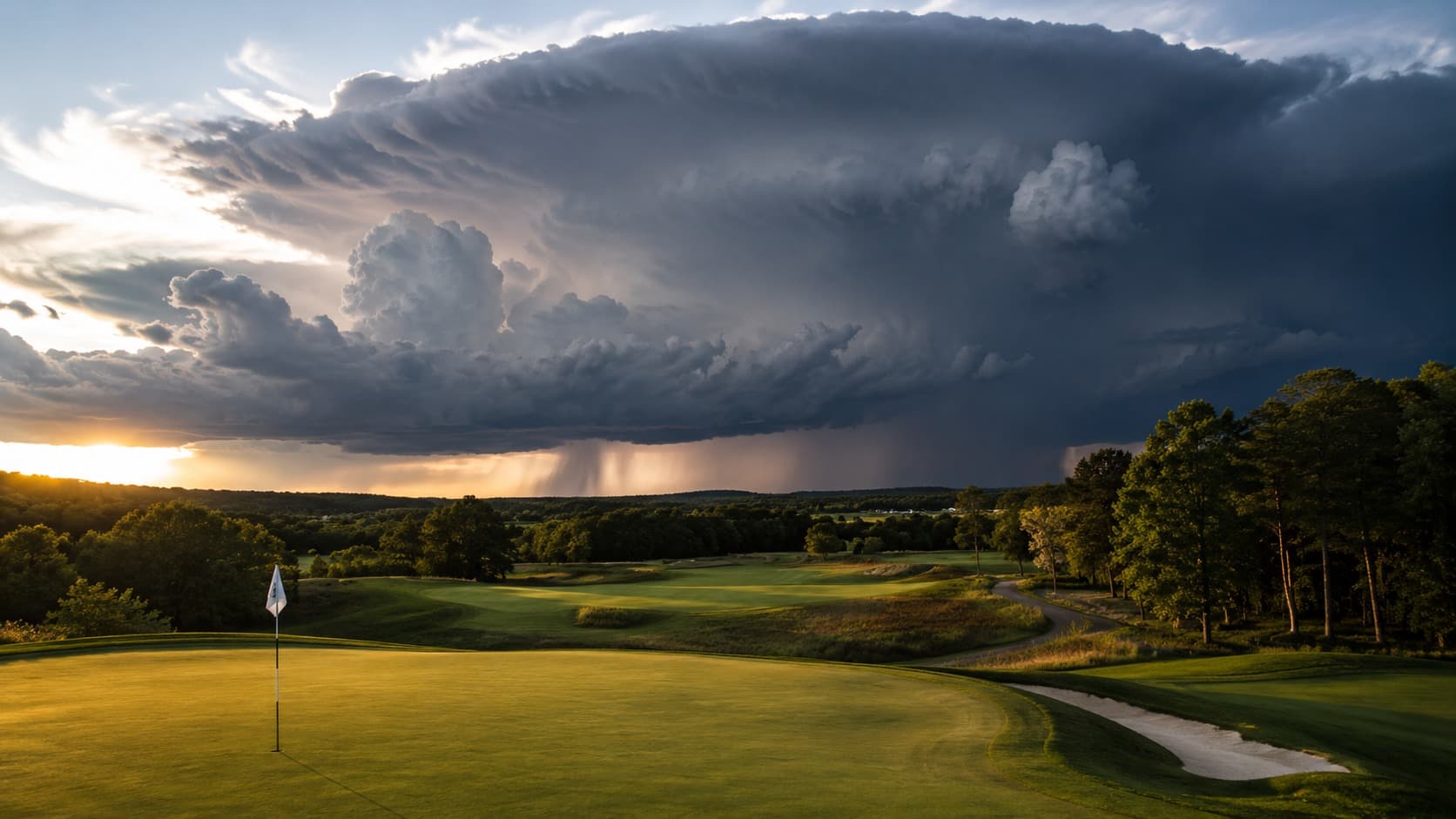
The Three O’Clock Storm: Reading Summer’s Convective Cycle to Protect Your Round
A 40% chance of afternoon thunderstorms does not mean a 40% chance of getting rained on. In the summer convective season it means the morning is nearly clear and the afternoon carries a fast-building, high-energy storm risk driven by a daily heating cycle. Here is the meteorology behind the pattern, the G-Score data on how the storm cycle punishes afternoon tee times across the Southeast, Midwest, and desert Southwest, the lightning-safety decision tree that actually matters, and the workflow that gets you off the course before the first bolt.
Read StoryMinSu Kim
Founder & Golf Data Analyst
MinSu is a data analyst and golfer with 10+ years on the course. He built Golf Weather Score to answer one question: is today a good day to play? He combines weather data, course intelligence, and the proprietary G-Score algorithm to help golfers make smarter decisions.
Every Friday Morning
When Interlachen Country Club plays best next weekend.
Friday 6am ET: peak G-Score windows for Interlachen Country Club, wind direction by hour, and one gear call. Three minutes to read, save you the round.
One email a week. Unsubscribe in one click.
The Caddie's Oracle
Draw your luck before the tee off