
Caddie's Gear Advisor
Curated for today's 54°F · Clouds
Cold-Weather Performance Layers
Thermal mid-layers that move with your swing
Tour Hand Warmers
Rechargeable warmers trusted by caddies
Thermal Base Layers
Lightweight compression that traps heat
Winter Golf Headwear
Beanies and ear warmers built for the links
Your Golf Trip, Handled
The Ultimate Golf Trip Planner
Everything you need to play Merion Golf Club East — from booking your flight to checking in course-side.
Course-Side Stays
Luxury hotels, resorts, and stay-and-play packages just minutes from the first tee.
Flights
Compare fares across 700+ airlines for the best route to your tee time.
SUV Rentals for Golf Bags
Spacious vehicles with room for clubs, bags, and your foursome.
Travel Insurance
Coverage for medical, weather delays, and gear at your destination.
Merion Golf Club East: Course Intelligence
Signature Setup
I didn't get to play Merion's East Course — it is one of the most guarded private grounds in American golf — but I walked all 18 inside the ropes during the 2013 U.S. Open, a soaked Thursday in Ardmore, 64°F at 8 a.m. with the fairways still holding overnight rain. What surprised me on foot was the scale: the place is tiny by modern standards, yet it kept beating up the longest hitters in the world.
Hugh Wilson routed the East Course in 1912 in Ardmore, Pennsylvania, just west of Philadelphia. It has hosted more USGA championships than any other course — including five U.S. Opens (1934, 1950, 1971, 1981, 2013). The 1950 Open is golf's most famous photograph: Ben Hogan's 1-iron into the 18th, sixteen months after the bus crash that nearly killed him. Justin Rose won in 2013 at +1 over a setup that measured just 6,996 yards to a par of 70.
Hole-by-Hole Wind & Playing Lines
Hole 18 (#1 handicap, par-4 ~521y). It climbs out of the old quarry into the prevailing W/SW wind, which is why a sub-500-yard par-4 still plays like a par-5. Even a 280-yard drive leaves 230-plus uphill into the breeze. Treat it as three shots: drive, lay-up to a full wedge, and walk off with par smiling.
Hole 16 (par-4 ~430y, "Quarry"). The approach is all carry over the disused quarry to a green perched on the far rim. Into a W wind the quarry gapes wider — bail short and right into the fescue rather than chasing a half-club-short iron that the wind drops into the pit.
Hole 11 (signature par-4, 367y). Short and lethal. Baffling Brook (a tributary of Cobbs Creek) wraps the front and right of a small green. A SW wind off the willows pushes timid wedges into the water; favor the left third and spin it back, because anything pin-high right feeds toward the creek.
Green & Fairway Characteristics
The greens are Poa annua and bentgrass, small — averaging around 5,500 square feet — and they ran 12.5–13.5 on the Stimp for the 2013 Open. They are also severely contoured for their size, so a downhill 20-footer can scoot eight feet past on a misread. Fairways are tight and lined with fescue and the famous "white faces of Merion" bunkers — flashed-sand hazards that punish the slightly-off drive far more than the wild miss. The closing quarry stretch (16-17-18) is the toughest finish in U.S. Open rotation: a drivable-looking 16th that isn't, a 246-yard par-3 17th, and the 18th out of the quarry.
Seasonal Weather Pattern
Merion sits in southeastern Pennsylvania's humid continental zone, about 10 miles west of downtown Philadelphia and far enough inland to miss any real coastal moderation. Spring (April–May) is cool and wet, 48–66°F, with soft fairways and zero roll — exactly the spongy conditions the 2013 Open played in after heavy rain. Summer (June–August) is warm and sticky, often 80–90°F, with afternoon thunderstorms and a prevailing W/SW wind. Autumn (late September–October) is the prime window: 52–70°F, firm turf, and the calmest mornings of the year. NOAA's Philadelphia-area records show summer afternoon winds commonly 8–14 mph out of the west-southwest, and the course closes under winter frost.
Local Play Tips
Honest limitation first: I have not teed it up at Merion — access is essentially member-or-invited-guest only — so my read of the lines comes from walking the 2013 Open and from the historical record, not from a personal scorecard. The thing no yardage book prints: the wicker baskets. Merion uses woven baskets instead of flags on the pins, so you cannot read wind speed or direction off the stick the way you do everywhere else. On the exposed quarry holes (16–18) read the breeze off the high treetops on the quarry rim; on the 11th, watch the brook-side willows. Get that wind read wrong on a basket hole and the small greens will not bail you out.
Pre-Round Weather Workflow
Use the 7-day G-Score on this page the way I would here. Three days out, check whether your tee window lands before or after the afternoon W/SW wind build — on a 6,996-yard par 70 that finishes uphill out of a quarry, that one factor swings the score several strokes. The morning of, read the windExposure panel: a W or SW reading means the 18th and the quarry approaches on 16 all play into the breeze, so club up and aim left-center on every quarry-side green. If the temperature reads below 55°F with overnight rain — the 2013 scenario — expect no fairway release at all; take an extra club into the small, fast Poa greens and let your putter, not your driver, be the club you trust on a course this short and this mean.
Related Reading
Before you tee off at Merion Golf Club East

The Mental Game: Sports Psychology Research Behind Golf's Greatest Clutch Performers
Science-backed sports psychology research reveals why golf's greatest clutch performers master pressure through routines, visualization, and focus.
Read Story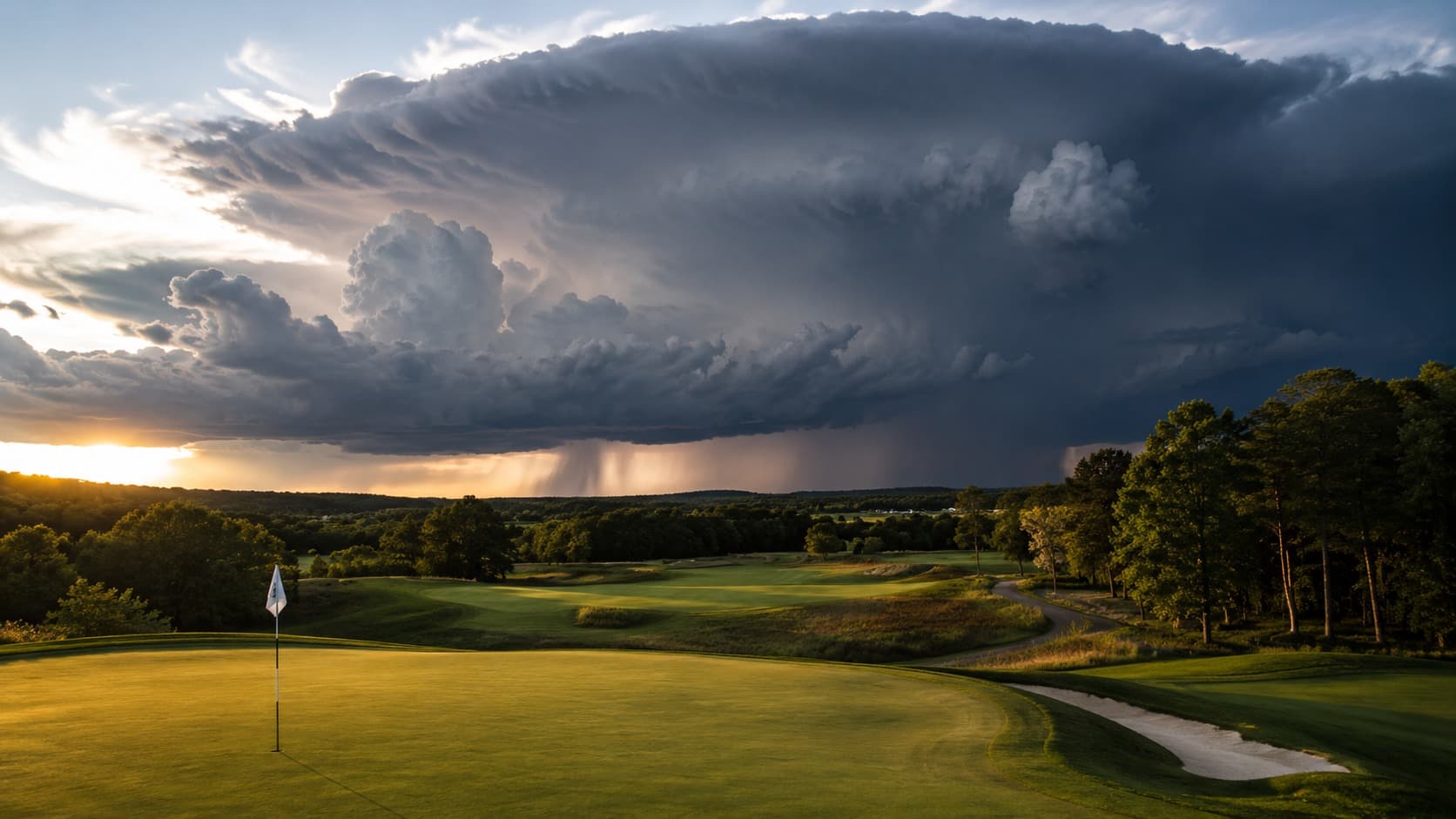
The Three O’Clock Storm: Reading Summer’s Convective Cycle to Protect Your Round
A 40% chance of afternoon thunderstorms does not mean a 40% chance of getting rained on. In the summer convective season it means the morning is nearly clear and the afternoon carries a fast-building, high-energy storm risk driven by a daily heating cycle. Here is the meteorology behind the pattern, the G-Score data on how the storm cycle punishes afternoon tee times across the Southeast, Midwest, and desert Southwest, the lightning-safety decision tree that actually matters, and the workflow that gets you off the course before the first bolt.
Read StoryDanorie
Editorial & Data
Golf Weather Score is built by Danorie. We compute the G-Score — our own playability rating — from live NOAA forecasts and published course scorecards, so any US course can be compared on any day with a single number. Methodology and data sources are documented on every page.
Every Friday Morning
When Merion Golf Club East plays best next weekend.
Friday 6am ET: peak G-Score windows for Merion Golf Club East, wind direction by hour, and one gear call. Three minutes to read, save you the round.
One email a week. Unsubscribe in one click.
The Caddie's Oracle
Draw your luck before the tee off