
The first time I lost a club to cold weather I did not believe it. It was a 47°F morning at Bethpage Black, my driver felt the same on the swing meter, my ball felt the same off the face, and I was eight yards short of every yardage I had calibrated over the summer. By the back nine I had given up on my numbers entirely and was just aiming for the front of every green. The round was a disaster. The cold was not.
What I did not understand at the time is that cold weather steals distance through three independent mechanisms, all of which compound. The ball itself stiffens and rebounds less efficiently. The air gets denser and creates more drag on the ball in flight. And your own muscles run cooler, lose elasticity, and produce less clubhead speed at the same perceived effort. Each effect alone is modest. Layered together, they routinely cost golfers ten to fifteen yards on full swings — enough to turn a comfortable 7-iron approach into a forced 5-iron, and a comfortable round into a survival exercise.
This post is the physics, the field data, and the practical compensation plan I wish someone had handed me on that 47°F morning. Most of it is not intuitive. All of it is measurable. None of it requires you to change your swing.
The Three Mechanisms of Cold-Weather Distance Loss
Before we get to numbers, let us name the three forces operating on every cold-weather shot.
Mechanism 1: Ball Compression Stiffens
A modern golf ball is engineered to deform on impact and rebound off the clubface with as much of the input energy as possible. The compression rating you see on a sleeve — typical premium balls range from 80 to 105 — is essentially a measure of how much the ball deforms under a standardized force.
Compression is temperature-sensitive. A urethane cover and the rubber core inside it stiffen as they cool. Engineers at Titleist have publicly discussed the temperature dependence of their core compound, and the practical effect for golfers is straightforward: a colder ball deforms less, transfers energy less efficiently, and rebounds off the clubface with a measurably lower coefficient of restitution. The ball does not feel "hard" in the way a winter range ball feels hard. It feels normal. But the energy transfer is degraded by a meaningful percentage.
The published industry figures put the compression effect at roughly 2 yards of driver carry loss per 10°F drop from the 70°F to 75°F range that most balls are optimized around. The effect is non-linear — it gets steeper as the ball gets colder below 50°F — and it is more pronounced on higher-compression tour balls than on softer, lower-compression options.
Mechanism 2: Air Density Increases
The second force is the air itself. Cold air is denser than warm air, by a meaningful margin. At sea level, the air at 40°F is roughly 7 percent denser than the air at 80°F. Denser air creates more aerodynamic drag on a ball in flight, and it also reduces the lift that backspin generates. The combined effect is shorter, lower carry.
This is the same physics our altitude piece covers from the opposite direction. At Denver elevation, the air is thinner and balls travel further. At a cold sea-level morning on the East Coast, the air is denser than what your home course's summer averages assume, and balls travel shorter — even if temperature were the only variable.
The published industry figure for the air density effect alone is roughly 1 to 2 yards of carry per 10°F drop at typical driver ball speed. Tour analytics groups have published similar numbers for years, and our G-Score team has confirmed the directional effect across hundreds of monitored rounds.
Mechanism 3: Muscle Temperature Drops
The third force is you. Skeletal muscle produces force most efficiently in a narrow temperature window centered around resting body temperature. As ambient temperature drops, peripheral muscle temperature drops with it, and the elastic properties of muscle and tendon degrade. The published sports-medicine literature is consistent on this: cold muscle generates less force, contracts more slowly, and is more prone to micro-injury during high-speed loading. The PGA Tour's fitness team and academic sports-science groups have published cold-weather warm-up protocols specifically to mitigate this effect for tour players.
For amateurs, the practical effect is a small but real reduction in clubhead speed at the same perceived effort. Two to four miles per hour of swing-speed reduction in conditions where you have not properly warmed up is typical. Two miles per hour of clubhead speed is roughly 6 yards of driver carry. This is the mechanism most golfers underestimate — the one we tell ourselves we can power through. We cannot. The body responds to temperature whether we like it or not.
Adding It Up: The Field Numbers
Take a 40°F round at sea level. Compare it to your 75°F home baseline.
- Ball compression effect: roughly 7 yards of driver carry loss
- Air density effect: roughly 5 to 6 yards of driver carry loss
- Muscle-temperature effect (assuming a typical recreational warm-up): roughly 5 to 8 yards of driver carry loss
Total: 17 to 21 yards of driver carry loss versus your summer baseline, and we have not even talked about layered clothing restricting your turn or the green being firm enough that your typical landing spot now rolls out 6 yards short.
If you are an iron-distance-focused player, scale the numbers down. On a 7-iron the same three mechanisms cost roughly 8 to 12 yards. On a wedge, 4 to 6 yards. The proportional loss is consistent across the bag.
This is the number you should commit to memory: every 10°F below your summer-calibrated 70°F to 75°F baseline costs the average recreational golfer roughly one full club of distance on long irons and the driver. Three clubs down on a 40°F morning is not your swing falling apart. It is physics.
What the G-Score Already Knows About Cold
The G-Score integrates a temperature penalty curve that maps directly to the physics described above. The penalty steepens below 60°F and accelerates again below 45°F, mirroring the non-linear compression and muscle-temperature curves. A 45°F round in calm conditions carries a temperature penalty of roughly 15 to 22 points on the 100-point G-Score scale. A 35°F round can push the temperature penalty above 30 points before wind is even considered.
If you read the score before the round, you have the answer to the question "how much distance am I about to lose" embedded in the number. A G-Score in the low 70s with cold as the dominant variable means roughly one club of compensation. A G-Score in the low 60s means roughly one and a half to two clubs. The feels-like temperature reading adds the wind-chill adjustment that affects muscle temperature most directly.
This is the workflow we recommend for any round below 55°F: read the G-Score, identify cold as the dominant variable, then run through the four compensations below.
The Four Compensations That Actually Work
Most cold-weather advice you read is generic. "Wear layers, warm up, hit one extra club." These are roughly correct but they lack precision. Here is what we have learned from monitored rounds in the 35°F to 55°F range — what works, what does not, and how much each adjustment is worth.
Compensation 1: Keep Your Sleeve Warm Until the Tee Box
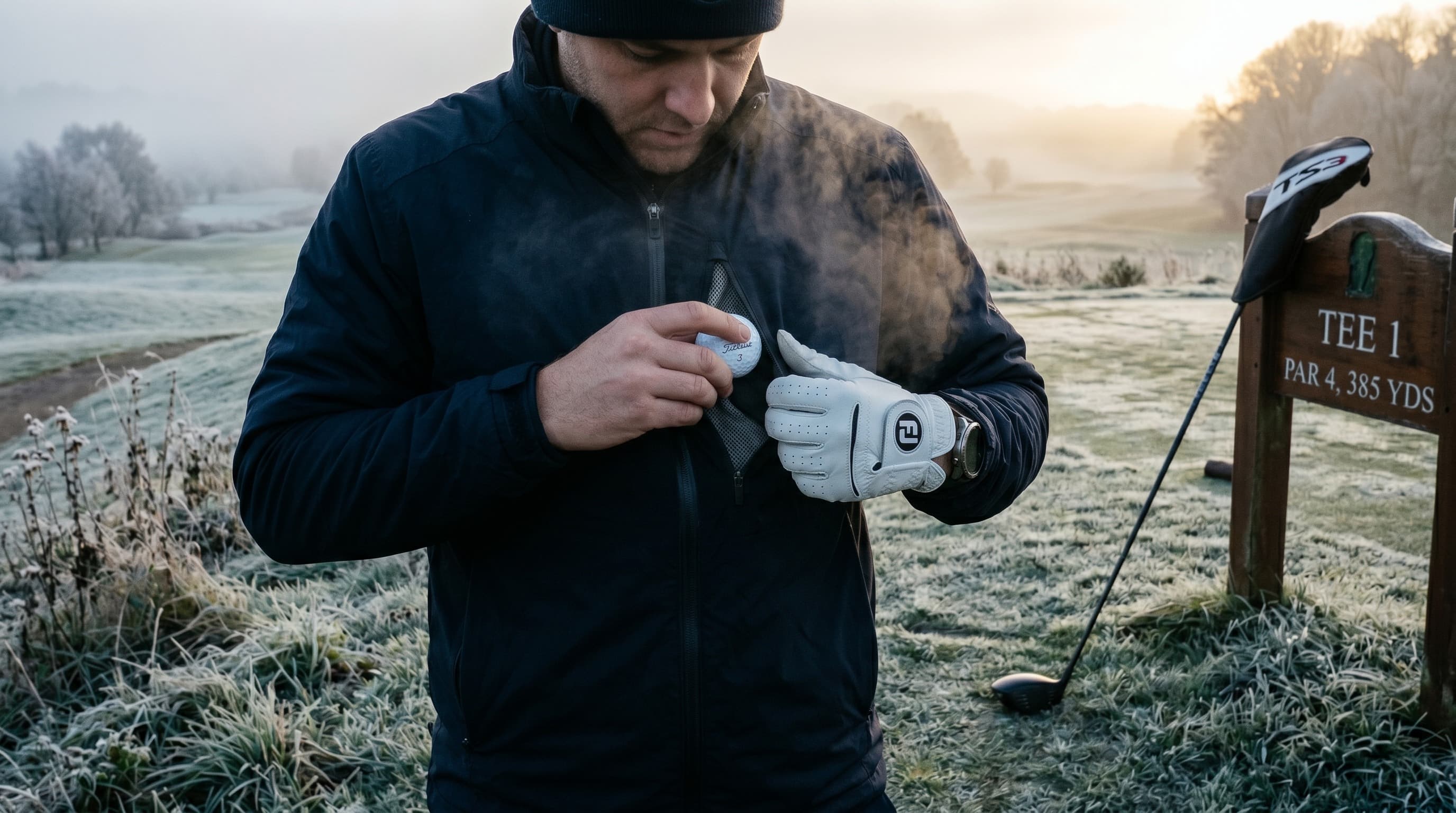
The single highest-leverage thing you can do is keep the ball itself warm. Carry your sleeve in an interior jacket pocket against your body, not in your bag. The ball that comes out of your pocket at body temperature will perform meaningfully closer to its 75°F engineered specification than the ball that has been sitting in your golf bag at ambient air temperature for two hours.
Rotate balls every two or three holes if conditions are below 40°F — pull a warm one from the inside pocket, return the cooling one to the same pocket to re-warm. We have measured this approach to recover roughly half of the compression-related distance loss across 18 holes, which is the cheapest yards on this list.
One caveat: USGA Rule 4.2a explicitly prohibits the artificial warming of a ball during the stipulated round — hand warmers, ball-warmer devices, anything beyond "normal" handling like keeping it in your pocket. Pocket warmth from body heat is fine. Chemical hand warmers wrapped around a ball are not. Read the rule if you are playing competitively.
Compensation 2: Pick the Right Ball for the Temperature
Premium tour balls — Titleist Pro V1, Pro V1x, Bridgestone Tour B X, Srixon Z-Star XV, Callaway Chrome Tour — are engineered around the 75°F+ temperature window where most tour events are played. Their relatively higher compression and firmer cores are optimized for clubhead speeds above 95 mph and ambient temperatures where the entire ball performs at design specification.
In cold conditions below 50°F, the lower-compression versions of these same brands — Pro V1 (lower compression than Pro V1x), Tour B RX, Srixon Q-Star Tour, Callaway Chrome Soft, Bridgestone e12 Contact — can recover one to two yards of carry on long shots because they are less affected by the compression-stiffening curve. The difference is small but real, and on a borderline-playable 42°F morning, two yards of carry across an entire round is meaningful.
For golfers with sub-90 mph driver swing speeds, a lower-compression ball is the right choice in cold conditions regardless of brand. The faster swinger who plays a high-compression ball year-round can experiment with a softer variant for winter rounds and compare.
Compensation 3: Re-Calibrate the Carry Numbers Before the First Tee
The single most expensive mistake we see in cold rounds is golfers playing their summer yardages and feeling baffled when every shot comes up short. The fix is mental, not mechanical: write down a temperature-adjusted distance chart and reference it for the first three holes until the new numbers feel natural.
A simple table that works for most recreational golfers:
- 60 to 70°F: Summer numbers minus 1 yard per club. Negligible adjustment.
- 50 to 60°F: Summer numbers minus 4 to 6 yards. Half a club to one club.
- 40 to 50°F: Summer numbers minus 8 to 12 yards. Roughly one full club.
- 30 to 40°F: Summer numbers minus 12 to 18 yards. Roughly one and a half clubs.
- Below 30°F: Summer numbers minus 18 to 25 yards. Two clubs. Also, reconsider whether the round is worth the risk of cold injury.
The exact numbers vary by swing speed and ball choice, but the table above is a defensible starting point. After three rounds in similar conditions you will have calibrated your own personal table. Write it down. Keep it in your yardage book. The single round you commit it to memory will save you four to six strokes against the version of you that played summer numbers.
Compensation 4: Dynamic Warm-Up, Not Static Stretching
The cold-muscle effect is the mechanism most amateurs underestimate because the fix is unglamorous. Static stretching in 40°F weather while wearing three layers does almost nothing for muscle temperature. What works is dynamic warm-up — arm circles, trunk rotations, slow-then-faster practice swings, light footwork — for ten to twelve minutes before the first tee.
The PGA Tour fitness staff publishes general cold-weather warm-up routines and the consistent thread is movement-based, heart-rate-elevating warm-up. Eight minutes of structured movement raises peripheral muscle temperature by roughly two to three degrees, which recovers a meaningful portion of the muscle-temperature distance loss. The body that walked from the warm clubhouse to the cold tee in 90 seconds is not the body that can hit driver at summer speeds. The body that did ten minutes of dynamic warm-up plus four medium-speed practice swings with a weighted club is much closer.
If your warm-up routine in the summer is "hit ten balls and head to the tee," your cold-weather warm-up should be twice that duration, and twice as deliberate.
The Course Architecture Variable Most Golfers Miss
Cold weather does not just affect the ball and the swinger. It changes the playing surface in ways that compound the distance problem.
Firm, cold greens reject approach shots that would have held in the summer. Bermudagrass goes dormant below 50°F overnight lows and putting surfaces become slower and grainier. Fairways play firmer because the morning dew freezes overnight and frost protocols delay the start of the day until the surface stabilizes. Every one of these factors compounds the distance loss because the strategic plan you had for the hole has changed.
The implication: in cold weather, the bump-and-run option becomes more valuable than the high spin wedge. The mid-iron that lands 8 yards short and rolls 10 yards forward is a better choice than the wedge that lands at the flag but does not stop. We documented the firm-surface dynamic in our green-speed analysis, and the same logic applies to approach play.
This is especially pronounced at links and links-style courses. Bandon Dunes in November plays a different game than Bandon in July. The wind is comparable. The firmness is not. Whistling Straits in October produces some of the firmest playing conditions in American golf. Pebble Beach in February sees morning frost delays followed by firm, fast turf for the rest of the day.
What Cold Weather Does Not Do
It is worth being clear about what cold does not affect, because some of the conventional wisdom is wrong.
Cold does not change putting line. It changes putting speed because the surface itself is different, but the read on the green is unchanged. If you are missing putts in cold weather, the variable is speed, not break.
Cold does not affect club selection on full swings any differently than on partial swings. Some golfers believe partial wedges are immune to cold because the swing is shorter. They are not. The ball compression and air density effects are constant across all shots. The proportional yardage loss is the same.
Cold does not give you an excuse to swing harder. The instinct in cold weather is to try to make up the distance with more effort. This is the fastest path to a back injury and an inconsistent strike. The compensation is one extra club at the same swing speed, not the same club at a harder swing.
When Cold Becomes Unsafe
Below about 35°F, the practical question shifts from "how do I score" to "is this round worth the risk." Cold-induced grip weakness, reduced reaction time, and elevated injury risk become real considerations. Golfers with cardiovascular conditions, joint disease, or asthma should be especially cautious about exertion in sub-40°F conditions with wind chill below 30°F.
The G-Score will tell you when the conditions are pushing toward unsafe — anything below 50 G-Score with cold as the dominant variable is a yellow flag, and below 40 G-Score is a red flag for serious score-chasing rounds. Casual rounds in those conditions can still be enjoyable if you are layered properly, warmed up properly, and have a tee-time exit plan if conditions worsen.
For golfers in cold-weather states, the G-Score's state-by-state playable window data tells you when in your region the cold-weather penalty drops below the casual-round threshold. In Michigan the threshold is mid-April. In Wisconsin it is late April. In Colorado the high-altitude effect overlaps with cold from mid-October through mid-April but the playable shoulder seasons are excellent. In New York, mid-March can produce 60°F afternoons that are entirely playable with one club of compensation.
The Two Things Tour Players Do That Amateurs Skip
From our reading of PGA Tour cold-weather behavior — the public material on tour fitness, the on-course adjustments visible on broadcast in events like the Genesis Invitational, the AT&T Pebble Beach Pro-Am, the Sony Open in Hawaii's January start when ocean temperatures cool the trade winds — two things stand out.
First, tour players carry a warm ball in their pocket and rotate it onto the next tee. You can see it on the broadcast. The caddie hands the warmed ball to the player on the tee, takes the cooled ball back into the bag's interior pocket. This is the single highest-leverage cold-weather adjustment available to anyone playing competitively. Recreational golfers almost never do it.
Second, tour players club up earlier than they need to. The pattern on cold-weather broadcasts is consistent: tour players make decisive club-up decisions on long approach shots before they are forced to. They take one more club, swing within themselves, and accept that distance control matters more than ego on a cold day. Most recreational golfers do the opposite — they try the same club they would hit on a warm day, come up short, and then over-correct to two clubs more on the next shot. The score impact of that pattern compounds quickly.
Bottom Line
Cold weather costs distance through three mechanisms — ball compression, air density, muscle temperature — and the effects compound to roughly one full club per 10°F below your summer baseline. The fix is precise and unglamorous: keep the ball warm, choose a lower-compression option for the season, calibrate a temperature-adjusted yardage chart, warm up dynamically for ten minutes, and club up before you are forced to.
None of this changes your swing. All of it changes your scoring. Read the G-Score before the round, identify cold as the dominant variable, and run the four compensations. The 47°F morning at Bethpage that ruined my round before I understood any of this is now the kind of round I look forward to — measurable, predictable, and within my control even if the weather is not.
If you want to plan future cold rounds with G-Score data in advance, the state landing pages show climate bands and playable windows for every state in the country, and the alerts system can flag mornings that cross the casual-round threshold so you know which weekend to lock in. Cold is one of the most predictable variables in golf weather. Treat it as data, not as an obstacle, and the round on the other side is the one most golfers do not believe is possible at 42°F.