
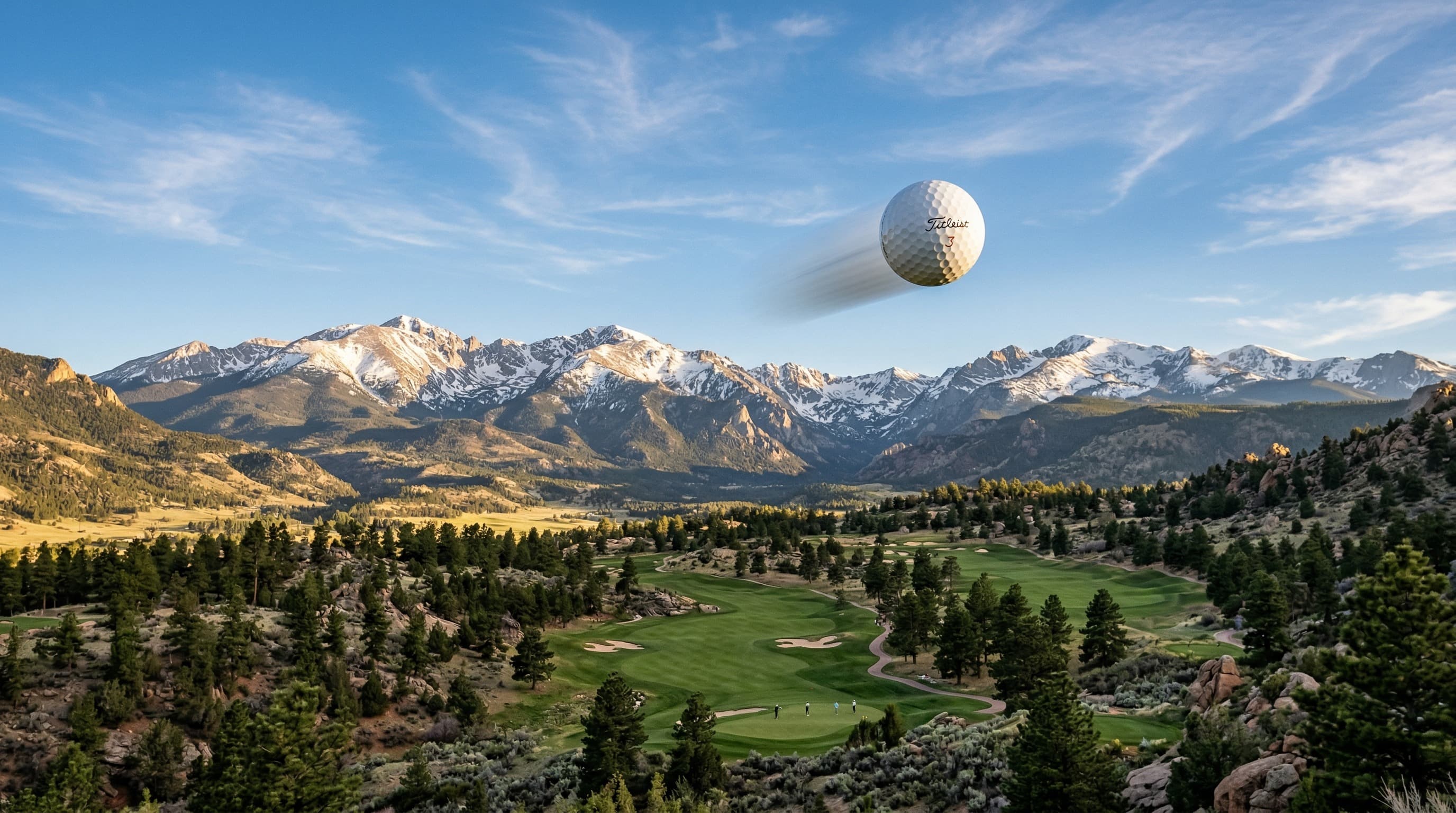
Every golfer who has played at altitude remembers the first time a 7-iron flew 15 yards past the green. It feels like cheating. The ball launches off the clubface, holds its line, and just keeps going. At sea level, that same swing lands pin-high. At 5,000 feet, it sails over the back edge. At 7,000 feet, you start questioning everything you thought you knew about your distances.
Altitude changes the game. Not subtly, not theoretically, but in ways that show up on every single shot from driver to wedge. And yet, most amateur golfers have no systematic approach to adjusting for elevation. They either guess, overcompensate, or ignore it entirely and spend the round confused about why nothing is landing where it should.
This guide will fix that. We are going to break down exactly how altitude affects golf ball flight, how much distance you gain at various elevations, what happens to spin and trajectory, and how to build a reliable adjustment system that works whether you are playing at Bandon Dunes at sea level or at a mountain course in the Colorado Rockies.
The Physics: Why Thinner Air Means Longer Shots
The fundamental mechanism is straightforward. As altitude increases, air density decreases. At sea level, the atmosphere exerts approximately 14.7 pounds per square inch of pressure. At 5,000 feet, that pressure drops to roughly 12.2 PSI. At 7,500 feet, it falls to about 11.1 PSI.
Thinner air creates two effects that both increase distance. First, there is less aerodynamic drag on the ball during flight. A golf ball traveling through thinner air encounters fewer air molecules, which means less resistance slowing it down. The ball maintains more of its initial velocity throughout the flight, resulting in a longer carry.
Second, reduced air density affects the Magnus effect, which is the lift generated by backspin. In thinner air, backspin produces slightly less lift force, which means the ball flies on a slightly lower, more penetrating trajectory. This lower trajectory is actually more efficient for total distance because the ball trades some apex height for forward momentum.
The combined result is that a golf ball hit with identical launch conditions will travel measurably farther at altitude than at sea level. The question is: how much farther?
The General Rule: Two Percent Per Thousand Feet
The most widely cited rule of thumb is that golf ball distance increases by approximately two percent for every 1,000 feet of elevation gain above sea level. This is a reasonable starting point, but it oversimplifies a more nuanced reality.
At 1,000 feet of elevation, a shot that carries 150 yards at sea level will carry roughly 153 yards. That three-yard difference is barely noticeable and within the margin of error for most amateur swings.
At 3,000 feet, the same shot carries approximately 159 yards. Now you are talking about a full club difference on approach shots. A golfer who normally hits a 7-iron 150 yards at sea level might need an 8-iron to cover the same distance.
At 5,000 feet, expect roughly 165 yards from that same swing, an increase of ten percent. This is where altitude starts fundamentally changing club selection strategy. Courses in Denver, Albuquerque, and Salt Lake City all sit near this elevation.
At 7,000 feet, the gain approaches 14 percent, pushing that 150-yard shot to approximately 171 yards. Mountain courses in Colorado, New Mexico, and parts of Arizona see these conditions regularly.
At 10,000 feet, which is rare for golf but exists at a few extreme courses, the gain can exceed 20 percent. A 150-yard sea level shot might carry 180 yards or more. The ball seems to fly forever.
Why the Two Percent Rule Is Only an Approximation
The actual distance gain at altitude depends on several variables beyond raw elevation. Temperature matters because hot air is less dense than cold air at the same altitude. A warm summer day in Denver produces more distance gain than a cool autumn morning at the same elevation. Humidity plays a smaller role; contrary to popular belief, humid air is actually less dense than dry air because water molecules are lighter than nitrogen and oxygen molecules. So high humidity at altitude produces slightly more distance gain, though the effect is marginal.
Wind behaves differently at altitude too. Because the air is thinner, wind has less force per square foot of surface area. A 15 mph wind at 7,000 feet has less effect on the ball than a 15 mph wind at sea level. This means crosswind and headwind penalties are somewhat reduced at elevation, while tailwind benefits are also slightly diminished.
Ball construction matters as well. Tour-level balls with higher spin rates see a proportionally larger distance gain at altitude because the reduced drag affects their higher launch and spin profile more dramatically. Distance balls with lower spin rates still gain distance, but the percentage increase is slightly lower.
Club-by-Club Altitude Adjustments
Not all clubs gain the same amount of distance at altitude. The relationship between altitude and distance gain varies based on ball speed, launch angle, and spin rate. Understanding these differences is essential for smart course management at elevation.
Driver: Moderate Percentage Gain, Big Absolute Yardage
The driver sees a moderate percentage gain at altitude, typically slightly less than the two percent per thousand feet rule. This is because the driver already launches the ball at high speed with relatively low spin compared to irons. The aerodynamic efficiency of a driver shot means there is less drag to reduce in the first place.
However, because the absolute distances are large, even a moderate percentage increase translates to significant yardage. A golfer who carries the driver 240 yards at sea level might see 252 to 258 yards of carry at 5,000 feet. That is 12 to 18 extra yards, which can mean the difference between reaching a hazard or clearing it, between a fairway landing and running through the dogleg.
Total distance including roll may increase even more because the lower trajectory at altitude means the ball hits the ground at a shallower angle and runs out farther.
Long Irons and Hybrids: Full Club Differences
The 3 through 5 iron range and hybrid equivalents see distance gains that closely track the two percent rule. A 4-iron that carries 190 yards at sea level will carry roughly 209 yards at 5,000 feet. That is nearly a full club difference, and for long approach shots or par-three tee shots, the wrong club selection at altitude can turn a good swing into a disaster.
Hybrids are particularly affected because their higher launch angles and moderate spin rates interact strongly with reduced air density. Many golfers find that their hybrid distances become less predictable at altitude because the ball flies higher and farther than expected.
Mid-Irons: The Sweet Spot for Altitude Awareness
The 6 through 8 iron range is where altitude awareness matters most for scoring. These are the clubs most commonly used for approach shots into greens, and the distance changes at altitude are significant enough to affect pin-seeking accuracy but subtle enough to be overlooked.
A 7-iron that carries 155 yards at sea level will carry approximately 170 yards at 5,000 feet. That is a full club and a half of difference. Golfers who do not adjust will consistently fly greens, leaving difficult downhill chips or putts instead of makeable birdie looks.
The reduced spin at altitude also means these shots hold greens less effectively. A 7-iron approach at sea level might check and stop within a few feet of where it lands. The same shot at altitude may release and run 10 to 15 feet past the landing spot because the ball arrives with less backspin and at a shallower angle.
Short Irons and Wedges: Precision Gets Complicated
The 9-iron through lob wedge range sees the highest percentage distance gains at altitude. These high-spin, high-launch shots are most affected by reduced air density because they rely heavily on aerodynamic forces to shape their trajectory and control distance.
A pitching wedge that carries 125 yards at sea level might carry 138 to 140 yards at 5,000 feet. A sand wedge that normally flies 90 yards could reach 100 yards. These are enormous differences for scoring clubs, and they completely change how you plan approach shots from inside 130 yards.
The spin reduction is also most noticeable with wedges. Shots that normally bite and stop at sea level will bounce and release at altitude. Golfers accustomed to attacking pins with spin need to recalibrate their expectations. Landing the ball short and letting it feed to the pin often works better than trying to fly it at the flag.
Practical Adjustments: A System That Works
Knowing the physics is useful. Having a practical system for adjusting on the course is essential. Here is a straightforward approach that works for golfers at any level.
Step One: Know Your Baseline Distances
Before you can adjust for altitude, you need reliable sea-level carry distances for every club. If you have access to a launch monitor at a facility near sea level, get a full bag fitting with carry numbers for each club at your typical swing speed. These numbers are your baseline.
If you play primarily at altitude, you need to calculate what your distances would be at sea level. Take your known altitude carry distances and subtract the appropriate percentage. A golfer in Denver who carries a 7-iron 168 yards is hitting a 7-iron that would carry approximately 153 yards at sea level.
Step Two: Calculate the Elevation Difference
For every round at a new course, check the course elevation. Most course websites list this information, and GPS apps display it in real time. Calculate the difference between the course elevation and your baseline elevation.
If your baseline is sea level and the course is at 4,500 feet, the adjustment is approximately nine percent, which translates to roughly one full club across most of your bag. If your baseline is already at 5,000 feet, like Denver, and you are playing a course at 7,200 feet, the additional adjustment is about four percent, or roughly half a club.
Step Three: Build an Altitude Card
Create a simple reference card that lists your carry distances at three or four key elevations: sea level, 2,500 feet, 5,000 feet, and 7,500 feet. Keep this in your bag or on your phone. During a round, glance at the card to confirm your club selection rather than trying to calculate percentages in real time.
A sample card might look like this for a golfer who carries a 7-iron 155 yards at sea level: at 2,500 feet the carry is 163 yards, at 5,000 feet it is 170 yards, and at 7,500 feet it is 178 yards. Having these numbers written down eliminates guesswork and builds confidence in your selections.
Step Four: Account for Conditions on Top of Altitude
Altitude is one variable, but temperature, wind, and humidity layer on top of it. A hot summer day at 5,000 feet produces more distance than a cool morning at the same elevation. Wind at altitude has less effect per mph but still needs adjustment.
The smartest approach is to use the G-Score weather system, which already factors altitude and atmospheric conditions into its course-level analysis. When you check the G-Score for a specific course, the data incorporates elevation alongside temperature, wind, humidity, and other variables to give you a complete picture of playing conditions.
Famous High-Altitude Courses and What to Expect
Understanding altitude adjustments in theory is one thing. Applying them at actual courses brings the concept to life. Here are some notable high-altitude golf experiences across America and what the elevation means for your game.
The Broadmoor, Colorado Springs (6,320 feet)
One of America's most prestigious resorts sits at over 6,300 feet in the shadow of Pikes Peak. Golfers visiting from sea level can expect approximately 12 to 13 percent additional carry distance on every shot. A 150-yard approach becomes a 168 to 170 yard carry. The thin mountain air makes the ball soar, and the stunning views can distract from the fact that your club selection needs to drop by a full club and a half for most shots.
The Broadmoor's courses are designed with altitude in mind. Greens are large to accommodate the extra distance, and hazards are positioned knowing that players will be flying the ball farther than usual. But visiting golfers who do not adjust still find themselves long on approach after approach.
Castle Pines Golf Club, Castle Rock, Colorado (6,400 feet)
Former host of The International on the PGA Tour, Castle Pines sits at nearly 6,400 feet. Tour professionals competing here would see their driving distances increase by 25 to 35 yards compared to sea-level events. Approach shots required constant recalibration, and even the best players in the world had to spend practice rounds dialing in their altitude numbers.
Sandia Golf Club, Albuquerque (5,300 feet)
Albuquerque's desert courses sit at approximately 5,300 feet, high enough to produce 10 to 11 percent distance gains. The dry desert air is even less dense than the altitude alone would suggest, and summer temperatures amplify the effect. Golfers visiting from sea level are regularly surprised by how far the ball travels.
The combination of altitude, dry air, and firm desert conditions means total distances including roll can be 15 to 20 percent longer than sea-level expectations. Course management here requires a complete mental reset for visiting players.
Promontory Club, Park City, Utah (6,800 feet)
Set in the Wasatch Mountains above Park City, Promontory Club reaches nearly 6,800 feet on some holes. The Jack Nicklaus and Pete Dye courses here play dramatically different from their yardage on the scorecard. A par four measuring 410 yards might play like 360 yards at sea level once altitude is factored in.
Summer golf at Promontory is spectacular, with warm days, cool evenings, and mountain views that make the altitude adjustment challenge feel like a small price to pay. The thin air also means the ball curves less on mishits, which is a subtle benefit that helps golfers keep the ball in play.
Angel Fire Resort, New Mexico (8,600 feet)
One of the highest regulation golf courses in America, Angel Fire sits at an extraordinary 8,600 feet in the Sangre de Cristo Mountains. At this elevation, distance gains approach 17 to 18 percent. A 150-yard sea-level shot carries approximately 176 yards. Golfers need to drop two full clubs on every approach shot.
The air at Angel Fire is noticeably thinner when you exert yourself. Walking the course requires more effort, and the ball behaves in ways that feel almost surreal to sea-level players. But the mountain scenery and the sheer novelty of the experience make it a bucket-list destination for golfers who want to see altitude effects at their most extreme.
Going the Other Direction: Playing Below Your Home Elevation
The altitude conversation usually focuses on gaining distance, but the reverse scenario is equally important and arguably more dangerous for your scorecard. A golfer who lives at altitude and travels to a sea-level course will lose distance on every shot.
This adjustment trips up experienced golfers more often than the altitude gain scenario. A Denver-based player who carries a 7-iron 168 yards at home will carry that same club only 153 yards at a sea-level course. If they do not adjust, every approach shot comes up short. Short is usually worse than long in golf because most course designs feature trouble in front of greens, including bunkers, water, and closely mown collection areas.
The mental challenge is also harder. Nobody minds hitting the ball too far. But coming up short on shot after shot, watching approaches land in front bunkers or die on front slopes, creates frustration and scoring damage quickly.
If you live at altitude and travel to play at lower elevations, add one club to your normal selection as a starting point. For a trip from 5,000 feet to sea level, expect to need one to one and a half extra clubs across your bag. Your 7-iron distance becomes your 6-iron distance. Your pitching wedge distance becomes your 9-iron distance.
Technology and Altitude: Modern Tools That Help
Today's technology has made altitude adjustments easier than ever. GPS devices and rangefinders with slope adjustment increasingly incorporate altitude as a variable. Some premium units display plays-like distances that account for both slope and elevation above sea level.
Launch monitors are invaluable for understanding your personal altitude profile. A session on a Trackman, FlightScope, or GCQuad at your home elevation gives you precise carry distances in your actual playing conditions. Many indoor simulators also allow you to set the simulated elevation, which means you can practice for an upcoming trip to a mountain course or a sea-level destination without leaving home.
The GolfWeatherScore.com platform integrates course elevation data into its analysis. When you check weather conditions and G-Score for a specific course, the elevation is part of the equation. This means the playing conditions you see already reflect the altitude reality, helping you plan not just whether to play but how to play.
The Altitude Mindset: Embrace the Adjustment
The biggest mistake golfers make at unfamiliar altitudes is not the wrong club. It is the refusal to trust the adjustment. You know intellectually that the ball will fly farther at 7,000 feet, but when you are standing over a 165-yard shot and the calculation says 8-iron, everything in your gut screams 7-iron. And when you flush the 8-iron and it sails over the green, you still struggle to believe it next time.
Trust the numbers. Write them down. Reference your altitude card on every approach shot until the new distances become second nature. It usually takes three to five rounds at a new elevation before the adjustments feel automatic. Until then, lean on the data rather than your instincts.
Altitude is not an obstacle. It is one of the variables that makes golf endlessly fascinating. Every course exists in a specific place with specific conditions, and understanding how those conditions shape your game is part of what separates a thoughtful golfer from one who is perpetually surprised by the results. The thin air might be unfamiliar, but with the right preparation, it is just another dimension of the course waiting to be mastered.