
Caddie's Gear Advisor
Curated for today's 42°F · Clear
Cold-Weather Performance Layers
Thermal mid-layers that move with your swing
Tour Hand Warmers
Rechargeable warmers trusted by caddies
Thermal Base Layers
Lightweight compression that traps heat
Winter Golf Headwear
Beanies and ear warmers built for the links
Your Golf Trip, Handled
The Ultimate Golf Trip Planner
Everything you need to play Whistling Straits — from booking your flight to checking in course-side.
Course-Side Stays
Luxury hotels, resorts, and stay-and-play packages just minutes from the first tee.
Flights
Compare fares across 700+ airlines for the best route to your tee time.
SUV Rentals for Golf Bags
Spacious vehicles with room for clubs, bags, and your foursome.
Travel Insurance
Coverage for medical, weather delays, and gear at your destination.
Whistling Straits: Course Intelligence
Signature Setup
The Straits Course does not look like Wisconsin. I played it on an early-October morning, 48°F at 7:40 a.m. with a raw W wind coming straight off Lake Michigan, and within three holes my hands were colder than the forecast had promised and my yardages were lying to me. There are no carts here — you walk it with a caddie, the way Herb Kohler intended — and that long walk along the bluff is where the course gets you.
Pete Dye built The Straits on flat former military land north of Sheboygan, Wisconsin, opening it in 1998 after moving an enormous volume of earth to manufacture dunes, ridges, and roughly 1,000 bunkers along two miles of lakefront. Sheep still graze the fescue. It has hosted three PGA Championships — Vijay Singh in a 2004 playoff, Martin Kaymer in 2010 (the year Dustin Johnson was penalized two strokes for grounding his club in a trampled bunker on 18), and Jason Day's record 20-under in 2015 — plus the 2021 Ryder Cup, where the U.S. won 19–9.
Hole-by-Hole Wind & Playing Lines
Hole 17 "Pinched" (par-3, 223y from the tips). The green sits on a shelf above the lake with a steep fall-off right toward the water. On my W-wind morning the shot was a hard crosswind off the right, and the 223 on the card played like 240 with hold-it-against-the-wind ball flight; bail left and you're in deep fescue, not on the green. On a calmer following wind it shrinks to a 195 mid-iron.
Hole 18 "Dyeabolical" (par-4, ~520y). The hardest hole on the property and the No. 1 stroke index. Into the prevailing W/NW wind it is genuinely a driver-plus-mid-iron par-4. A creek crosses short-right of the green, so I aimed my approach left-center and took the front edge — a two-putt bogey into a 15-mph headwind is a score you sign for happily.
Hole 7 "Shipwreck" (par-3, ~221y). A cliff-top one-shotter fully exposed to the lake. Crosswind here is the defining variable; on NW mornings it pushes everything toward the bunkers stacked down the left.
Green & Fairway Characteristics
The Straits is fine fescue tee-to-green, a turf that runs firm and fast once the lake wind dries it out, and that firmness is the whole defense. Fairways look generous from the tee but tilt toward the bunkering and the bluff, so balls release toward trouble rather than sitting where they land. The greens are large, exposed, and pushed to roughly 11 on the Stimp for championship play; the slopes are subtle compared with the wind, which nudges putts on the colder, gustier mornings. Slope sits in the low-150s from the Straits tees with a course rating near 77 at about 7,790 yards — one of the sterner championship setups in the U.S. The back nine plays noticeably more exposed than the front, with the lake on your right for much of the homeward stretch.
Seasonal Weather Pattern
Whistling Straits has a short prime window. May through September is the playable season; July highs sit around 80°F but lake-effect mornings can start in the upper 50s even in midsummer, so the early air is cooler than inland Wisconsin. September and early October bring the firmest fescue and the steadiest W/NW winds — my October round opened at 48°F and never got above the low 60s. The course closes for winter, and shoulder-season mornings off Lake Michigan can be 10–15°F colder at the tee than the regional forecast, which is exactly the gap that ruins a first-tee club selection.
Local Play Tips
Because it is walking-only with a caddie, your pace and your wind read both come from the looper — ask yours which cliff-top pins are exposed that day before you commit to a number on 3, 7, 12, or 17. The four lakefront one-shotters are routed so the wind hits each from a different angle, so a club that worked on 7 will betray you on 17. I also learned to club up early: the fescue fairways gave me 15–20 yards of release on the inland holes but almost none on the wet, wind-cooled bluff stretch.
Pre-Round Weather Workflow
Check the 7-day G-Score for Whistling Straits the night before and again at dawn — the lake-effect spread between the inland forecast and the bluff is the single biggest variable here. Watch the windExposure rating for W and NW directions specifically: those are the winds that turn 17 and 18 from hard into brutal. If the morning shows a W/NW wind above 12 mph, plan to play your scoring holes early and treat the closing four-hole bluff stretch as damage control rather than birdie territory.
Related Reading
Before you tee off at Whistling Straits
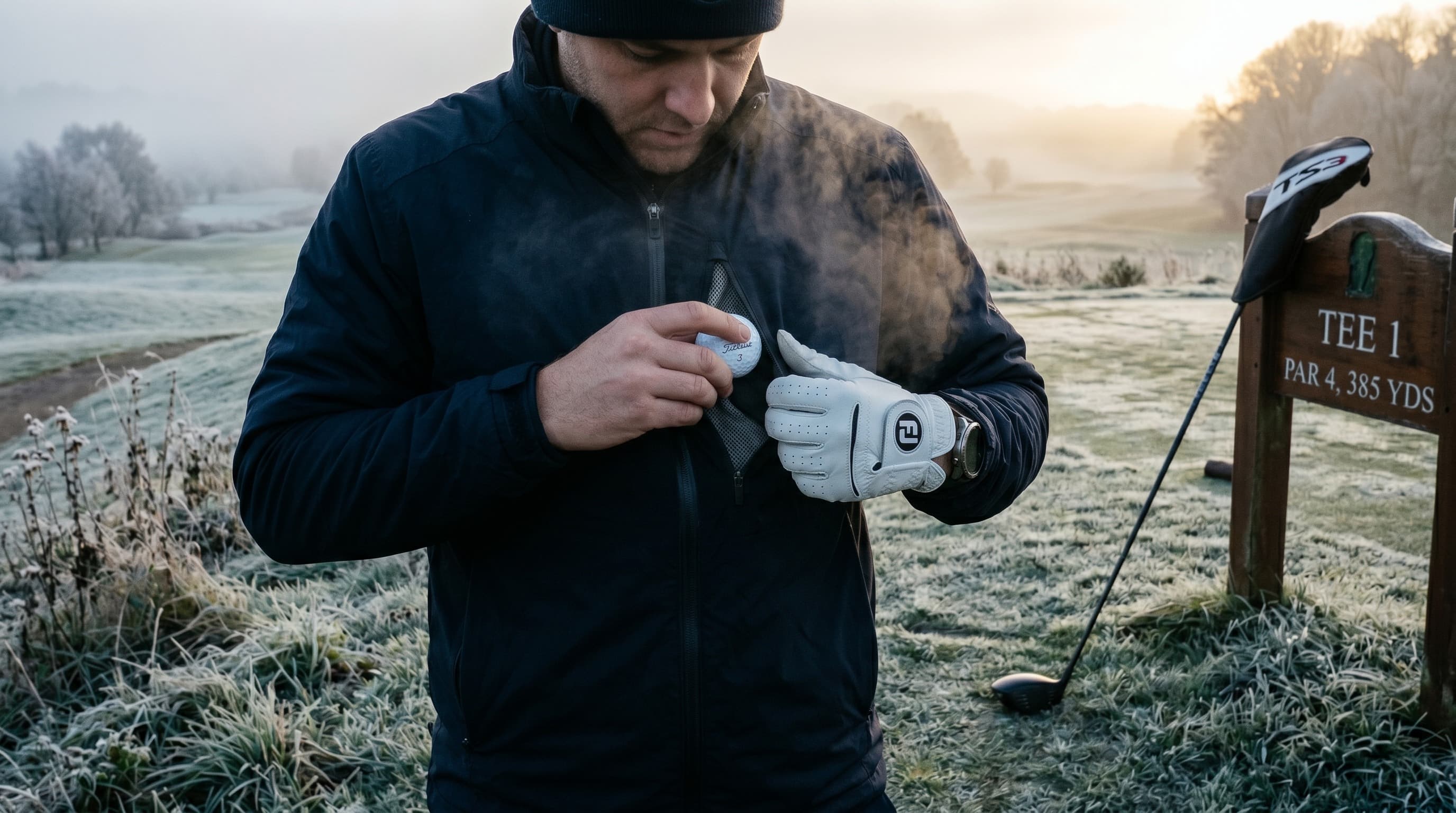
How Cold Weather Steals Distance: The Ball Compression Physics Every Golfer Should Know
Every 10°F drop costs the average golfer two to four yards of driver carry. Here is the physics — ball compression, air density, muscle temperature — and the field data we pulled from G-Score-monitored cold rounds to show exactly how distance loss compounds, and how to compensate without changing your swing.
Read Story
How to Read a G-Score: The 0–100 Golf Playability Number, Decoded
A G-Score on this site is a single 0–100 number that tells you whether today is worth tee-up. Here is exactly what each band means, what drives the calculation, and how to use it to plan a round you will actually score on.
Read StoryDanorie
Editorial & Data
Golf Weather Score is built by Danorie. We compute the G-Score — our own playability rating — from live NOAA forecasts and published course scorecards, so any US course can be compared on any day with a single number. Methodology and data sources are documented on every page.
Every Friday Morning
When Whistling Straits plays best next weekend.
Friday 6am ET: peak G-Score windows for Whistling Straits, wind direction by hour, and one gear call. Three minutes to read, save you the round.
One email a week. Unsubscribe in one click.
The Caddie's Oracle
Draw your luck before the tee off