
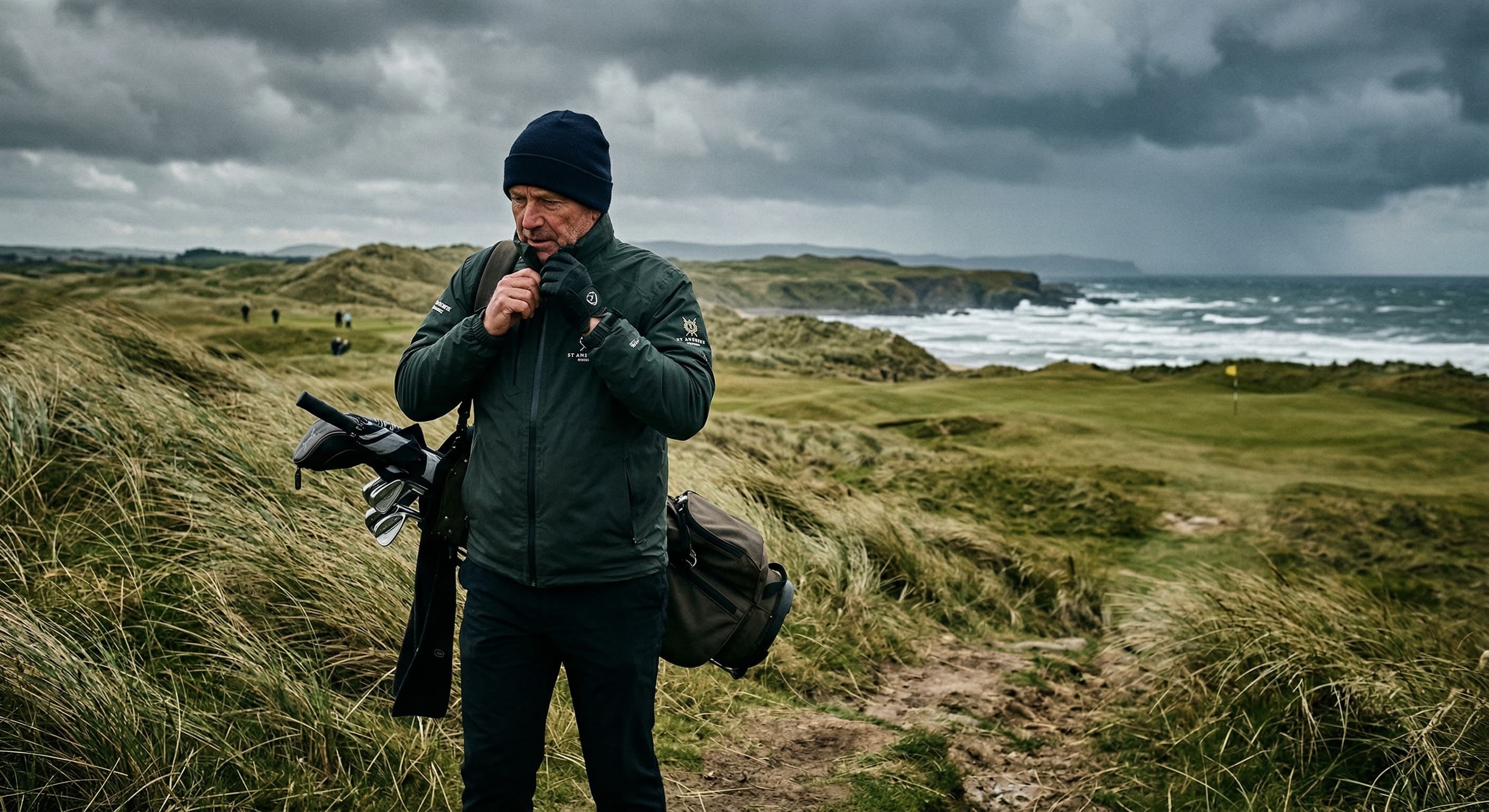
It started with a polo shirt and a bad decision.
The founder of GolfWeatherScore.com drove two hours to a gorgeous coastal course on a spring Saturday. The weather app on his phone said the same thing it always said: Sunny, 65°F. Perfect golf weather by any standard measure. He packed light. A single polo, a pair of shorts, and a cap. No layers. No windbreaker. Nothing that suggested the day would be anything other than ideal.
Then he stepped onto the first tee.
The Pacific wind was relentless. Not gusting. Not swirling. Just a steady, cold, 20 mph wall of moving air that came off the ocean and never stopped. By the third hole, his hands were stiff. By the fifth, his grip pressure had changed involuntarily because his fingers were losing feeling. By the turn, he was playing with his arms tucked into his body between shots, shivering in a polo shirt on what every weather service in the country called a 65-degree sunny day.
The actual temperature his body experienced was closer to 45°F. Twenty degrees colder than the thermometer reading. Twenty degrees that turned a dream round into a survival exercise. Twenty degrees that no standard weather app thought to mention.
That day became the origin story for GolfWeatherScore.com. Not because standard weather data is wrong. It is not. Air temperature readings are perfectly accurate. But they are also perfectly incomplete for anyone who plans to spend four to five hours standing, walking, and swinging in open air with no shelter.
Golfers do not experience temperature. They experience feels-like temperature. And the gap between those two numbers can be the difference between a great round and a miserable one, between peak performance and physical decline, between smart preparation and costly ignorance.
This guide breaks down exactly what feels-like temperature means, why golfers are uniquely vulnerable to its effects, how the G-Score Real Feel Index works, and what you should wear and plan for across every temperature range you will encounter on a golf course.
What Is 'Feels Like' Temperature?
The number on your weather app is the dry-bulb air temperature. It measures how warm or cool the air molecules are at a given moment. That measurement is taken in shade, inside a ventilated enclosure, at a standardized height above the ground. It is scientifically precise and practically misleading for anyone who will be outdoors for hours at a time.
The reason is simple: your body does not feel air temperature in isolation. It feels the combined effect of air temperature, wind speed, humidity, solar radiation, and your own metabolic output. The 'feels like' temperature is an attempt to capture that combined experience in a single number.
Two primary formulas drive feels-like calculations, depending on conditions.
Wind Chill: When Cold Gets Colder
When the air temperature drops below approximately 50°F and wind is present, the dominant factor in perceived temperature becomes wind chill. Wind strips heat from exposed skin faster than still air. The stronger the wind, the faster the cooling, and the lower the effective temperature your body experiences.
The National Weather Service uses a specific formula to calculate wind chill, known as the NWS Wind Chill Temperature Index:
Wind Chill = 35.74 + 0.6215T - 35.75(V^0.16) + 0.4275T(V^0.16)
In this formula, T is the air temperature in degrees Fahrenheit and V is the wind speed in miles per hour. The exponent of 0.16 reflects the nonlinear relationship between wind speed and heat loss from human skin. Doubling the wind speed does not double the chill effect, but the penalties are still severe and cumulative over a multi-hour round.
Consider a practical example. If the air temperature is 50°F and the wind is blowing at 20 mph, the feels-like temperature drops to approximately 40°F. That is a 10-degree penalty. At 50°F with calm winds, you might be comfortable in a long-sleeve polo. At an effective 40°F, you need a windbreaker, a thermal layer, and possibly gloves between shots.
Wind chill matters even more at lower starting temperatures. At 40°F with 25 mph wind, the feels-like drops to roughly 29°F. That is below freezing. Exposed fingers, ears, and face begin losing heat rapidly. Grip strength and fine motor control deteriorate. Swing mechanics change because the body instinctively tenses and restricts range of motion to conserve warmth.
Heat Index: When Hot Gets Dangerous
On the opposite end of the spectrum, when air temperatures climb above 80°F, humidity becomes the dominant modifier of perceived temperature. The human body cools itself primarily through sweat evaporation. When the air is already saturated with moisture, sweat cannot evaporate efficiently, and the body's cooling system begins to fail.
The Heat Index quantifies this effect. It uses the Rothfusz regression equation, a complex polynomial that accounts for the interaction between temperature and relative humidity. The full equation involves nine terms and multiple adjustments for extreme conditions, but the practical results are what matter to golfers.
At 90°F with 70% humidity, the heat index reaches approximately 106°F. That is the temperature your body actually experiences. At that level, heat exhaustion becomes a serious risk within two to three hours of sustained outdoor activity. For a golfer walking 18 holes, that timeline falls squarely within a normal round.
Even moderate humidity shifts can create meaningful differences. At 85°F with 40% humidity, the heat index is around 86°F, which is manageable with proper hydration. At 85°F with 75% humidity, the heat index jumps to roughly 97°F, which puts you in a completely different risk category.
The Combined Reality: Wind, Humidity, Sun, and Exposure
In practice, feels-like temperature on a golf course involves more than just wind chill or heat index in isolation. Real conditions stack multiple factors simultaneously.
On a coastal morning, you might face 58°F air, 18 mph sustained wind, and intermittent cloud cover. The wind chill formula gives you one number, but the moments when clouds clear and direct sunlight hits your skin add a few degrees of warmth. Then you step behind a dune and the wind drops, and suddenly it feels 10 degrees warmer. Then you walk back into the open and the chill returns.
In summer, a 92°F afternoon with 65% humidity gives one heat index number, but a 10 mph breeze provides some evaporative relief while direct overhead sun adds radiant heat load. Standing on an exposed tee box with no shade feels different from walking a tree-lined fairway.
The true body-temperature experience on a golf course is dynamic, shifting hole by hole and sometimes shot by shot. That is precisely why a single air temperature reading from a weather app is so inadequate for golf preparation.
Why Golfers Are Especially Vulnerable
Among all outdoor recreational athletes, golfers occupy a uniquely exposed position. The combination of duration, intensity, terrain, and physical demands creates a vulnerability profile that most golfers dramatically underestimate.
Duration of Exposure
A typical 18-hole round takes four to five hours. That is longer than a soccer match, longer than most tennis sessions, longer than a distance run for all but elite marathoners. And unlike those activities, golf offers very little shelter. You are outside for the entire duration, usually on open terrain with minimal tree cover, especially on links-style and desert courses.
Four to five hours is enough time for gradual cooling to become dangerous in cold-wind conditions. It is enough time for cumulative sun and heat exposure to push a well-hydrated athlete into dehydration territory. And it is enough time for the gap between actual temperature and feels-like temperature to compound into real performance degradation.
Caloric Expenditure and Metabolic Heat
Walking 18 holes covers approximately five to seven miles depending on course layout, cart path routing, and how often you visit the rough. That walk, combined with the physical demands of 60 to 90 full swings and an equal number of putting and short-game strokes, burns between 1,200 and 2,000 calories for most adult golfers.
That caloric burn generates metabolic heat, which in warm conditions adds to the body's thermal load. In cold conditions, the metabolic heat helps initially but is eventually overwhelmed by wind chill, especially during inactive periods like waiting on tee boxes or reading putts.
Sweat Evaporation and Wind-Accelerated Cooling
During physical exertion, the body sweats to cool itself. In windy conditions, that sweat evaporates faster than normal, which can actually over-cool the body. This is why golfers often feel fine while walking and swinging but suddenly become very cold when they stop to wait or stand still. The combination of damp skin and moving air creates rapid heat loss that catches people off guard.
This evaporative cooling trap is especially dangerous in the 45-60°F feels-like range, where golfers are warm enough to sweat during activity but cool enough to chill rapidly during pauses. Many golfers dress for the walking segments and forget that they will spend a significant portion of the round standing still.
Extremity Vulnerability: Hands and Fingers
The body prioritizes core temperature. When external conditions threaten cooling, blood flow to extremities is reduced first. Hands, fingers, toes, ears, and nose lose warmth fastest. For most outdoor athletes, this is inconvenient. For golfers, it is performance-critical.
Golf requires exceptional fine motor control in the hands and fingers. Grip pressure, clubface awareness, wrist hinge, and putting touch all depend on sensory feedback from fingertips and palms. When those areas cool, sensitivity drops. When sensitivity drops, compensatory grip tightening follows. When grip tightening follows, swing mechanics change. The cascade is predictable and costly.
Research in sports physiology consistently shows that muscle performance drops 10-15% when body temperature falls below the comfort zone. For golfers, that translates to reduced clubhead speed, less consistent strike quality, and degraded short-game feel. A three to five club-length loss on iron shots is common in cold conditions, and the miss pattern becomes less predictable because the body is working against its own tension.
Dehydration and Heat Fatigue
In hot conditions, the risks shift but remain severe. Walking five to seven miles in direct sunlight at temperatures above 85°F feels-like creates significant fluid loss. Most golfers do not drink enough water during a round, and the gradual onset of dehydration masks its early symptoms.
By the time thirst becomes noticeable, the body has already lost enough fluid to impair cognitive function and physical coordination. Decision-making degrades. Concentration narrows. Fatigue accelerates on the back nine. Many golfers blame a 'back nine collapse' on mental weakness when the actual cause is physiological: they ran out of water and electrolytes three holes earlier.
The G-Score Real Feel Index
Standard weather apps report feels-like temperature as a single number, usually derived from either the wind chill formula or the heat index formula depending on conditions. That approach is a useful starting point, but it was not designed for golf.
The G-Score Real Feel Index used by GolfWeatherScore.com was built specifically for the way golfers experience weather. It differs from standard calculations in several important ways.
Multi-Factor Calculation
Instead of switching between wind chill and heat index based on a temperature threshold, the G-Score algorithm calculates an effective temperature that simultaneously considers:
- Air temperature: the baseline thermometer reading
- Wind speed: sustained speed and gust intensity, weighted for typical golf course exposure
- Humidity: relative humidity's impact on both cooling efficiency and heat stress
- Cloud cover: the difference between direct sun exposure and overcast protection
- UV radiation: the additional radiant heat load from solar exposure on open terrain
This combined approach produces a feels-like number that more accurately reflects what a golfer's body will actually experience across the four to five hours of a round, rather than what a thermometer in a shaded box reports.
Scoring Impact: How Feels-Like Drives the G-Score
The G-Score does not just report effective temperature. It translates that temperature into a playability score that reflects how conditions will affect the quality of a golf experience and the likely impact on performance.
The scoring penalties are calibrated to real-world golfer feedback and sports science data:
- Every 5°F below 55°F feels-like results in a 3-5 point G-Score penalty. This reflects the progressive impact of cold on grip, muscle performance, flexibility, and overall comfort. A feels-like of 45°F might cost 6-10 points. A feels-like of 35°F could cost 12-20 points.
- Every 5°F above 90°F feels-like results in a 3-5 point G-Score penalty. This reflects heat stress, dehydration risk, and the cognitive and physical fatigue that accumulates during prolonged hot-weather exposure.
- The sweet spot for maximum G-Score is a feels-like temperature between 60°F and 80°F with humidity below 60%. In that range, the body operates efficiently, grip remains natural, muscles stay loose, and neither cold stress nor heat stress degrades performance.
This scoring system means that two days with identical air temperatures can produce very different G-Scores. A 70°F day with 5 mph wind and 45% humidity might score near the top of the scale. A 70°F day with 25 mph wind and 80% humidity could score significantly lower because the effective playing conditions are dramatically different.
Feels Like Temperature by Season: What to Wear
Knowing the feels-like temperature is only useful if it changes how you prepare. The following gear recommendations are calibrated to feels-like ranges, not air temperature ranges. That distinction matters. A 55°F air temperature with strong wind is a 40-50°F feels-like situation, and you should dress for the latter.
30-40°F Feels Like: Full Winter Mode
At this range, you are playing in genuinely cold conditions. Every layer matters, and exposed skin should be minimized.
- Base layer: moisture-wicking thermal top, preferably merino wool or synthetic compression
- Mid layer: fleece pullover or insulated vest
- Outer layer: windproof and water-resistant jacket with stretch panels for swing freedom
- Hands: winter golf gloves on both hands between shots, switching to a single playing glove for swings
- Accessories: hand warmers in jacket pockets, thermal beanie or ear covers, neck gaiter for wind protection
- Lower body: thermal base layer under golf trousers
In this range, expect significant distance loss, reduced feel around the greens, and grip challenges. Keep spare golf balls in warm pockets, as cold balls compress less efficiently and fly shorter.
40-50°F Feels Like: Cool Weather Layering
This is the range where most golfers underestimate the chill. The air temperature might read 55-65°F, but wind makes it feel much cooler.
- Base: long-sleeve polo or lightweight thermal mock neck
- Mid layer: light vest, quarter-zip pullover, or sweater
- Hands: all-weather gloves or a cart mitt between shots
- Lower body: standard golf trousers, no shorts
- Accessories: wind-resistant hat or beanie
In this range, most golfers can play comfortably with proper layers but will notice reduced feel in the fingers during inactive periods. Keep hands active between shots. Flex fingers and maintain circulation.
50-60°F Feels Like: Transition Zone
This is the gray area where preparation separates experienced golfers from everyone else. Many players show up in a polo and regret it by the back nine.
- Top: polo with a light quarter-zip or windbreaker
- Option: packable wind jacket in the bag for when conditions shift
- Lower body: trousers or performance joggers, shorts only if wind is minimal
- Hands: standard golf glove, no special cold-weather gear needed
The key in this range is layering flexibility. Morning tee times may start at the bottom of this range and warm into the 60s by midround. A packable layer that fits in your bag gives you the option to adapt without committing to heavy gear from the start.
60-75°F Feels Like: The Ideal Window
This is what every golfer dreams about. Comfortable, controlled, and requiring minimal gear management.
- Top: polo shirt
- Lower body: shorts or lightweight trousers
- Accessories: standard golf cap, sunglasses
- Sun protection: sunscreen SPF 30+ on exposed skin, especially ears, neck, and forearms
In this range, the body operates at peak efficiency. Muscles are warm and flexible, grip pressure is natural, and there is no thermal distraction. Focus entirely on your game.
75-85°F Feels Like: Warm Weather Awareness
The transition from comfortable to warm requires a shift in hydration and sun protection strategy more than clothing.
- Top: moisture-wicking, UV-protective polo in a light color
- Lower body: lightweight shorts with stretch fabric
- Hat: wide-brim hat or performance cap with neck shade
- Sun protection: SPF 50+ sunscreen, reapplied at the turn
- Hydration: drink at least 8 ounces of water every three holes, start hydrating before the round
At the upper end of this range, pay attention to early signs of heat strain: unusual fatigue, mild headache, or decreased concentration. These signals often appear three to four holes before serious symptoms develop.
85-95°F Feels Like: Heat Management Mode
At this level, the round becomes as much about heat management as golf. Physical performance will degrade over 18 holes unless you actively counter the thermal load.
- Top: lightest available moisture-wicking polo, ideally with mesh ventilation panels
- Hat: light-colored, ventilated hat with full brim
- Accessories: cooling towel soaked in cold water, draped over the neck between shots
- Hydration: water plus electrolyte supplement every two to three holes
- Nutrition: light snacks to maintain blood sugar, avoid heavy food that increases metabolic heat
- Strategy: take shade whenever available, slow your pace between shots, accept that the back nine will be harder than the front
In this range, consider riding a cart even if you normally walk. The energy savings of not walking five to seven miles in extreme heat can preserve enough physical capacity to maintain swing quality through the closing holes.
95°F+ Feels Like: Danger Zone
At feels-like temperatures above 95°F, the risk-reward calculation changes fundamentally.
- Primary recommendation: consider not playing, or shift to a twilight tee time when temperatures drop
- If you do play: maximum sun protection, continuous hydration, ice towels, frequent shade breaks, and a cart
- Watch for heat exhaustion symptoms: heavy sweating followed by cessation of sweating, dizziness, nausea, confusion, or rapid heartbeat
- Have a partner who can recognize warning signs you might miss
No round of golf is worth a heat-related medical emergency. At this level, the G-Score will reflect conditions that are genuinely hostile to safe outdoor activity.
Wind Chill Scenarios Every Golfer Should Know
Theory is valuable, but golfers plan in specifics. Here are five real-world scenarios that illustrate why feels-like temperature should drive every pre-round decision.
Scenario 1: Pebble Beach, Spring Morning
Air temperature: 58°F
Wind: 18 mph sustained, 25 mph gusts off the Pacific
Feels like: approximately 48°F
This is the classic coastal trap. The forecast says upper 50s and sunny. The reality is a relentless onshore wind that drops the effective temperature by 10 degrees and never lets up. Holes along the cliffs, particularly the iconic 7th and 8th, face direct ocean wind with zero shelter.
What to bring: windproof outer layer, long-sleeve base, vest for layering flexibility, wind-resistant hat (not a standard cap that will blow off), and at least one pair of winter golf gloves. Leave the shorts at home.
Golfers who show up dressed for 58°F will be uncomfortable by the 4th hole and physically impaired by the 10th. Golfers who dress for the 48°F feels-like will play all 18 in relative comfort and keep their hands functional throughout.
Scenario 2: Scottsdale, Winter Afternoon
Air temperature: 68°F
Wind: 5 mph, variable
Feels like: approximately 66°F
This is desert golf at its finest. Mild air, minimal wind, low humidity, and bright sunshine. The feels-like temperature is nearly identical to the actual temperature because there is no significant wind chill and humidity is too low to create heat index effects.
What to bring: polo and shorts. Sunscreen and sunglasses for the bright desert sun. A light pullover in the bag just in case clouds roll in, but you probably will not need it.
This is the benchmark scenario. When feels-like matches air temperature, standard preparation works perfectly. The key lesson is recognizing how rare this alignment actually is in many popular golf destinations.
Scenario 3: Chicago, Fall Round
Air temperature: 52°F
Wind: 22 mph off Lake Michigan
Feels like: approximately 40°F
The Windy City earns its name on the lakeshore courses. A 52°F autumn day sounds crisp but manageable. Add 22 mph of sustained wind and the effective temperature plunges to 40°F. That is full winter gear territory.
What to bring: thermal base layer, fleece mid-layer, windproof outer shell, winter gloves, hand warmers, beanie or headband, and thermal trousers. You are dressing for 40°F, not 52°F.
The wind also affects ball flight dramatically at this speed, so club selection becomes a two-variable problem: distance loss from cold muscles and distance change from wind. Many golfers face a cumulative 15-20 yard reduction on approach shots in these conditions and do not account for it until they are consistently short.
Scenario 4: Augusta, April Morning
Air temperature: 62°F
Humidity: 85%
Wind: 4 mph
Feels like: approximately 64°F
Augusta in April is warm, humid, and relatively still. The feels-like temperature is actually slightly above air temperature because of the humidity effect on the body's ability to cool through evaporation. At 62°F, this is not dangerous, but it creates a muggy, heavy feeling that can sap energy over a long round.
What to bring: moisture-wicking polo, light trousers or shorts, and more water than you think you need. The humidity means sweat will not evaporate efficiently, so you will feel warmer and stickier than the thermometer suggests. A dry towel for grips and hands becomes essential in high-humidity conditions.
The air density from combined moisture and moderate temperature also subtly affects ball flight. High humidity means slightly less air density, which can add marginal carry, but the wet grass and heavy morning dew will reduce rollout on drives and approaches.
Scenario 5: Palm Springs, Summer
Air temperature: 108°F
Humidity: 12%
Wind: 8 mph
Feels like (heat index): approximately 105°F
This is an extreme scenario, but one that thousands of golfers face every summer in the desert Southwest. The low humidity actually provides some relief compared to what 108°F would feel like in a humid climate, where the heat index could reach 130°F or higher. But 105°F feels-like is still dangerous.
What to do: if you must play, tee off at dawn or during twilight. Bring a minimum of 80 ounces of water and an electrolyte supplement. Wear the lightest, most ventilated clothing available. Use a cart. Seek shade at every opportunity. Have someone in your group who can recognize heat stroke symptoms.
At this level, the G-Score will be very low. Not because the course is bad or the weather is inherently unplayable, but because the physiological risk to a golfer spending four to five hours in these conditions is genuinely high. The score reflects that reality honestly.
How to Use This Knowledge Before Every Round
Understanding feels-like temperature is only valuable if it changes your behavior. Here is a simple pre-round protocol that takes less than two minutes and can dramatically improve your preparation.
Step 1: Check GolfWeatherScore.com for your specific course and tee time. The G-Score incorporates feels-like temperature into a holistic playability score, so you get a single number that reflects real conditions, not just air temperature.
Step 2: Look at the feels-like temperature for your tee time AND for three to four hours after. Morning rounds often start cool and warm up. Afternoon rounds can start warm and cool down. You need to prepare for the full range, not just the start.
Step 3: Dress for the lowest feels-like temperature you will encounter, then plan to remove layers as conditions change. It is always easier to take off a layer than to wish you had one.
Step 4: Adjust your hydration plan based on feels-like temperature. Below 60°F, standard water intake is sufficient. Above 75°F feels-like, increase water consumption by 30-50%. Above 85°F feels-like, add electrolytes.
Step 5: Set realistic expectations. If the G-Score indicates challenging conditions, accept that your performance may not match your best-conditions baseline. Adjusting expectations is not defeatism. It is strategic intelligence that prevents frustration-driven mistakes on the course.
Conclusion: Stop Trusting the Thermometer Alone
The standard weather forecast was built for general awareness. It tells you whether to carry an umbrella or expect sunshine. It was not built for someone who will spend four to five hours walking seven miles across open terrain, gripping a precision instrument with bare hands, and making athletic movements that require full-body coordination and fine motor control.
Golfers deserve better weather intelligence. They deserve to know what the air will actually feel like on the 7th tee at 9:30 AM, not just what a thermometer in a shaded box measured at the nearest airport.
That is exactly what GolfWeatherScore.com was built to provide. Every G-Score calculation incorporates feels-like temperature as a core variable. Every course page shows you the effective conditions you will face, hour by hour, so you can make informed decisions about clothing, hydration, expectations, and strategy.
The thermometer tells you a number. The feels-like temperature tells you the truth. And on the golf course, truth is the only thing that keeps your hands warm, your body safe, and your game intact.
Check GolfWeatherScore.com before every round. Know the real conditions you will face. Dress for them. Hydrate for them. Plan for them. Because the best golfers do not just play the course. They play the weather.