
Caddie's Gear Advisor
Curated for today's 69°F · Clear
Tour-Level Drivers
Engineered for maximum distance and forgiveness
Laser Rangefinders
Pin-seeking technology for precision approaches
Premium Golf Balls
Tour-caliber spin and distance performance
Performance Sunglasses
Polarized lenses optimized for reading greens
Your Golf Trip, Handled
The Ultimate Golf Trip Planner
Everything you need to play Oakland Hills Country Club — from booking your flight to checking in course-side.
Course-Side Stays
Luxury hotels, resorts, and stay-and-play packages just minutes from the first tee.
Flights
Compare fares across 700+ airlines for the best route to your tee time.
SUV Rentals for Golf Bags
Spacious vehicles with room for clubs, bags, and your foursome.
Travel Insurance
Coverage for medical, weather delays, and gear at your destination.
Oakland Hills Country Club: Course Intelligence
Signature Setup
The 16th green at Oakland Hills sits closer to the water than the TV broadcasts make it feel. I stood near that tee on a still September morning, 60°F at 8 a.m. with dew still silvering the rough, and the pond short-right looked exactly as hungry as Ben Hogan made it sound in 1951. The fairway tilts, the willow leans, and you understand the nickname before you swing.
Donald Ross routed the South Course in 1918 in Bloomfield Hills, Michigan, just north of Detroit. Robert Trent Jones toughened it for the 1951 U.S. Open — the championship where Hogan shot a final-round 67 and said he had "brought this course, this monster, to its knees," giving Oakland Hills its enduring name. The South has hosted six U.S. Opens (1924, 1937, 1951, 1961, 1985, 1996), three PGA Championships (1972, 1979, 2008), the 2004 Ryder Cup, and a U.S. Amateur. Gil Hanse completed a full restoration in 2021, removing hundreds of trees, expanding the greens back to their Ross footprints, and rebuilding the bunkering. From the championship tees it plays roughly 7,445 yards to a par of 70.
Hole-by-Hole Wind & Playing Lines
Hole 16 (#1 handicap, par-4 ~406y). The dogleg bends right around a pond that guards the front-right of the green. Into the prevailing SW summer wind the carry corner gets longer and the landing area pinches. I'd hit 3-wood or a controlled driver to the left-center of the fairway, leave about 150 in, and aim at the left half of the green — bailing left leaves a chip; bailing right is a splash.
Hole 18 (par-4 ~498y, championship length). A long uphill two-shotter into a deep, sloping green framed by clubhouse-side bunkers. A SW or W wind plays directly into the approach, turning a mid-iron into a long-iron. Favor the front-center; anything long leaves a downhill putt that the restored green will not forgive.
Hole 5 (par-4 ~490y). A muscular, gently turning hole that plays into a cross wind off the open right side. The Hanse-restored fairway bunkers now sit exactly where a wind-pushed drive drifts, so start the ball up the left edge and let the breeze feed it back to center.
Green & Fairway Characteristics
The greens are a bentgrass/Poa mix and run fast — 12–14 on the Stimp for championship setups — with the bold internal contours Hanse recovered when he pushed the putting surfaces back out to their original Ross edges. They are larger than the Trent Jones era left them, which adds pin variety but also exposes more false-front and runoff. Fairways are bentgrass and, with the tree removal, play firmer and more wind-exposed than the old tree-lined corridors did; off-line drives now run into restored fairway bunkers rather than getting stymied behind oaks. The South's defense is its greens and its length at par 70 — there are no easy par-5 giveaways on the card.
Seasonal Weather Pattern
Oakland Hills sits inland in southeast Michigan, about 25 miles northwest of downtown Detroit, in a humid continental climate. Spring (April–May) is cool and wet, 45–63°F, with soft fairways that release nothing. Summer (June–August) runs 75–86°F with a prevailing SW wind and humid, occasionally thundery afternoons; the open restored terrain means wind matters more than it did under the old tree canopy. Autumn (late September–October) is the prime window — 50–66°F, firm bentgrass, and the calmest air at first light before the breeze fills in. Winters close the course under snow. NOAA southeast-Michigan records show summer afternoon winds commonly in the 9–15 mph range from the southwest.
Local Play Tips
Honest limitation first: the South Course is intensely private, so unless you are a member or an invited guest your access is the rare member-guest or charity day — I have walked it once and won't pretend to read every break like a home course. The thing the yardage book won't tell you: since the Hanse restoration the greens are noticeably firmer and the lost trees no longer block crosswind, so your approach math changed. Time your round before the mid-morning SW breeze, and on 16 resist the willow-side pin — the smart miss is always left.
Pre-Round Weather Workflow
Use the 7-day G-Score on this page the way I do. Three days out, check whether your tee window lands before or after the mid-morning SW wind build — on a 7,445-yard par 70 with firm restored greens, that single factor moves the score 7–11 points. The morning of, read the windExposure panel: a SW or W reading means 16, 18, and 5 all stiffen into the breeze, so club up one and favor left-side targets. If the temperature reads below 55°F with overnight rain, expect zero fairway release on the bentgrass — take an extra club into every green and let the fast, contoured putting surfaces, not your driver, be the part of this monster you respect most.
Related Reading
Before you tee off at Oakland Hills Country Club

America's 20 Windiest Golf Courses: A G-Score Wind Analysis
We ranked America's 20 windiest golf courses using G-Score wind penalty data. See how coastal gusts and prairie gales reshape playability scores.
Read Story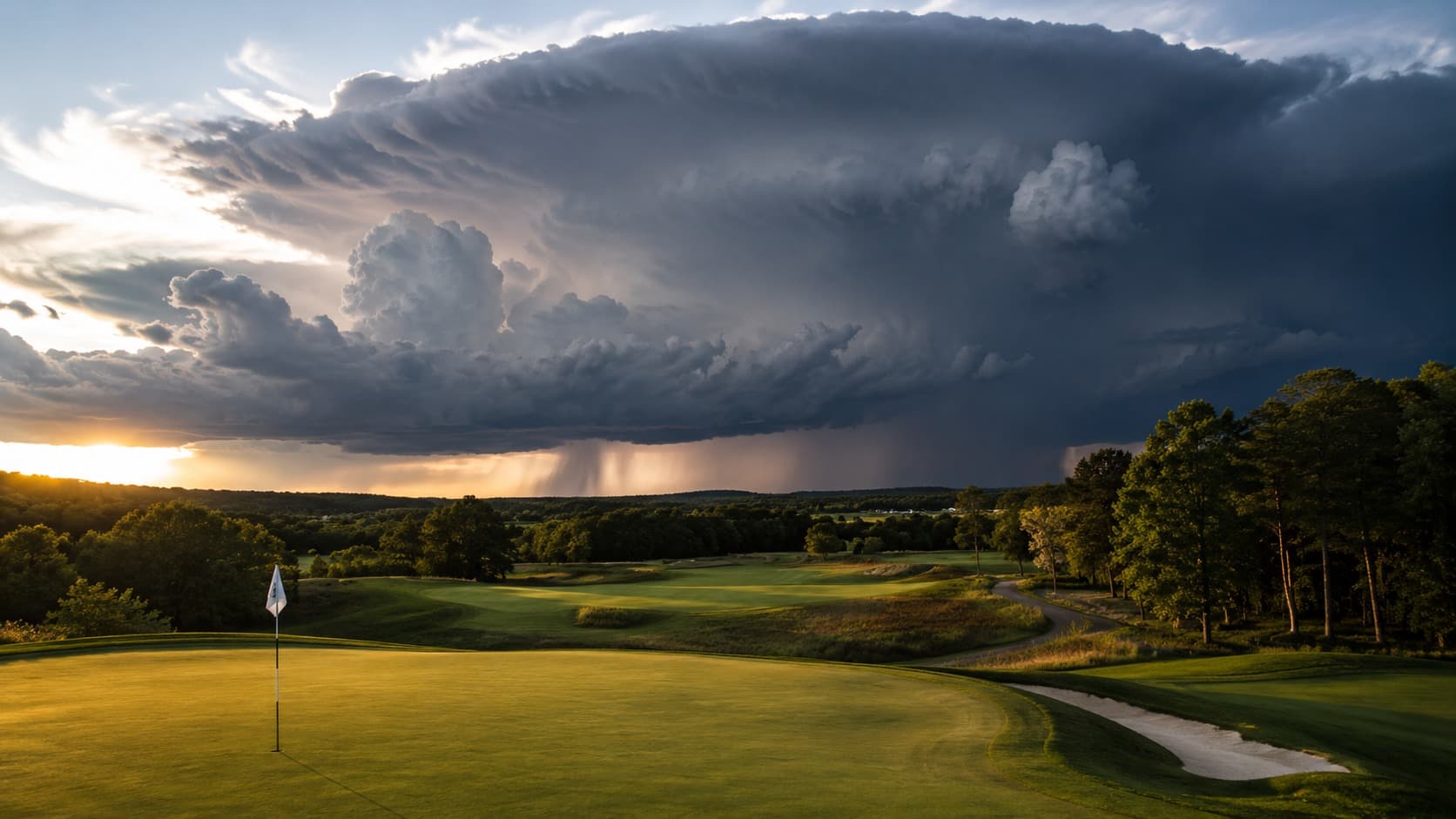
The Three O’Clock Storm: Reading Summer’s Convective Cycle to Protect Your Round
A 40% chance of afternoon thunderstorms does not mean a 40% chance of getting rained on. In the summer convective season it means the morning is nearly clear and the afternoon carries a fast-building, high-energy storm risk driven by a daily heating cycle. Here is the meteorology behind the pattern, the G-Score data on how the storm cycle punishes afternoon tee times across the Southeast, Midwest, and desert Southwest, the lightning-safety decision tree that actually matters, and the workflow that gets you off the course before the first bolt.
Read StoryDanorie
Editorial & Data
Golf Weather Score is built by Danorie. We compute the G-Score — our own playability rating — from live NOAA forecasts and published course scorecards, so any US course can be compared on any day with a single number. Methodology and data sources are documented on every page.
Every Friday Morning
When Oakland Hills Country Club plays best next weekend.
Friday 6am ET: peak G-Score windows for Oakland Hills Country Club, wind direction by hour, and one gear call. Three minutes to read, save you the round.
One email a week. Unsubscribe in one click.
The Caddie's Oracle
Draw your luck before the tee off