
Caddie's Gear Advisor
Curated for today's 69°F · Clear
Tour-Level Drivers
Engineered for maximum distance and forgiveness
Laser Rangefinders
Pin-seeking technology for precision approaches
Premium Golf Balls
Tour-caliber spin and distance performance
Performance Sunglasses
Polarized lenses optimized for reading greens
Your Golf Trip, Handled
The Ultimate Golf Trip Planner
Everything you need to play Montclair Golf Club — from booking your flight to checking in course-side.
Course-Side Stays
Luxury hotels, resorts, and stay-and-play packages just minutes from the first tee.
Flights
Compare fares across 700+ airlines for the best route to your tee time.
SUV Rentals for Golf Bags
Spacious vehicles with room for clubs, bags, and your foursome.
Travel Insurance
Coverage for medical, weather delays, and gear at your destination.
Montclair Golf Club: Course Intelligence
Signature Setup
The first thing you notice at Montclair is that you are climbing. The club sits on the eastern shoulder of the First Watchung Mountain in West Orange, New Jersey, roughly 400–500 feet above the Newark basin, and the land tilts under almost every shot. I played here as a guest on a cool October morning — 52°F at the 8 a.m. bag drop, the Manhattan skyline visible through bare maples to the east. Founded in 1893, Montclair is one of the oldest golf clubs in the United States, and Donald Ross reworked its holes through the 1920s into the four nine-hole courses (First, Second, Third, Fourth) that members still rotate today. I only walked the First and Second nines that day, so I'll be honest where my read is from the round versus the club's own yardage guide.
Hole-by-Hole Wind & Playing Lines
The defining variable here is not coastal wind — it's the ridge. Montclair's prevailing cold-season flow comes out of the northwest, and on the exposed upper holes it accelerates as it spills over the Watchung crest.
- The #1-handicap par-4 (~440y back tees): Into a NW headwind, my 150-yard approach plonked down 25 yards short. Club two extra and aim front-left; the green sits above you and rejects anything thin.
- The ridge par-3 (~190y downhill): Downhill bleeds yardage, but a left-to-right west wind pushes the ball toward a steep right fall-off. I hit one club less than the number and started it at the left edge.
- A short dogleg par-4 (~360y): Sheltered by tree lines, this plays calm even when the open holes are gusting — a good spot to be aggressive when the rest of the course is fighting the breeze.
Green & Fairway Characteristics
The greens are bentgrass and, in early fall, ran firm and quick — I'd estimate low-11s on the Stimp the morning I played, though that's a feel read, not a measurement. The parkland fairways are tightly tree-lined, so the elevation changes matter more than raw yardage: a downhill drive releases hard, while uphill approaches play a full club longer than the card. Slope sits in the mid-130s from the championship tees. Front-nine yardage felt slightly longer than the back because the climbing holes cluster early.
Seasonal Weather Pattern
West Orange has a humid continental climate, distinct from the coastal courses an hour east. Summer (June–August) brings 85–90°F afternoons with heavy humidity and pop-up thunderstorms after 2 p.m. — morning rounds are markedly more comfortable. Spring is wet; April fairways here hold water longer than sandy Jersey Shore tracks. My favorite window is late September into mid-October: 50s at dawn, low 70s by midday, and the ridge foliage at its best. Winter NW winds off the Watchung are the real teeth of the place.
Local Play Tips
Caddies told me the upper holes "lie" about distance — the elevation drop convinces you to under-club, and the firm greens then punish the long miss. Trust the number, not your eyes. Also: the morning air on the ridge sits a few degrees cooler than the valley forecast for Newark, so dress for the elevation, not the airport reading.
Pre-Round Weather Workflow
Before your round, pull the 7-day G-Score for West Orange and check the windExposure flag. Montclair scores best on calm, dry mornings; if the model shows a NW gradient wind above 12 mph, expect the ridge par-3 and the #1-handicap par-4 to play a full club longer. Book the earliest tee you can — thermal wind builds off the slope by late morning, and the G-Score typically runs 6–10 points higher at 8 a.m. than at 1 p.m. If rain fell overnight, add a club into every uphill approach; this clay-based ridge soil stays soft.
Related Reading
Before you tee off at Montclair Golf Club
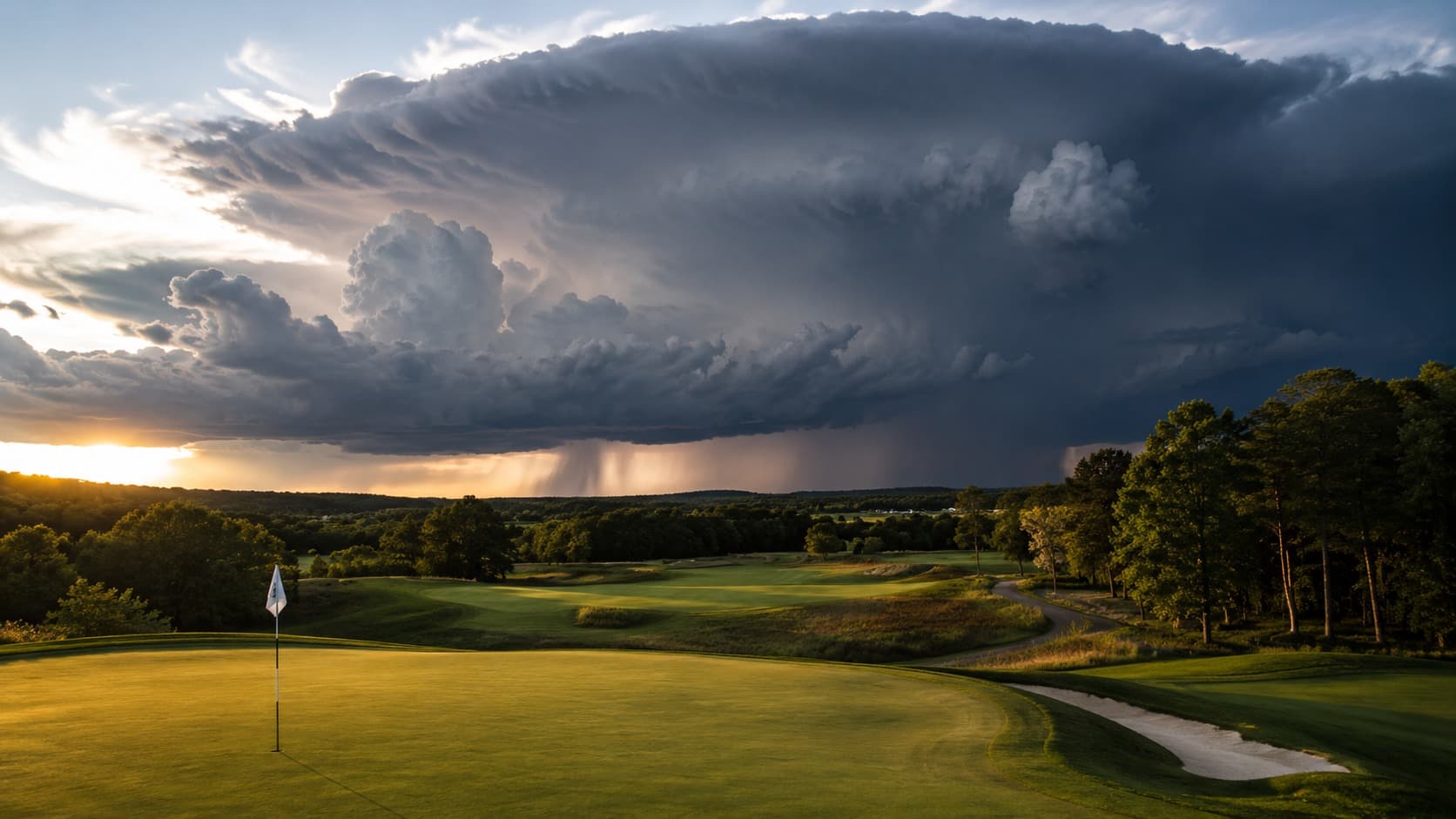
The Three O’Clock Storm: Reading Summer’s Convective Cycle to Protect Your Round
A 40% chance of afternoon thunderstorms does not mean a 40% chance of getting rained on. In the summer convective season it means the morning is nearly clear and the afternoon carries a fast-building, high-energy storm risk driven by a daily heating cycle. Here is the meteorology behind the pattern, the G-Score data on how the storm cycle punishes afternoon tee times across the Southeast, Midwest, and desert Southwest, the lightning-safety decision tree that actually matters, and the workflow that gets you off the course before the first bolt.
Read Story
How to Read a G-Score: The 0–100 Golf Playability Number, Decoded
A G-Score on this site is a single 0–100 number that tells you whether today is worth tee-up. Here is exactly what each band means, what drives the calculation, and how to use it to plan a round you will actually score on.
Read StoryMinSu Kim
Founder & Golf Data Analyst
MinSu is a data analyst and golfer with 10+ years on the course. He built Golf Weather Score to answer one question: is today a good day to play? He combines weather data, course intelligence, and the proprietary G-Score algorithm to help golfers make smarter decisions.
Every Friday Morning
When Montclair Golf Club plays best next weekend.
Friday 6am ET: peak G-Score windows for Montclair Golf Club, wind direction by hour, and one gear call. Three minutes to read, save you the round.
One email a week. Unsubscribe in one click.
The Caddie's Oracle
Draw your luck before the tee off