
Caddie's Gear Advisor
Curated for today's 59°F · Rain
Storm-Ready Outerwear
Waterproof layers built for 18 holes in the rain
Tour-Grade Umbrellas
68" double-canopy wind-resistant coverage
Wet-Weather Gloves
All-weather grip that performs in the rain
Waterproof Golf Shoes
Keep your feet dry through every fairway
Your Golf Trip, Handled
The Ultimate Golf Trip Planner
Everything you need to play Pine Valley Golf Club — from booking your flight to checking in course-side.
Course-Side Stays
Luxury hotels, resorts, and stay-and-play packages just minutes from the first tee.
Flights
Compare fares across 700+ airlines for the best route to your tee time.
SUV Rentals for Golf Bags
Spacious vehicles with room for clubs, bags, and your foursome.
Travel Insurance
Coverage for medical, weather delays, and gear at your destination.
Pine Valley Golf Club: Course Intelligence
Signature Setup
The first thing you notice in the New Jersey Pine Barrens is the ground. I walked the sandy fire-roads near Pine Valley on a 54°F October morning, and the soil drinks rain so fast it was firm underfoot an hour after a shower — the same sand that makes this golf course play the way it does. Honest limitation up front: I have not teed it up inside the gates. Pine Valley is one of the hardest invitations in American golf, men-only and ferociously private, so my read of the lines comes from the historical record and from knowing this turf, not from a personal scorecard.
George Crump routed Pine Valley starting in 1913 on sandy scrubland in Pine Valley, New Jersey, about 18 miles east of Philadelphia, with design help from the English architect Harry Colt. It opened in 1918; Crump died that year with four holes unfinished, and the back nine was completed posthumously by 1922. It has topped Golf Magazine's and Golf Digest's world rankings for decades — frequently named the No. 1 course on Earth — yet it has never hosted a U.S. Open, choosing privacy over spectacle.
Hole-by-Hole Wind & Playing Lines
Hole 13 (#1 handicap, par-4 ~486y). A long dogleg that runs into the prevailing W/SW summer breeze. Even a 290-yard drive leaves 200-plus to a green ringed by sandy scrub. Take the wide left landing area off the tee, then play the approach as a long-iron toward the short-right apron rather than chasing the flag over waste — par here is a stolen stroke.
Hole 5 (signature par-3, ~232y). A forced carry over wetland to a long, raised green, often called the hardest par-3 in the country. The hole sits in an open gap in the pines, so it catches wind the tree-lined holes don't. Into a W wind it can demand a fairway-metal or hybrid; there is no bail-out — short is wet, long is sand.
Hole 7 ("Hell's Half Acre," par-5 ~636y). A roughly 100-yard-wide sandy waste crosses the fairway near the second-shot landing zone. The play is a disciplined lay-up short of the waste, then a full carry over it — do not gamble a long second into a downwind gust that leaves you in the sand with no rake and no clean lie.
Green & Fairway Characteristics
The greens are bentgrass, firm, and quick — they run past 12 on the Stimp for the Crump Cup. The fairways are fast-draining sand framed by unraked waste areas and pine scrub, so the entire property plays firm and bouncy nearly year-round. The defining feature is the sand: there are no manicured bunkers in the modern sense, just native waste that is never raked, which means an off-line drive can settle into a footprint or a buried lie. The 10th is a tiny ~146-yard par-3 whose front bunker, nicknamed the "Devil's Asshole," is a deep sand pit that swallows anything short. Off the championship tees the course plays ~7,057 yards to a par of 70, and the slope of 153–155 is among the highest issued anywhere.
Seasonal Weather Pattern
Pine Valley sits in the South Jersey Pine Barrens, a humid zone but one with sandy, fast-draining soil that behaves nothing like the clay of most Northeast parkland courses. Summer (June–August) is warm and sticky, often 82–92°F, with afternoon thunderstorms and a prevailing W/SW wind of 8–14 mph by NOAA's regional records. Autumn (late September–October) is the prime window — 52–70°F, firm turf, and the calmest mornings, which is why the Crump Cup is held in September. Spring (April–May) runs 48–66°F and wet, but the sand drains it off quickly. Winter brings frost and occasional snow, with NW winds; the course closes in the coldest stretch.
Local Play Tips
The piece of local knowledge that no yardage book conveys: the sand drainage. On a normal parkland course, a rainy night means soft, receptive fairways and dart-throwing approaches. Here the Pine Barrens sand sheds water so fast that the course is firm again within hours, so you must plan for release on every landing — the ball will run out, and an approach that lands pin-high will scoot off the back. Wind matters less than you'd expect on the tree-lined interior holes, which are shielded by dense pine, but the open gaps — the 2nd, the 5th, the 13th, the 15th, the 18th — catch the full W/SW breeze. Misjudge those handful of exposed holes and the unraked waste will collect your ball with no good way out.
Pre-Round Weather Workflow
Use the 7-day G-Score on this page the way I would here. Three days out, check whether your tee window lands before or after the afternoon W/SW wind build — on a 7,057-yard par 70 framed by waste sand, that one factor swings the exposed holes (2, 5, 13, 15, 18) by several strokes. The morning of, read the windExposure panel: a W or SW reading means the 5th, 13th, and 18th all play into the breeze, so club up and respect the no-bail-out greens. And unlike anywhere else, do not read overnight rain as a soft course — the sand drains it off, so play for firm, fast, running conditions and take one less club into greens that will not hold a hot approach.
Related Reading
Before you tee off at Pine Valley Golf Club

America's 20 Windiest Golf Courses: A G-Score Wind Analysis
We ranked America's 20 windiest golf courses using G-Score wind penalty data. See how coastal gusts and prairie gales reshape playability scores.
Read Story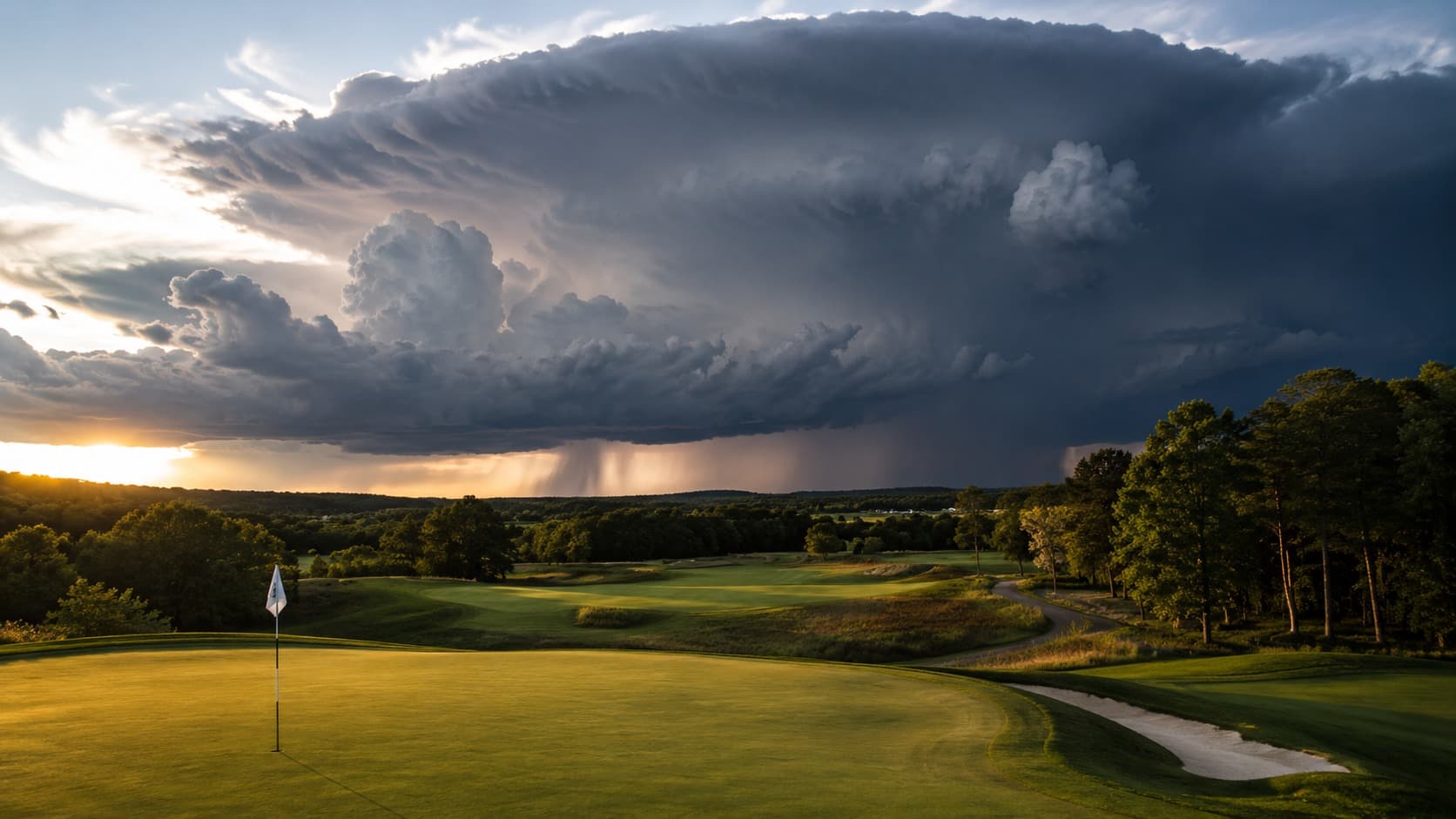
The Three O’Clock Storm: Reading Summer’s Convective Cycle to Protect Your Round
A 40% chance of afternoon thunderstorms does not mean a 40% chance of getting rained on. In the summer convective season it means the morning is nearly clear and the afternoon carries a fast-building, high-energy storm risk driven by a daily heating cycle. Here is the meteorology behind the pattern, the G-Score data on how the storm cycle punishes afternoon tee times across the Southeast, Midwest, and desert Southwest, the lightning-safety decision tree that actually matters, and the workflow that gets you off the course before the first bolt.
Read StoryMinSu Kim
Founder & Golf Data Analyst
MinSu is a data analyst and golfer with 10+ years on the course. He built Golf Weather Score to answer one question: is today a good day to play? He combines weather data, course intelligence, and the proprietary G-Score algorithm to help golfers make smarter decisions.
Every Friday Morning
When Pine Valley Golf Club plays best next weekend.
Friday 6am ET: peak G-Score windows for Pine Valley Golf Club, wind direction by hour, and one gear call. Three minutes to read, save you the round.
One email a week. Unsubscribe in one click.
The Caddie's Oracle
Draw your luck before the tee off