
Caddie's Gear Advisor
Curated for today's 63°F · Clouds
Tour-Level Drivers
Engineered for maximum distance and forgiveness
Laser Rangefinders
Pin-seeking technology for precision approaches
Premium Golf Balls
Tour-caliber spin and distance performance
Performance Sunglasses
Polarized lenses optimized for reading greens
Your Golf Trip, Handled
The Ultimate Golf Trip Planner
Everything you need to play Quail Hollow Club — from booking your flight to checking in course-side.
Course-Side Stays
Luxury hotels, resorts, and stay-and-play packages just minutes from the first tee.
Flights
Compare fares across 700+ airlines for the best route to your tee time.
SUV Rentals for Golf Bags
Spacious vehicles with room for clubs, bags, and your foursome.
Travel Insurance
Coverage for medical, weather delays, and gear at your destination.
Quail Hollow Club: Course Intelligence
Signature Setup
The 17th at Quail Hollow looks longer in person than it does on Sunday broadcasts. I stood on the tee on an early-May morning, 60°F at 7:40 a.m. with the pond glassy and a faint SW breeze just starting to wake — 223 yards on the card, all carry, and the green sitting low against the water like it wanted the ball back. It is the kind of par-3 that makes you commit to the club or pay for the doubt.
George Cobb routed Quail Hollow Club in 1961 on rolling Piedmont land in south Charlotte, North Carolina. Tom Fazio reshaped it across several phases, most heavily from 2013 to 2016, rebuilding the opening holes and regrassing the greens to MiniVerde Bermuda. It plays to par 71 at roughly 7,521 yards from the championship tees. The club has hosted the Wells Fargo Championship since 2003, the 2017 PGA Championship (won by Justin Thomas), the 2022 Presidents Cup, and the 2025 PGA Championship — a deep résumé for a course barely six decades old.
Hole-by-Hole Wind & Playing Lines
Hole 18 (#1 handicap, par-4, 494y). The hardest closing hole on the property. A creek runs the entire left side, and the prevailing SW breeze pushes the tee shot toward it. Into a 12 mph wind, favor the right-center bunker line, then club up one — the green runs back-to-front and won't hold a long iron that lands hot.
Hole 16 (par-4, 506y). The Green Mile opens with a long dogleg-left where water guards the left approach. Downwind it's reachable in two for the longest players; into the same SW breeze it becomes a true three-shot par-4 for most. Aim your second at the right half of the green and accept the long putt.
Hole 17 (par-3, 223y). All carry over water to a shallow green. On a calm morning it's a flushed long iron; once the afternoon breeze fills in from the SW, the shot stretches nearer 240 and the bailout right brings a slick downhill chip back toward the pond.
Green & Fairway Characteristics
The MiniVerde greens, laid in 2016, are the defining test — firm, grainy, and quick, rolling around 12 on the Stimp for tournament week. They sit on bold Piedmont contours, so the read matters as much as the speed; a downhill putt that misses the high side gets away from you fast. Fairways are Bermuda, generous off several tees but pinched by water and bunkering exactly where the strong holes demand precision. The front nine plays more forgiving; the closing stretch from 16 tightens with water on three straight holes. Slope sits in the low-150s from the tips — steep for the yardage, driven by green speed and the water hazards rather than rough.
Seasonal Weather Pattern
Charlotte is humid-subtropical Piedmont, and the calendar swings hard. Spring (April–May), when the Wells Fargo is played, runs 55–80°F with the calmest mornings before afternoon SW breezes of 8–14 mph build over the inland terrain. Summer (June–August) turns hot and sticky, often 85–93°F, with daily afternoon thunderstorms rolling off the southern Appalachians. Fall (September–October) is the firmest, most pleasant window — 60–82°F and lighter wind. NOAA Charlotte-area station records show summer afternoon humidity routinely above 70%, which softens carry distance more than players expect.
Local Play Tips
Something the scorecard won't tell you: the Green Mile is the only fully exposed stretch on the course, and all three holes touch or flirt with water. If your tee time puts you on 16 through 18 after early afternoon, you meet the building SW breeze precisely when the holes are hardest and the greens have baked firmest. I haven't played Quail Hollow in mid-summer heat, so I rely on historical data there — but in May, an early window let me play the closing three in near-still air, and that alone was worth two or three strokes.
Pre-Round Weather Workflow
Use the 7-day G-Score on this page the way I do. Three days out, check whether your tee window lands before or after the afternoon SW breeze build — on the exposed closing holes that single factor moves the score 10–14 points. The morning of, read the windExposure panel: an SW reading means 17 and 18 play into the breeze, so club up one and favor right-side targets to stay off the left-side creek on 18. If the forecast reads above 85°F with high humidity, expect shorter carry — take the extra club, fly your approach in with spin, and let Quail Hollow's firm Bermuda greens reward the committed shot rather than the cautious one.
Related Reading
Before you tee off at Quail Hollow Club
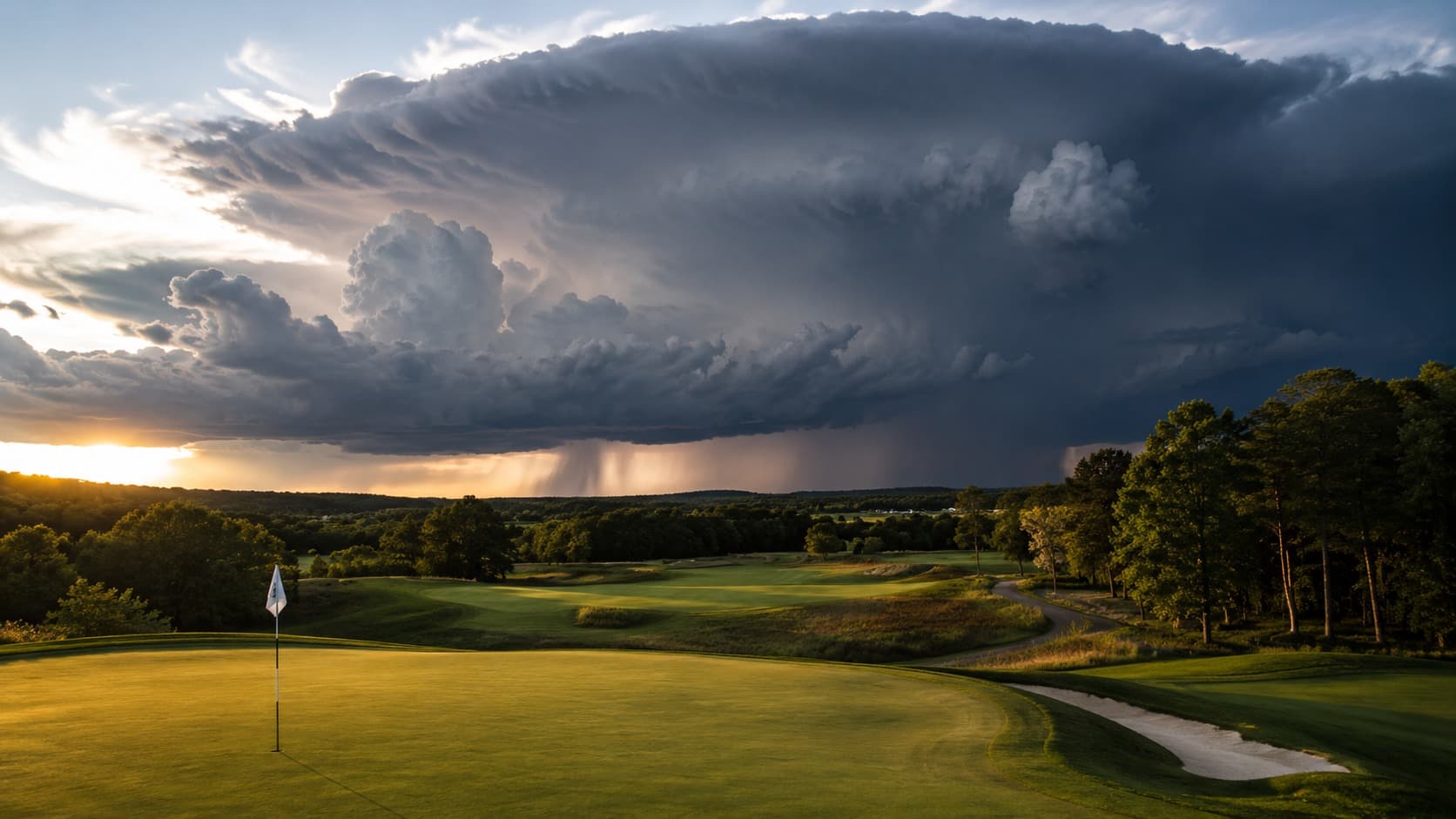
The Three O’Clock Storm: Reading Summer’s Convective Cycle to Protect Your Round
A 40% chance of afternoon thunderstorms does not mean a 40% chance of getting rained on. In the summer convective season it means the morning is nearly clear and the afternoon carries a fast-building, high-energy storm risk driven by a daily heating cycle. Here is the meteorology behind the pattern, the G-Score data on how the storm cycle punishes afternoon tee times across the Southeast, Midwest, and desert Southwest, the lightning-safety decision tree that actually matters, and the workflow that gets you off the course before the first bolt.
Read Story
The May 2026 G-Score Heatmap: Where American Golf Peaks This Spring
May is the most underrated month on the American golf calendar. Five regions hit their annual peak this spring, three turn quietly hostile, and the data tells a clearer story than the brochures. Here is where to play, where to avoid, and how to time your booking window.
Read StoryDanorie
Editorial & Data
Golf Weather Score is built by Danorie. We compute the G-Score — our own playability rating — from live NOAA forecasts and published course scorecards, so any US course can be compared on any day with a single number. Methodology and data sources are documented on every page.
Every Friday Morning
When Quail Hollow Club plays best next weekend.
Friday 6am ET: peak G-Score windows for Quail Hollow Club, wind direction by hour, and one gear call. Three minutes to read, save you the round.
One email a week. Unsubscribe in one click.
The Caddie's Oracle
Draw your luck before the tee off