
Caddie's Gear Advisor
Curated for today's 66°F · Clear
Tour-Level Drivers
Engineered for maximum distance and forgiveness
Laser Rangefinders
Pin-seeking technology for precision approaches
Premium Golf Balls
Tour-caliber spin and distance performance
Performance Sunglasses
Polarized lenses optimized for reading greens
Your Golf Trip, Handled
The Ultimate Golf Trip Planner
Everything you need to play Quail Hollow Golf Course — from booking your flight to checking in course-side.
Course-Side Stays
Luxury hotels, resorts, and stay-and-play packages just minutes from the first tee.
Flights
Compare fares across 700+ airlines for the best route to your tee time.
SUV Rentals for Golf Bags
Spacious vehicles with room for clubs, bags, and your foursome.
Travel Insurance
Coverage for medical, weather delays, and gear at your destination.
Quail Hollow Golf Course: Course Intelligence
The first time I teed off at a Boise foothills course in July, my 7-iron flew a full club longer than it does back home in Irvine — thin high-desert air near 2,900 feet does that to a sea-level swing. It was 58°F and dead calm at 7 a.m.; by the time I reached the turn, the up-valley wind had found the canyon. Quail Hollow sits in exactly that kind of draw, and the weather here rewrites your yardages hour by hour.
TL;DR
- Par-70, 6,373-yard Bruce Devlin & Robert von Hagge design (1982); rating 70.7, slope 129 — short on paper, defended by terrain and thermal wind.
- High-desert altitude (~2,900 ft) adds roughly 5% carry; club down off the tee, then add it back when the afternoon wind arrives.
- Play before ~1 p.m.: mornings are calm and cool, afternoons bring the up-valley thermal wind through the foothills.
Signature Setup
Quail Hollow opened in 1982 as a Bruce Devlin & Robert von Hagge layout — a partnership known for bold bunkering and water that frames a shot rather than just punishing it. This is a 6,373-yard, par-70 semi-private course from the tips, with a course rating of 70.7 and a slope of 129. It has no PGA Tour pedigree, and I won't pretend otherwise; its identity is the Boise Foothills it's routed through, not a trophy cabinet. The par-70 number tells you the story: you give back length the moment you trade a par-5 for a tighter par-4 or an exposed par-3.
Hole-by-Hole Wind & Playing Lines
I'm working from the published scorecard and the Treasure Valley's wind behavior here, not from a personal card for all 18 — so I'll talk wind direction and exposure rather than hand you a fake #1-handicap yardage. Two patterns matter. Mornings: down-canyon drainage flow, light (5–8 mph) and usually helping or neutral — this is when the course is shortest. Afternoons: up-valley thermal, prevailing NW, building to 10–18 mph by mid-day. On the holes that climb toward the foothills, that NW wind quarters into you: a 150-yard morning approach plays close to 165 in the afternoon, and the short par-3s are where it bites most — the card says 7-iron, the wind says 5.
Green & Fairway Characteristics
The turf is cool-season Treasure Valley grass, and in the dry high-desert summer the fairways run firm and fast — plan for roll, not carry, on tee shots. The greens sit on foothills tilt, so a putt that looks flat often leans toward the lower, valley side; read the whole hillside, not just the surface. At 6,373 yards over a par of 70 it's a position course, not a bomber's course: a fairway finder off the tee is worth more than 15 extra yards here.
Seasonal Weather Pattern
This is high desert, and the calendar is sharp. April–May: frontal systems bring gustier, less predictable wind — check the forecast, not the season. June–August: hot and very dry, afternoon highs in the low-to-mid 90s°F, mornings 55–62°F, single-digit humidity, and that reliable NW up-valley thermal after roughly 1 p.m. Late August–September: regional wildfire smoke can settle in the valley — worth an air-quality check before you commit. October: crisp and often the best playing window. Winters are cold and the course's playable season is short, so this isn't a year-round venue.
Local Play Tips
The single highest-value move is tee time: get out before the thermal wind, and you play a different, easier golf course. The altitude is real free distance — expect about 5% more carry than a sea-level course, so club down off the tee but keep the extra club ready for into-wind approaches. In late summer, glance at the smoke/AQI reading the night before. And trust the firmness — these greens release, so land short and let the high-desert ground do the work. I haven't played here in deep winter (it's effectively closed), so I won't speak to cold-season conditions.
Pre-Round Weather Workflow
Pull the 7-day G-Score for Quail Hollow and weight the morning slots — the early G-Score will read higher because of the calm, cool start. Check the windExposure indicator: when it flags an NW afternoon build, move your tee time earlier or add a club to every foothills approach in your plan. Two days out, glance at the dew point and any smoke advisory; one day out, lock the morning slot. The forecast isn't trivia here — at a wind-and-altitude course like this, it's the difference between shooting your number and chasing it.
Related Reading
Before you tee off at Quail Hollow Golf Course
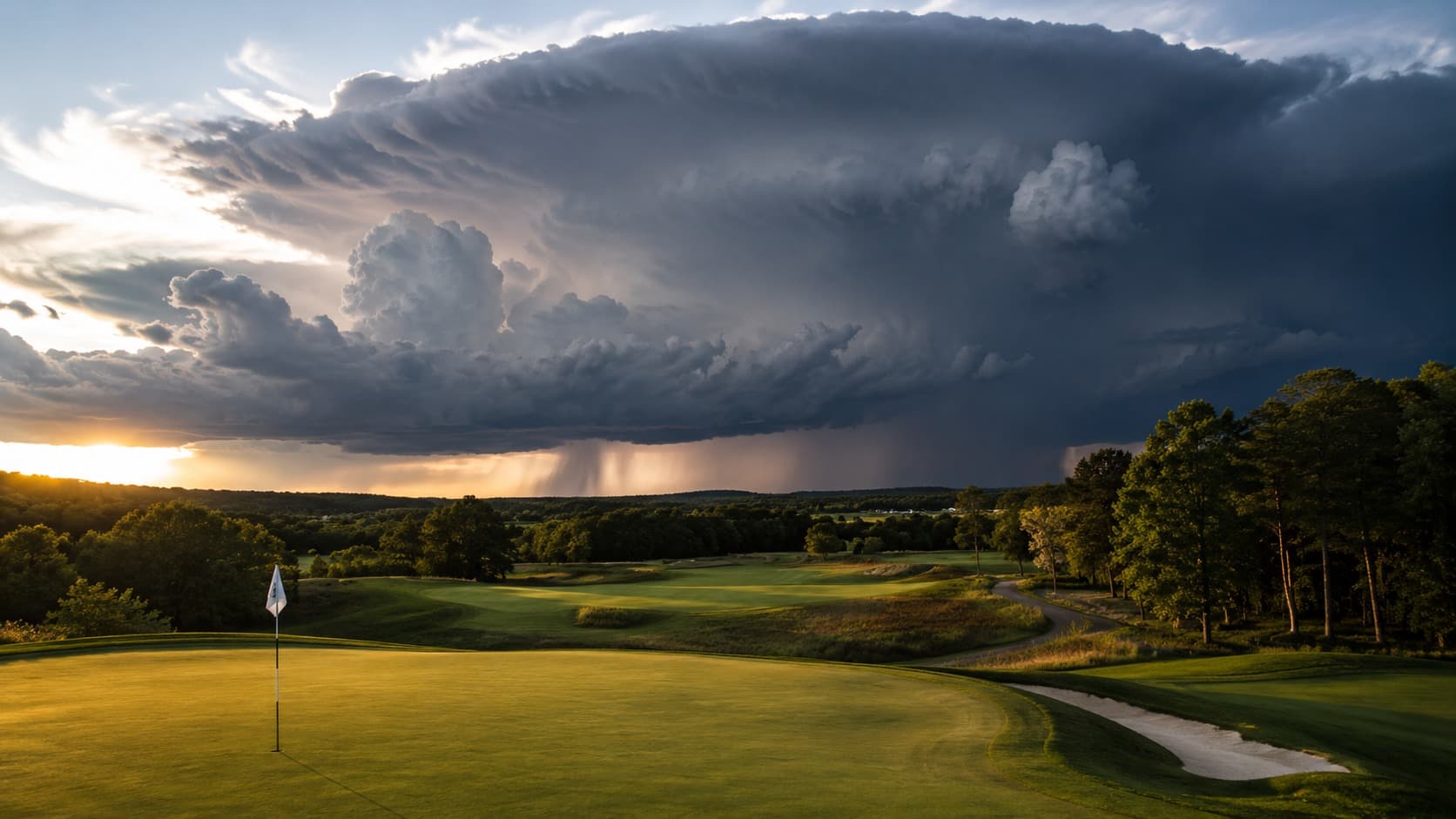
The Three O’Clock Storm: Reading Summer’s Convective Cycle to Protect Your Round
A 40% chance of afternoon thunderstorms does not mean a 40% chance of getting rained on. In the summer convective season it means the morning is nearly clear and the afternoon carries a fast-building, high-energy storm risk driven by a daily heating cycle. Here is the meteorology behind the pattern, the G-Score data on how the storm cycle punishes afternoon tee times across the Southeast, Midwest, and desert Southwest, the lightning-safety decision tree that actually matters, and the workflow that gets you off the course before the first bolt.
Read Story
How to Read a G-Score: The 0–100 Golf Playability Number, Decoded
A G-Score on this site is a single 0–100 number that tells you whether today is worth tee-up. Here is exactly what each band means, what drives the calculation, and how to use it to plan a round you will actually score on.
Read StoryMinSu Kim
Founder & Golf Data Analyst
MinSu is a data analyst and golfer with 10+ years on the course. He built Golf Weather Score to answer one question: is today a good day to play? He combines weather data, course intelligence, and the proprietary G-Score algorithm to help golfers make smarter decisions.
Every Friday Morning
When Quail Hollow Golf Course plays best next weekend.
Friday 6am ET: peak G-Score windows for Quail Hollow Golf Course, wind direction by hour, and one gear call. Three minutes to read, save you the round.
One email a week. Unsubscribe in one click.
The Caddie's Oracle
Draw your luck before the tee off