
Caddie's Gear Advisor
Curated for today's 92°F · Thunderstorm
Storm-Ready Outerwear
Waterproof layers built for 18 holes in the rain
Tour-Grade Umbrellas
68" double-canopy wind-resistant coverage
Wet-Weather Gloves
All-weather grip that performs in the rain
Waterproof Golf Shoes
Keep your feet dry through every fairway
Your Golf Trip, Handled
The Ultimate Golf Trip Planner
Everything you need to play The Club at the Strand — from booking your flight to checking in course-side.
Course-Side Stays
Luxury hotels, resorts, and stay-and-play packages just minutes from the first tee.
Flights
Compare fares across 700+ airlines for the best route to your tee time.
SUV Rentals for Golf Bags
Spacious vehicles with room for clubs, bags, and your foursome.
Travel Insurance
Coverage for medical, weather delays, and gear at your destination.
The Club at the Strand: Course Intelligence
Signature Setup
The Club at The Strand sits in North Naples, Florida, a private 27-hole community course laid out by Gordon Lewis around the turn of the millennium across three nines — Sabal, Palm, and Estuary. Lewis built it as a member's course, not a tournament stage, which shows in the routing: generous landing zones, water in play on a majority of holes, and wetland preserve framing rather than punishing the everyday golfer. From the back tees any 18-hole combination runs in the 6,700–7,000-yard range at par 72. I should be honest that this is a gated club, so I lean on the course's published records for the opening year and the Lewis attribution rather than a member's logbook — what I can speak to directly is how a Gulf-coast layout like this plays through the seasons.
Hole-by-Hole Wind & Playing Lines
The Strand has no coastal dunes, but it has Naples' defining feature: a Gulf sea breeze that builds from the west-southwest most late mornings. That single fact reshapes the hardest holes.
- Sabal 5 (#1 handicap, par-4 ~440y): In the dead-calm of an 8 a.m. start this is a driver and a mid-iron. By 11 a.m., into a 12–15 mph SW breeze, your 150-yard approach becomes a 175-yard shot. Club up, aim right-center, and play for the fat of the green.
- Estuary 4 (short par-4 ~360y): The risk-reward tee shot of the property. Calm and firm, big hitters flirt with the green; with the breeze quartering off the left, the smart play is a hybrid to 100 yards and a wedge in.
- The par-3s over water: On a southerly wind they balloon. A stock 175-yard 6-iron can come up 10–15 yards short of a back pin — take the front edge and let the firm surface release.
Green & Fairway Characteristics
The greens are Bermuda, kept firm through the dry months, and roll in a medium-fast range typical of a well-conditioned Southwest Florida club rather than a tournament shave. They are mid-sized with subtle internal movement — the danger is the surrounding water and bunkering, not severe slope. Fairways drain well on sandy Naples soil, so after a dry winter week the ball runs out 15–25 yards. Several of the par-4s play as gentle doglegs around wetland, which means tee-shot shape matters more than raw length: a holdable right-to-left ball opens up the most landing area.
Seasonal Weather Pattern
This is Gulf-coast subtropical, and the calendar splits hard. The dry season, roughly mid-November through April, is the prize: mornings in the low-to-mid 60s°F, light winds before the sea breeze fills, and firm, fast turf. I've teed Naples-area rounds at 61°F at 7:30 a.m. and watched it climb to the mid-80s by the turn — pack a layer you can shed at the 4th. The wet season, June through September, flips the course: highs near 90°F, dew points around 74°F, and near-daily convective thunderstorms that fire between roughly 2 and 5 p.m. Lightning clears an open Florida course fast, so a wet-season round is a dawn round or nothing. I haven't played The Strand in August, so I'll only repeat what the regional climate record and local players say — get off before the afternoon cells build.
Local Play Tips
Two things a tee sheet won't tell you. First, with three nines, the combination you draw changes the round's character — Estuary brings the most water and the most wetland carries, so if you're between sets and the breeze is up, the Sabal/Palm pairing is the more forgiving 18. Second, the sea breeze is your scorecard's biggest variable here, bigger than pin position: the same hole that gives up a birdie at 8 a.m. can demand two extra clubs by noon. Locals book early tee times in season for exactly this reason, not just to beat the heat.
Pre-Round Weather Workflow
Check the 7-day G-Score the night before and again at dawn. On a Gulf-coast course like The Strand, prioritize two signals: the hour the sea breeze is forecast to fill, and afternoon storm probability in the wet season. A morning G-Score 8–10 points higher than the afternoon is the norm — tee early, finish the front before the wind turns the par-4s into three-shot holes. Cross-reference the windExposure rating: on an open layout with water on most holes, a 15 mph SW breeze plays harder than the same number on a sheltered track, so add a club to every approach and aim to the dry side of the hazards.
Related Reading
Before you tee off at The Club at the Strand
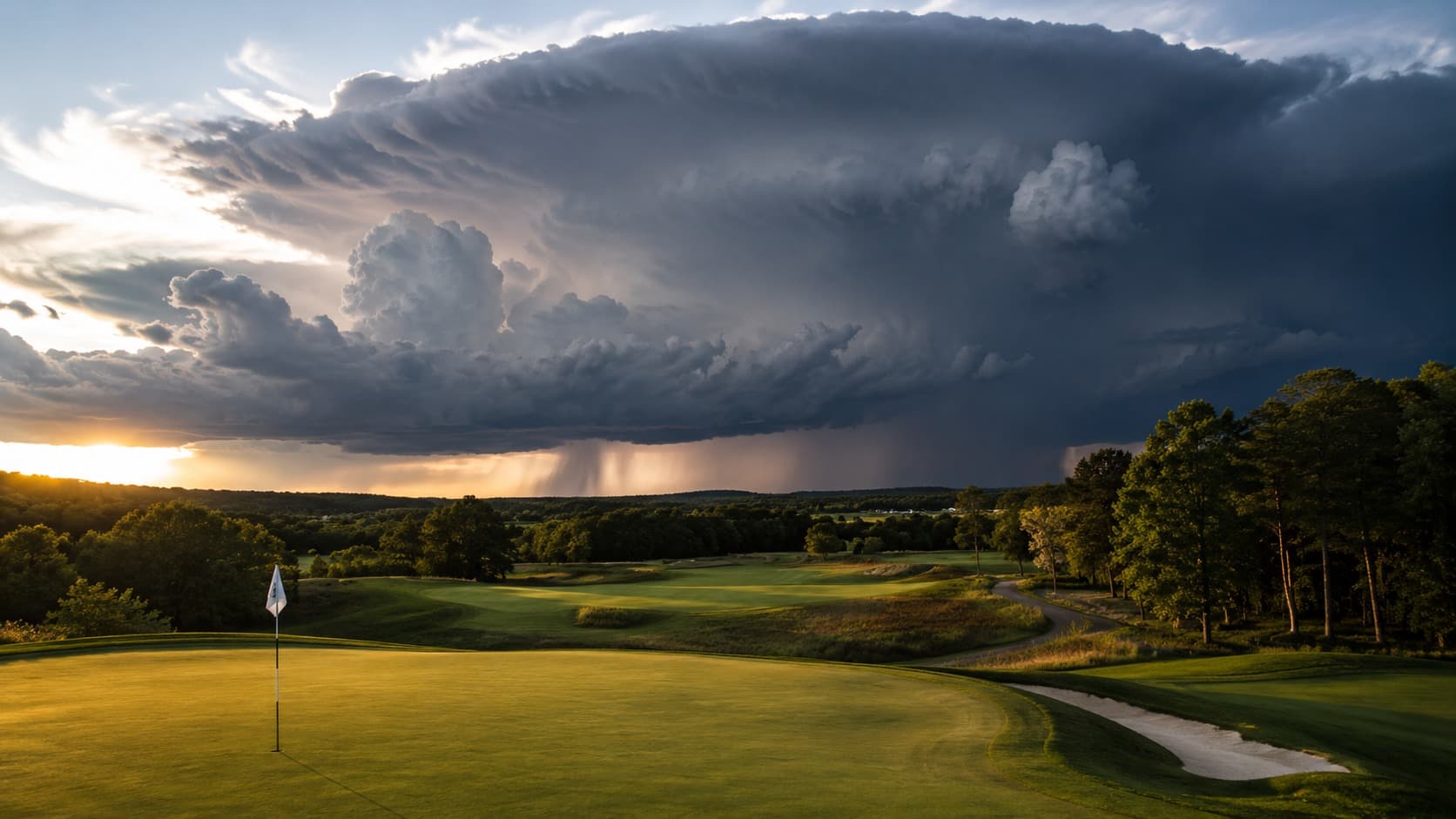
The Three O’Clock Storm: Reading Summer’s Convective Cycle to Protect Your Round
A 40% chance of afternoon thunderstorms does not mean a 40% chance of getting rained on. In the summer convective season it means the morning is nearly clear and the afternoon carries a fast-building, high-energy storm risk driven by a daily heating cycle. Here is the meteorology behind the pattern, the G-Score data on how the storm cycle punishes afternoon tee times across the Southeast, Midwest, and desert Southwest, the lightning-safety decision tree that actually matters, and the workflow that gets you off the course before the first bolt.
Read Story
How to Read a G-Score: The 0–100 Golf Playability Number, Decoded
A G-Score on this site is a single 0–100 number that tells you whether today is worth tee-up. Here is exactly what each band means, what drives the calculation, and how to use it to plan a round you will actually score on.
Read StoryMinSu Kim
Founder & Golf Data Analyst
MinSu is a data analyst and golfer with 10+ years on the course. He built Golf Weather Score to answer one question: is today a good day to play? He combines weather data, course intelligence, and the proprietary G-Score algorithm to help golfers make smarter decisions.
Every Friday Morning
When The Club at the Strand plays best next weekend.
Friday 6am ET: peak G-Score windows for The Club at the Strand, wind direction by hour, and one gear call. Three minutes to read, save you the round.
One email a week. Unsubscribe in one click.
The Caddie's Oracle
Draw your luck before the tee off