
Caddie's Gear Advisor
Curated for today's 50°F · Clouds
Cold-Weather Performance Layers
Thermal mid-layers that move with your swing
Tour Hand Warmers
Rechargeable warmers trusted by caddies
Thermal Base Layers
Lightweight compression that traps heat
Winter Golf Headwear
Beanies and ear warmers built for the links
Yale Golf Course: Course Intelligence
Charles Blair Macdonald and Seth Raynor designed the Yale Golf Course in 1926 on a piece of West Haven, Connecticut hillside land owned by Yale University. The course was conceived as a university-owned championship-grade facility — Macdonald and Raynor delivered one of their most-ambitious collaborative routings, with template-hole strategies adapted to the rugged New England terrain. The site sits on glacial moraine with significant elevation changes between holes, and the routing carries the Macdonald-Raynor template vocabulary (Redan, Biarritz, Alps, Cape, Road Hole) translated into hillside settings that the British originals never had.
The course plays around 6,749 yards par 70 from the back markers, with bent fairways and a slope in the upper 140s. The ninth hole — a 213-yard par-3 across a natural pond to a Biarritz green divided by a deep swale — is one of the most-photographed mid-round holes in American university-golf rotation. The eighteenth closes with a 621-yard par-5 that plays uphill through a natural valley. The green complexes carry Macdonald-Raynor's signature squared, geometrically-precise surfaces; the bunkers are deep, steep-walled, and placed with strategic intent that defends against modern equipment in ways the back-tee yardage understates.
Yale Golf Course is open to public daily-fee play, with Yale faculty and student-rate discounts. The pricing is modest by championship-course standards. The course operates as a university amenity rather than a destination property, which has kept the routing relatively unknown nationally despite consistent high architectural rankings. Roger Rulewich's 2010s restoration brought the bunkers and green complexes back closer to Macdonald-Raynor's original lines.
Connecticut climate gives Yale Golf Course a playing season of April through November, with the firmest conditions in October. The course closes through brief winter cold snaps but reopens within days. The university calendar gives the property reliable patterns — summer rounds run heavier than fall and winter rounds — and the New England autumn color through October is part of the routing's seasonal photographic signature.
More Courses in Connecticut
View AllRelated Reading
Before you tee off at Yale Golf Course

How Rain Probability Affects Your Golf Round: A Weather Data Study
What does '30% chance of rain' really mean for your round? We decode precipitation forecasts and reveal how rain impacts distance, grip, and scoring.
Read Story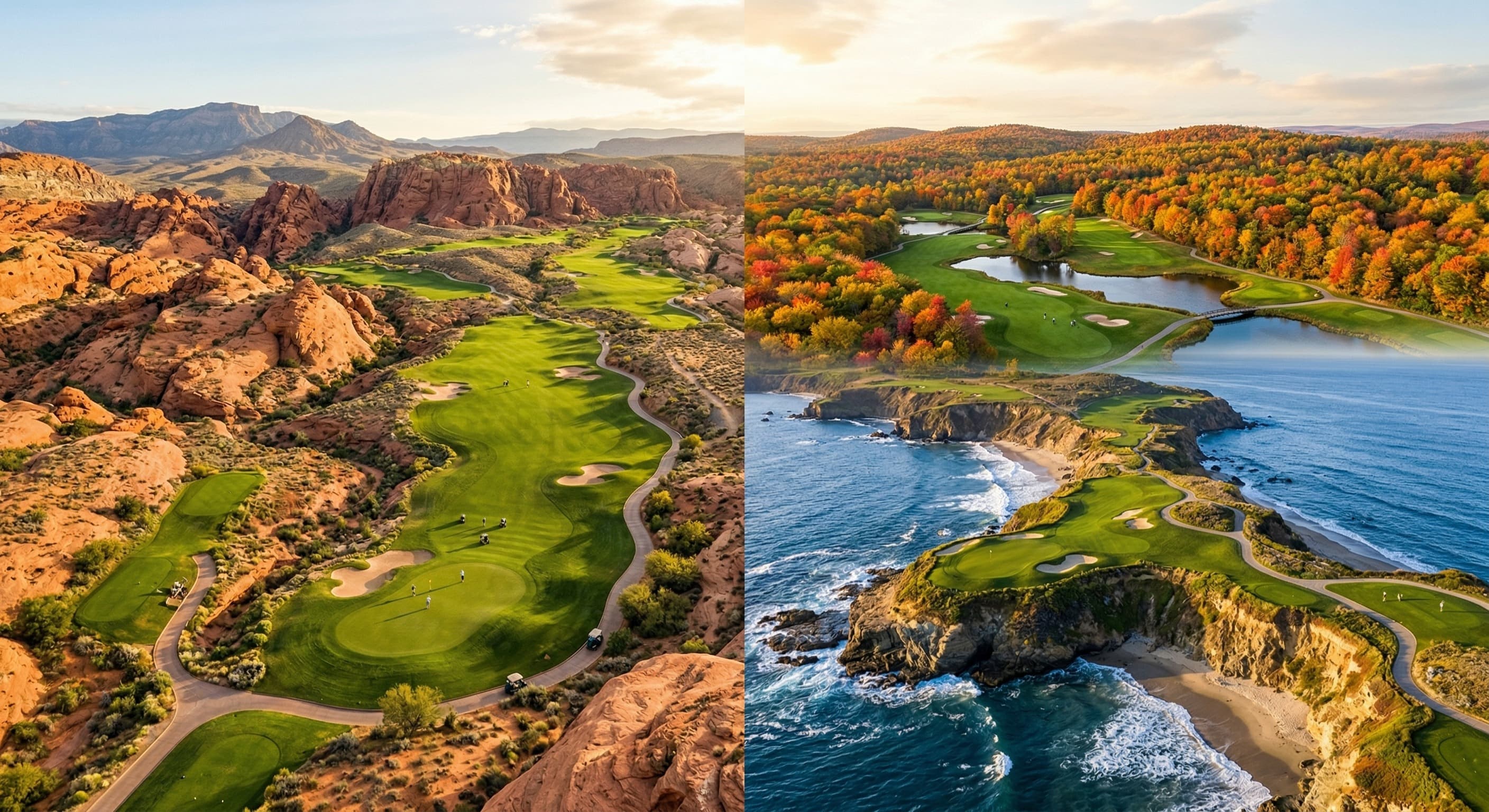
Best Golf Weather by State: Ranking America by Average G-Score
We ranked all 50 US states by average G-Score golf playability. California tops the list, but the results beyond the top five may surprise you.
Read StoryDanorie
Editorial & Data
Golf Weather Score is built by Danorie. We compute the G-Score — our own playability rating — from live NOAA forecasts and published course scorecards, so any US course can be compared on any day with a single number. Methodology and data sources are documented on every page.
Every Friday Morning
When Yale Golf Course plays best next weekend.
Friday 6am ET: peak G-Score windows for Yale Golf Course, wind direction by hour, and one gear call. Three minutes to read, save you the round.
One email a week. Unsubscribe in one click.
The Caddie's Oracle
Draw your luck before the tee off