
Caddie's Gear Advisor
Curated for today's 78°F · Clear
Tour-Level Drivers
Engineered for maximum distance and forgiveness
Laser Rangefinders
Pin-seeking technology for precision approaches
Premium Golf Balls
Tour-caliber spin and distance performance
Performance Sunglasses
Polarized lenses optimized for reading greens
Your Golf Trip, Handled
The Ultimate Golf Trip Planner
Everything you need to play Abilene Country Club North Course — from booking your flight to checking in course-side.
Course-Side Stays
Luxury hotels, resorts, and stay-and-play packages just minutes from the first tee.
Flights
Compare fares across 700+ airlines for the best route to your tee time.
SUV Rentals for Golf Bags
Spacious vehicles with room for clubs, bags, and your foursome.
Travel Insurance
Coverage for medical, weather delays, and gear at your destination.
Abilene Country Club North Course: Course Intelligence
Signature Setup
Abilene Country Club sits on the rolling uplands of Taylor County, in West Texas, at roughly 1,710 feet of elevation and 32.4°N. It is a private two-course club — North and South — and I want to be straight from the first line: I have not walked the North Course in person, so I will separate what I write from regional knowledge versus what is on the card. What I can tell you with confidence is the setting. This is high-plains golf, not coastal or parkland golf. The ground rolls gently, the air is dry, and at 1,700-plus feet the ball carries a touch farther than a sea-level golfer expects — perhaps 2–3% on a full shot. None of that is the story here, though. In Abilene, the wind is the course.
Hole-by-Hole Wind & Playing Lines
West Texas wind is the most predictable hard variable in American golf, and it dominates the North Course. From roughly March through June the prevailing wind is S to SSW, frequently sustained at 15–25 mph and gusting higher by mid-afternoon. On the #1-handicap par-4, that breeze sits into or across your tee shot: a 150-yard approach becomes a 170- to 175-yard shot, and the disciplined play is to club up one and hold the upwind side of the fairway rather than aim at the flag and let the crosswind carry you long and right. On any hole routed toward the south, treat the card yardage as a floor. Then in winter the pattern flips hard — a "blue norther" cold front swings the wind to the NW at 20–30 mph behind the front, dropping the temperature 20–30°F in an hour. The holes that played long into the spring south wind now play downwind and fast, and your distance control inverts completely.
Green & Fairway Characteristics
Expect bermuda fairways and bermuda greens, the standard turf for a private club at this latitude, with winter overseed common across West Texas to hold a playing surface through dormancy. The defining quality is firmness: the dry high-plains air and summer heat bake the fairways from June onward, so plan for hard run-out off the tee and approach shots that release rather than stop. Bermuda grain pushes afternoon putts, and on a wind-exposed upland site the greens dry and quicken through the day — a morning putt that holds its line will run out by late afternoon. Slopes are typical for a Taylor County private layout.
Seasonal Weather Pattern
Abilene is semi-arid, and the calendar is distinct from anywhere in the humid Southeast. Summer (June–August) brings daytime highs of 94–97°F with low humidity but relentless sun and afternoon wind — the heat is real but the wind decides your score. Spring (March–May) is the windiest stretch of the year and also the severe-weather window, when Gulf moisture meets dry-line storms; morning tee times are not a preference but a necessity. Winters are mild but volatile — January highs near 56°F — punctuated by sudden cold fronts. October is the genuine sweet spot: highs in the mid-70s, the lightest and steadiest wind of the year, and dry, fast turf.
Local Play Tips
The local read that does not appear on any tee sheet: in Abilene, wind speed is a clock, not a constant. A 6 a.m. round can begin nearly calm and finish in a 25-mph gale by the back nine, so the front and back of the same round can play like two different courses. Plan your clubbing for what the wind will be at the turn, not what it is on the first tee. And because this is a private club on open upland ground, there is almost no tree shelter — the wind you read on the forecast is the wind you will actually play.
Pre-Round Weather Workflow
Use the 7-day G-Score forecast on the course page to plan around the one variable that decides your round here: wind. Watch the windExposure indicator the night before — a S/SSW reading above 12 mph means clubbing up into every south-facing hole and the earliest tee time the forecast allows. In spring, check the afternoon gust and storm probability and move your round earlier the moment either climbs. In winter, watch for the NW post-front wind and the sharp temperature drop behind it. Read the G-Score trend, set your tee time to the calmest block of the day, and let the data — not the card — pick your clubs.
Related Reading
Before you tee off at Abilene Country Club North Course
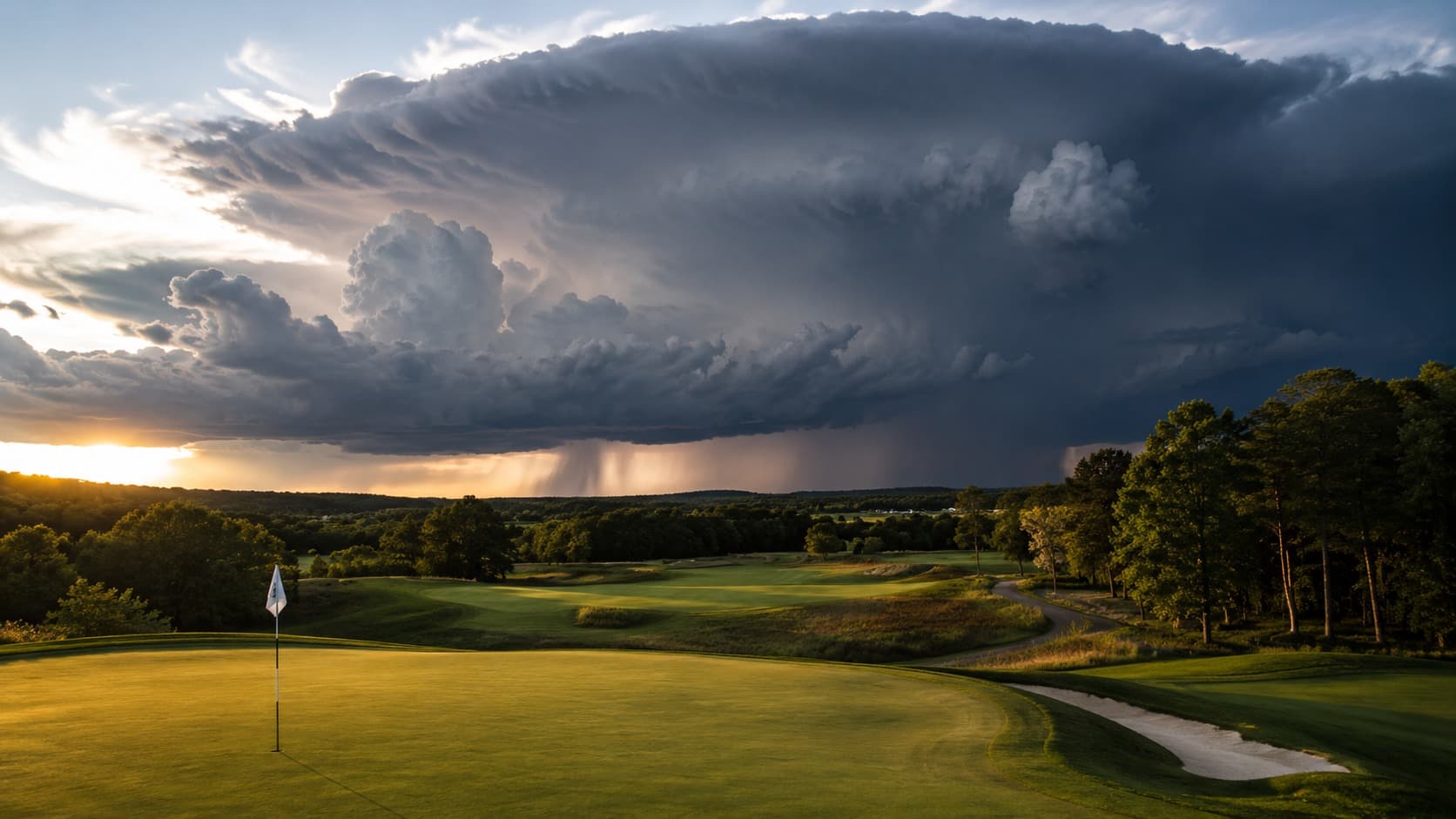
The Three O’Clock Storm: Reading Summer’s Convective Cycle to Protect Your Round
A 40% chance of afternoon thunderstorms does not mean a 40% chance of getting rained on. In the summer convective season it means the morning is nearly clear and the afternoon carries a fast-building, high-energy storm risk driven by a daily heating cycle. Here is the meteorology behind the pattern, the G-Score data on how the storm cycle punishes afternoon tee times across the Southeast, Midwest, and desert Southwest, the lightning-safety decision tree that actually matters, and the workflow that gets you off the course before the first bolt.
Read Story
The May 2026 G-Score Heatmap: Where American Golf Peaks This Spring
May is the most underrated month on the American golf calendar. Five regions hit their annual peak this spring, three turn quietly hostile, and the data tells a clearer story than the brochures. Here is where to play, where to avoid, and how to time your booking window.
Read StoryMinSu Kim
Founder & Golf Data Analyst
MinSu is a data analyst and golfer with 10+ years on the course. He built Golf Weather Score to answer one question: is today a good day to play? He combines weather data, course intelligence, and the proprietary G-Score algorithm to help golfers make smarter decisions.
Every Friday Morning
When Abilene Country Club North Course plays best next weekend.
Friday 6am ET: peak G-Score windows for Abilene Country Club North Course, wind direction by hour, and one gear call. Three minutes to read, save you the round.
One email a week. Unsubscribe in one click.
The Caddie's Oracle
Draw your luck before the tee off