
Caddie's Gear Advisor
Curated for today's 96°F · Clear
Low-Spin Wind-Cheating Balls
Penetrating ball flight that holds its line in the gusts
Wind-Blocking Layers
Cut the chill and drag without choking your swing
Low-Launch Drivers
Lower spin off the tee for control in a crosswind
Secure-Fit Caps
Stay-put headwear built for a blustery round
Your Golf Trip, Handled
The Ultimate Golf Trip Planner
Everything you need to play Big Lake Country Club — from booking your flight to checking in course-side.
Course-Side Stays
Luxury hotels, resorts, and stay-and-play packages just minutes from the first tee.
Flights
Compare fares across 700+ airlines for the best route to your tee time.
SUV Rentals for Golf Bags
Spacious vehicles with room for clubs, bags, and your foursome.
Travel Insurance
Coverage for medical, weather delays, and gear at your destination.
Big Lake Country Club: Course Intelligence
Signature Setup
Honesty first: everything below comes from the scorecard math, the regional climate record, and Permian Basin weather data — I have not walked Big Lake Country Club, and I'd rather say so than fake a memory of a course I haven't played. What the record does give me is a clear frame. The club sits in Big Lake, Texas, the seat of Reagan County, out in the dry oil country southwest of San Angelo at roughly 2,650 feet of elevation. It's a 9-hole, semi-private community layout — the kind of course built to serve a small West Texas town, not to host a tour event. That matters for how you read it: the yardage on a 9-hole card is never what beats you here. The high-plains wind and the firm, baked turf are.
TL;DR: A 9-hole community course in Big Lake, Reagan County, West Texas, sitting near 2,650 ft in the semi-arid Permian Basin. The scorecard is short; the defense is wind and firmness. No coast means no sea breeze — the wind is driven by fronts and the daily afternoon ramp. Favor placement, club up into the gust, and play your round before the wind peaks.
Hole-by-Hole Wind & Playing Lines
Big Lake doesn't publish a per-hole stroke index I can verify, so rather than invent hole numbers I'll lay out how the West Texas wind rewrites a card this size:
- Two-shot holes into a spring SW wind: at 20–25 mph out of the southwest — routine on an April or May afternoon — a flushed 150-yard shot lands like a 175. The penalty for a high ball is severe; the answer is two extra clubs and a flighted knock-down, not a hero carry over the gust.
- Holes running downwind on a post-front NW flow: behind a passing dry line the northwesterly shrinks the property. Firm bermuda fairways start chasing hard, so land short and let the bounce feed forward instead of spinning a high wedge that skids off a baked green.
- Crossing holes: with almost no timber to break it, the wind hits flush from the side. A player who can hold a fade or draw into a quartering breeze will beat a longer hitter who only flies it straight and tall.
The portable lesson: on the first open hole, decide whether you're fighting a frontal wind or the daily thermal ramp, and let that set your club selection for the rest of the loop.
Green & Fairway Characteristics
The turf here is built for heat — bermuda fairways and bermuda greens that handle the semi-arid West Texas summer where bentgrass would struggle. Under roughly 16 inches of annual rainfall, the ground runs firm and fast most of the season, so your stock carry numbers only hold up in the rare windless, recently-watered window. The greens on a 9-hole community card tend to be honest rather than tricked-up; the difficulty is exposure and firmness, not severe contour. From a short layout the card flatters a straight driver on a calm day — but calm days in the Basin are the exception, and a baked surface punishes the high spinning wedge that a softer northern course rewards.
Seasonal Weather Pattern
Big Lake lives in a true semi-arid continental climate with no ocean anywhere near to soften the edges. Spring (Mar–May) is the windiest stretch of the year on the high plains — sustained 20–25 mph SW winds, blowing dust, and big day-to-day temperature swings make it the hardest scoring season. Summer (Jun–Aug) is hot and dry, highs frequently in the upper-90s°F, with firm fast turf and occasional afternoon thunderstorms riding the dry line. Fall (Sep–Oct) is the sweet spot — cooler mornings, lighter wind, and the most pleasant golf of the year. Winter is short and mostly playable but can swing cold fast behind a blue norther; for that gap I lean on NOAA West Texas historicals rather than firsthand knowledge.
Local Play Tips
The instinct a coastal golfer carries that fails out here: you cannot outrun a sea breeze, because there isn't one. Big Lake's wind isn't a daily land-sea thermal — it's synoptic plus a strong diurnal ramp. The practical read is that mornings are reliably calmer than afternoons, and the gap widens through spring. A 7 a.m. tee time in April can give you near-still air while the same course at 3 p.m. is throwing 25 mph gusts on you from the first swing. So the question that decides your scorecard isn't morning versus tide, it's how early you can play before the afternoon wind ramps — and whether a dry-line front is sitting on top of that ramp. Read the systems and the clock together, and you'll score better than a player who books the convenient afternoon slot.
Pre-Round Weather Workflow
Use golfweatherscore's 7-day G-Score and windExposure as your decision tools — but interpret them for a high-plains layout:
- Three days out: look at the G-Score curve for where the fronts and dry lines land. Out here a 9 dropping to a 4 almost always means a weather system or a wind event arriving, not a quiet change in conditions.
- The evening before: pin down wind direction and speed and pick your tee time accordingly. A SW spring flow signals warm, dusty, gusty golf; a NW flow behind a front means firm, dry, fast turf where the downwind holes get short.
- Round morning: if windExposure shows sustained gusts past ~20 mph — routine here through spring afternoons — accept that even a short 9-hole card will play a club or two longer into the breeze, and let smart placement, not aggression, carry your score.
Related Reading
Before you tee off at Big Lake Country Club
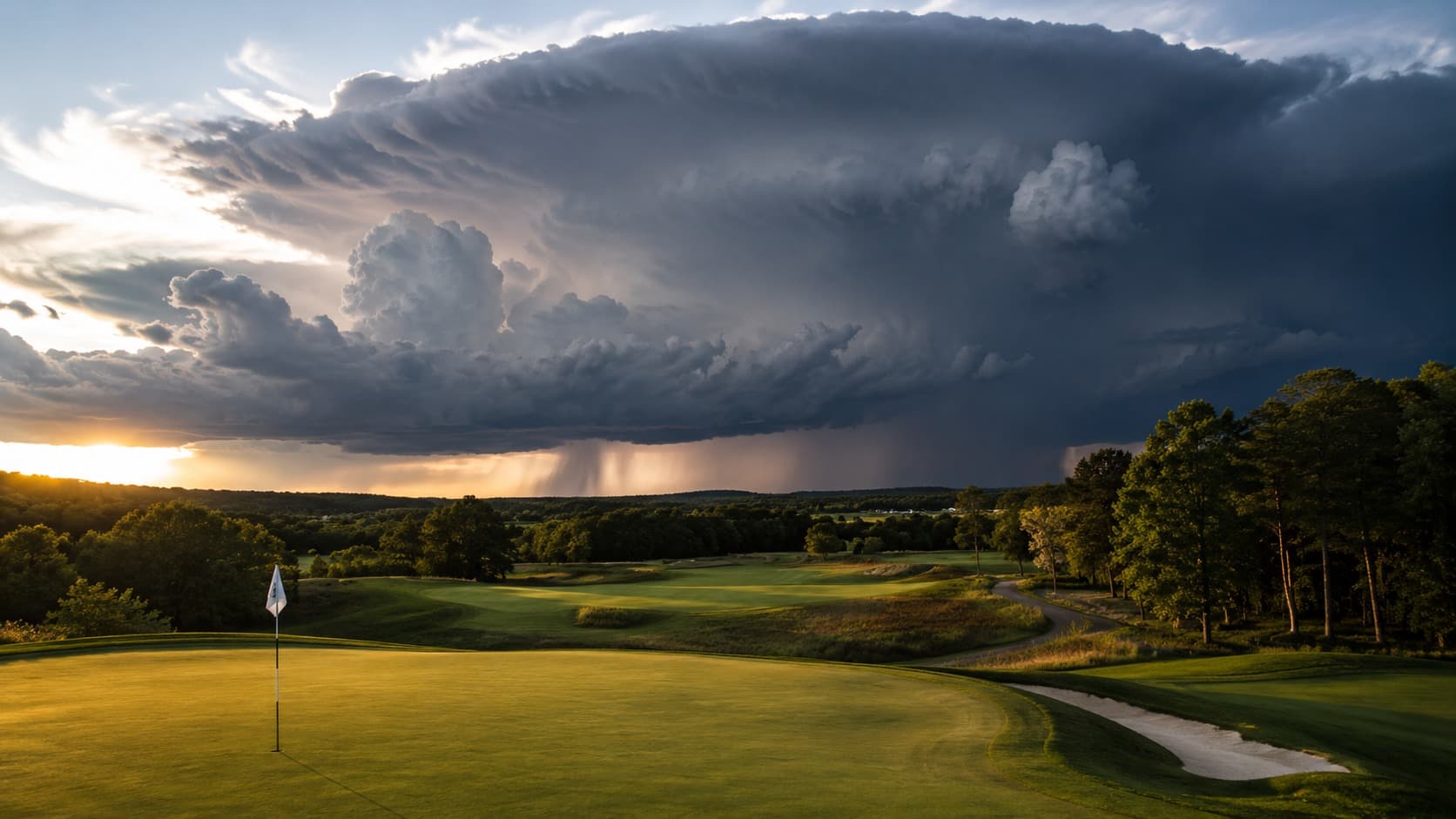
The Three O’Clock Storm: Reading Summer’s Convective Cycle to Protect Your Round
A 40% chance of afternoon thunderstorms does not mean a 40% chance of getting rained on. In the summer convective season it means the morning is nearly clear and the afternoon carries a fast-building, high-energy storm risk driven by a daily heating cycle. Here is the meteorology behind the pattern, the G-Score data on how the storm cycle punishes afternoon tee times across the Southeast, Midwest, and desert Southwest, the lightning-safety decision tree that actually matters, and the workflow that gets you off the course before the first bolt.
Read Story
The May 2026 G-Score Heatmap: Where American Golf Peaks This Spring
May is the most underrated month on the American golf calendar. Five regions hit their annual peak this spring, three turn quietly hostile, and the data tells a clearer story than the brochures. Here is where to play, where to avoid, and how to time your booking window.
Read StoryMinSu Kim
Founder & Golf Data Analyst
MinSu is a data analyst and golfer with 10+ years on the course. He built Golf Weather Score to answer one question: is today a good day to play? He combines weather data, course intelligence, and the proprietary G-Score algorithm to help golfers make smarter decisions.
Every Friday Morning
When Big Lake Country Club plays best next weekend.
Friday 6am ET: peak G-Score windows for Big Lake Country Club, wind direction by hour, and one gear call. Three minutes to read, save you the round.
One email a week. Unsubscribe in one click.
The Caddie's Oracle
Draw your luck before the tee off