
Caddie's Gear Advisor
Curated for today's 79°F · Clear
Tour-Level Drivers
Engineered for maximum distance and forgiveness
Laser Rangefinders
Pin-seeking technology for precision approaches
Premium Golf Balls
Tour-caliber spin and distance performance
Performance Sunglasses
Polarized lenses optimized for reading greens
Your Golf Trip, Handled
The Ultimate Golf Trip Planner
Everything you need to play Aguila Golf Course — from booking your flight to checking in course-side.
Best time to golf in ArizonaCourse-Side Stays
Luxury hotels, resorts, and stay-and-play packages just minutes from the first tee.
Flights
Compare fares across 700+ airlines for the best route to your tee time.
SUV Rentals for Golf Bags
Spacious vehicles with room for clubs, bags, and your foursome.
Travel Insurance
Coverage for medical, weather delays, and gear at your destination.
Aguila Golf Course: Course Intelligence
Signature Setup
Aguila gives you South Mountain as a backdrop on almost every tee, and on a March morning — 54°F at 7:40 a.m., a thin haze still over the valley — the bunkers throw long shadows that make the carries look meaner than they are. The name is Spanish for "eagle," and the course earns the optimism: it is wide, generous off the tee, and built to let a public golfer make a number. Gary Panks designed it and it opened in 1999 as a City of Phoenix municipal facility in Laveen, on the southwest edge of the metro, at the base of the South Mountain foothills. The championship 18 measures roughly 7,232 yards, par 72, with a slope around 128 from the tips — a fair, honest number. There is also a lighted nine-hole executive course and a full range on site, which makes it a working man's golf complex rather than a resort showpiece.
Hole-by-Hole Wind & Playing Lines
Aguila sits in the open Salt River Valley, so the dominant force is the afternoon thermal — out of the west to southwest on most clear days, strongest from spring through early summer.
- 4th (par 4, 455y, #1 handicap): Into the WSW afternoon wind this stretches past 480. I favor the right-center off the tee to open the angle, then take one extra club. The green sheds long, so aim for the fat front-left rather than flying the deep greenside bunker.
- 9th (par 4, 430y): A left-to-right hole that quarters into a W wind. Hold the left side off the tee; the right rough leaves a blind, downwind approach that is hard to stop.
- 18th (par 5, 555y): The closing hole runs along the foothills and plays straight into the WSW thermal late in the round. Reachable in calm morning air, but by 2 p.m. I lay back to a full 100-yard wedge instead of forcing a long second over the front bunkering.
Green & Fairway Characteristics
The fairways are Tifway 419 Bermuda, overseeded with perennial ryegrass from roughly October through May, which keeps them green and a touch softer through the cool season; on summer Bermuda they run firm and fast, and a drive can pick up 15–20 yards of release on the flatter front nine. The greens are mid-sized with gentle contour rather than wild tiers — medium-fast when freshly overseeded, slowing through the heat of the day as they dry. Grain follows the late-day sun, so afternoon putts break a little harder than the slope suggests. The routing is broad and desert-parkland in feel: open landing areas, scattered fairway bunkering, and only a few forced carries. Slope 128 from the back tees tells the truth — the trouble sits in front of you, not hidden.
Seasonal Weather Pattern
Phoenix golf splits hard by season. From October through April, mornings are cool and calm, often 48–62°F at first light, climbing into the comfortable 70s by midday — this is the prime window, and the overseed keeps the course in its best shape. May through September is desert summer: dawn temperatures already in the 80s, daytime highs routinely 105–115°F, and the North American monsoon building dust and convective storms in July and August. The danger in summer is heat, not rain — afternoon rounds become a hydration problem more than a scoring one. I have played Aguila only in the cool-season months, so I describe the summer monsoon timing from NOAA Phoenix climate records rather than from my own scorecard.
Local Play Tips
The detail that does not show up online: Aguila's wind exposure is uneven because of South Mountain to the east. The early holes near the foothills can feel sheltered while the open stretch from the 4th onward catches the full valley thermal an hour later. Do not judge the day's wind from the first tee. And because this is a high-volume municipal track, the overseed transition weeks — typically mid-October and again in spring — can leave fairways patchy; if you are traveling in for a round, call the pro shop and ask where they are in the transition before you commit.
Pre-Round Weather Workflow
Pull the 7-day G-Score for Aguila the night before and again at dawn. Watch two things: wind direction and, in summer, the afternoon heat index. If the forecast shows a W or WSW wind above 12 mph, plan to be through the exposed 4th, 9th, and 18th before midday and add a club on every approach into the breeze. From May to September treat any tee time after 9 a.m. as a heat-management round — the windExposure flag matters less than the temperature here. On a cool spring or fall morning, the early calm is your scoring window; use it before the valley thermal sets up firm and lengthens the closing stretch along the foothills.
Related Reading
Before you tee off at Aguila Golf Course
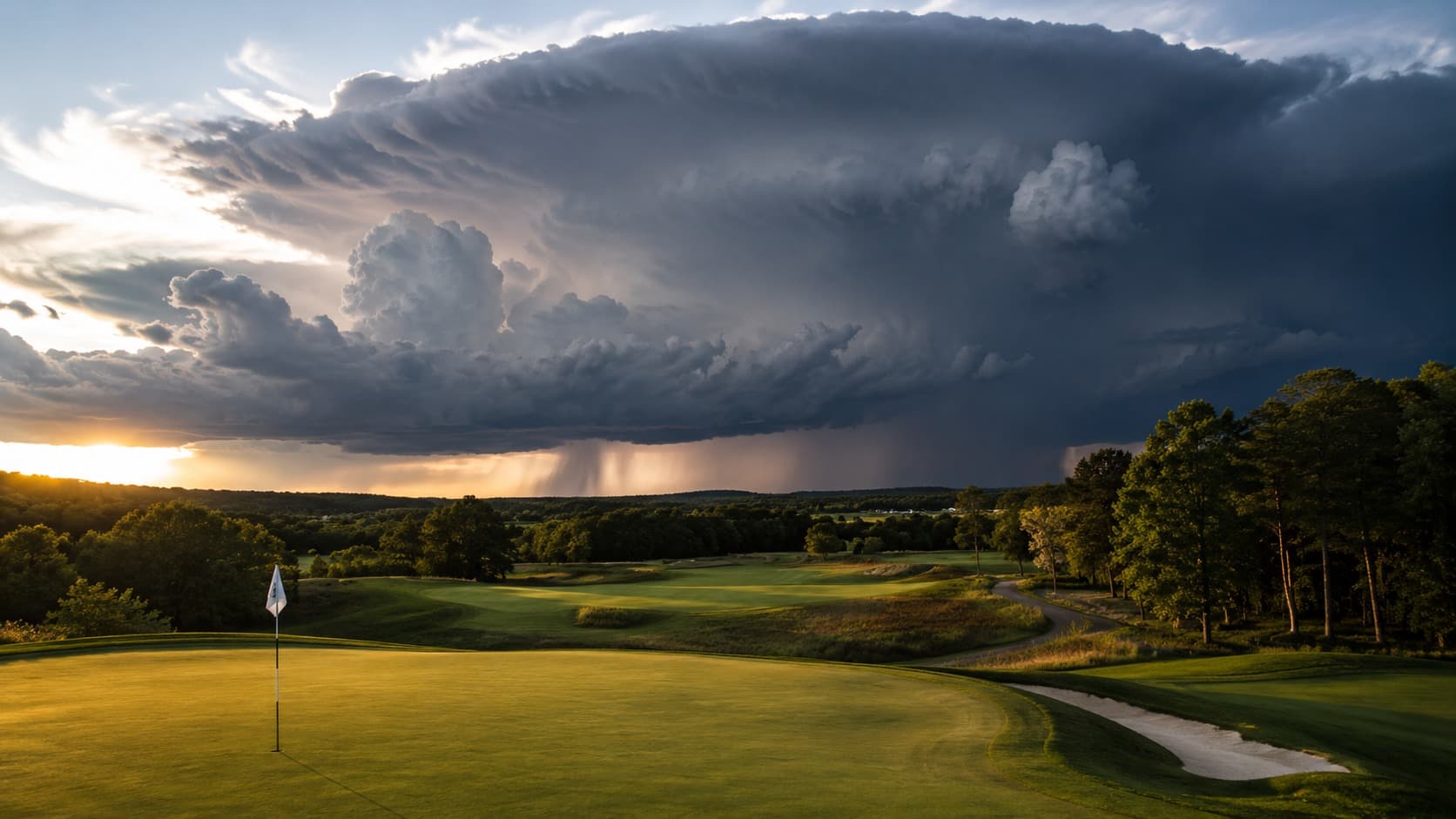
The Three O’Clock Storm: Reading Summer’s Convective Cycle to Protect Your Round
A 40% chance of afternoon thunderstorms does not mean a 40% chance of getting rained on. In the summer convective season it means the morning is nearly clear and the afternoon carries a fast-building, high-energy storm risk driven by a daily heating cycle. Here is the meteorology behind the pattern, the G-Score data on how the storm cycle punishes afternoon tee times across the Southeast, Midwest, and desert Southwest, the lightning-safety decision tree that actually matters, and the workflow that gets you off the course before the first bolt.
Read Story
How to Read a G-Score: The 0–100 Golf Playability Number, Decoded
A G-Score on this site is a single 0–100 number that tells you whether today is worth tee-up. Here is exactly what each band means, what drives the calculation, and how to use it to plan a round you will actually score on.
Read StoryDanorie
Editorial & Data
Golf Weather Score is built by Danorie. We compute the G-Score — our own playability rating — from NOAA forecasts and published course scorecards, so any US course can be compared on any day with a single number. Methodology and data sources are documented on every page.
Every Friday Morning
When Aguila Golf Course plays best next weekend.
Friday 6am ET: peak G-Score windows for Aguila Golf Course, wind direction by hour, and one gear call. Three minutes to read, save you the round.
One email a week. Unsubscribe in one click.
The Caddie's Oracle
Draw your luck before the tee off