
Caddie's Gear Advisor
Curated for today's 77°F · Clear
Tour-Level Drivers
Engineered for maximum distance and forgiveness
Laser Rangefinders
Pin-seeking technology for precision approaches
Premium Golf Balls
Tour-caliber spin and distance performance
Performance Sunglasses
Polarized lenses optimized for reading greens
Your Golf Trip, Handled
The Ultimate Golf Trip Planner
Everything you need to play Ajo Country Club and Golf Course — from booking your flight to checking in course-side.
Best time to golf in ArizonaCourse-Side Stays
Luxury hotels, resorts, and stay-and-play packages just minutes from the first tee.
Flights
Compare fares across 700+ airlines for the best route to your tee time.
SUV Rentals for Golf Bags
Spacious vehicles with room for clubs, bags, and your foursome.
Travel Insurance
Coverage for medical, weather delays, and gear at your destination.
Ajo Country Club and Golf Course: Course Intelligence
Signature Setup
Ajo Country Club sits in the old Phelps Dodge copper-mining town of Ajo, Arizona, about 40 miles north of the Mexican border in the low Sonoran Desert (~1,750 ft elevation). It is a 9-hole desert course built for the mining community in the early company-town era — the exact designer of record I have not been able to verify, so I treat the opening date as approximate (1920s) rather than claim a named architect. What is not in doubt is the setting: open desert, scattered mesquite and palo verde, and the kind of hard, sun-baked ground that defines low-desert golf. This is not a manicured resort track. It is a community course where the weather, not the design, is the primary opponent.
Hole-by-Hole Wind & Playing Lines
The prevailing wind here runs out of the southwest, building through the afternoon as the desert floor heats. On a 9-hole layout the same exposures repeat, so wind reading matters more than memorizing holes.
- The long par-4 (~410y): In the morning calm it can play a half-club shorter than the card because firm Bermuda gives you 15–25 yards of run-out. By afternoon, into the SW breeze, that same hole stretches and the run-out works against you near the green.
- The par-3 over the wash (~165y): Directly into the afternoon SW wind this can climb to a 185-yard club. I'd take the extra club and aim for the fat of the green rather than flirt with the desert short.
- A shorter par-4 doglegging with the wind: Downwind in the afternoon, a driver can run through the corner into the native scrub — a 3-wood or long iron off the tee keeps you in play.
Green & Fairway Characteristics
Fairways are Bermuda, typically overseeded with ryegrass for winter play, which is when the course is most playable. Greens are small and firm — in dry heat they get fast and release very little on approach, so a high, soft wedge holds better than a running shot into them. I'd estimate slope in the mid-120s for a course of this length and openness, though I'd confirm against the posted scorecard before betting on it. The defining characteristic is firmness: low desert ground in April–June bakes hard, and the difference between a 7-iron and an 8-iron is often whether the ball checks or bounds over.
Seasonal Weather Pattern
This is where Ajo separates itself from most US courses. The low Sonoran Desert is one of the hottest inhabited places in the country. Summer highs (June–August) routinely exceed 105°F, with stretches above 110°F — genuinely dangerous for an unshaded walking round by midday. The playable window is roughly October through April, when daytime highs sit in the comfortable 65–80°F range and mornings can start near 45–55°F in midwinter. Rainfall is minimal (the region averages well under 10 inches annually), split between gentle winter rains and the July–September monsoon, when isolated afternoon thunderstorms and dust can shut play down with little warning. Unlike a coastal or transition-zone course, here the enemy is heat and sun load, not moisture.
Local Play Tips
Two things the search results won't tell you. First: this is a 9-hole desert community course, so verify current operating hours and seasonal status directly before driving out — small-town desert courses adjust hours or close midday in summer. Second: water and sun protection are not optional gear here, they are scoring equipment. In the low desert, dehydration degrades your decision-making by the back nine before you feel it; carrying more water than you think you need is, practically, a way to protect your score over the closing holes.
Pre-Round Weather Workflow
Use the 7-day G-Score and windExposure read like this for Ajo:
- Pick your tee time off temperature, not convenience. Oct–Apr, target a tee time before 9 a.m. Afternoon heat plus the building SW breeze typically costs 6–10 G-Score points versus an early start.
- Check windExposure for the SW prevailing. If the afternoon forecast shows a strengthening SW wind, club up one on the over-the-wash par-3 and on any approach playing into it.
- Watch the monsoon window (Jul–Sep). Scan for afternoon thunderstorm probability; desert storms arrive fast and bring dust and lightning. Finish early or reschedule.
- Account for firmness after dry stretches. Several rainless days in spring mean fast greens and long fairway run — plan to land approaches short of the flag and let the ground feed them on.
Related Reading
Before you tee off at Ajo Country Club and Golf Course
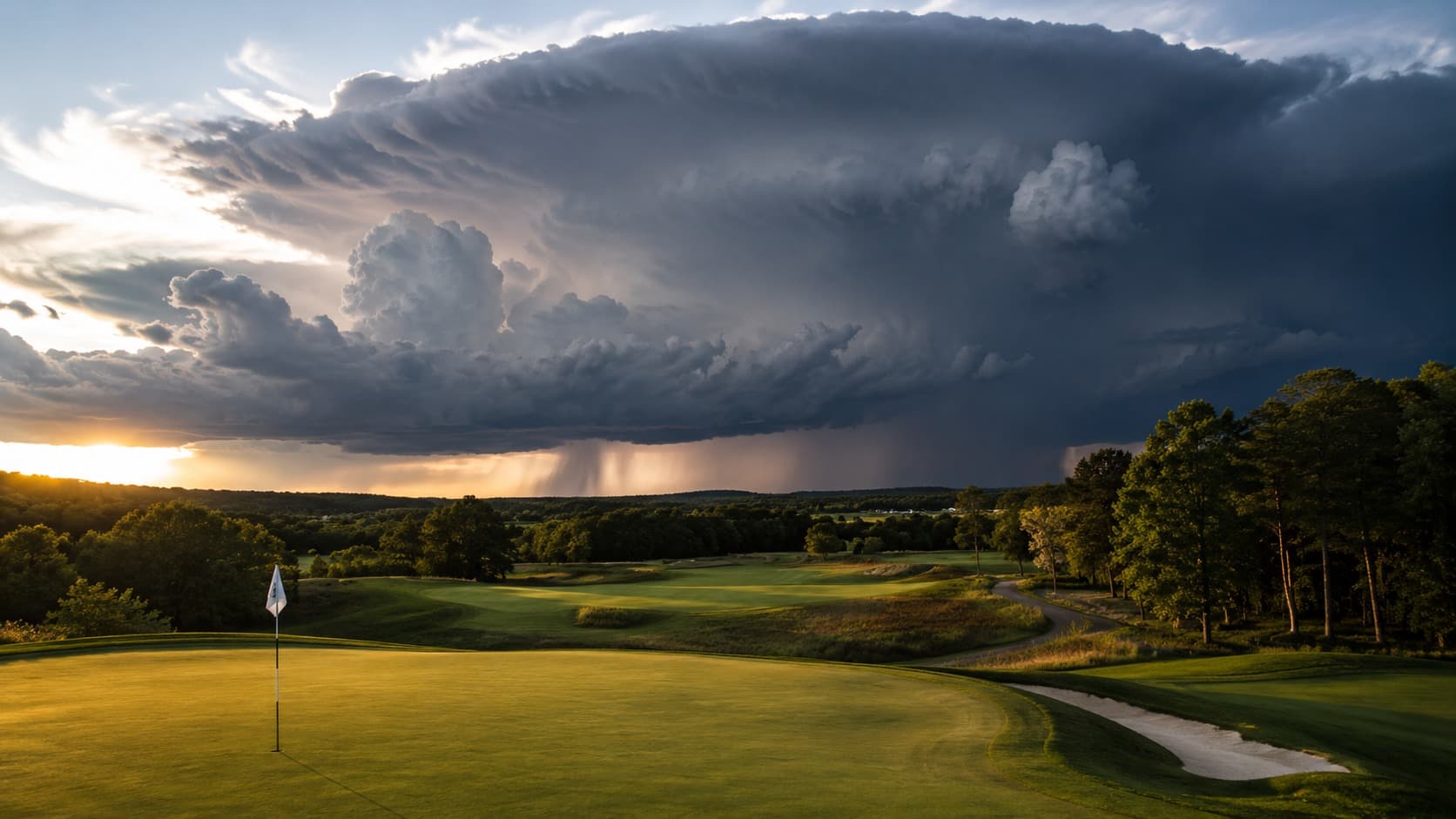
The Three O’Clock Storm: Reading Summer’s Convective Cycle to Protect Your Round
A 40% chance of afternoon thunderstorms does not mean a 40% chance of getting rained on. In the summer convective season it means the morning is nearly clear and the afternoon carries a fast-building, high-energy storm risk driven by a daily heating cycle. Here is the meteorology behind the pattern, the G-Score data on how the storm cycle punishes afternoon tee times across the Southeast, Midwest, and desert Southwest, the lightning-safety decision tree that actually matters, and the workflow that gets you off the course before the first bolt.
Read Story
How to Read a G-Score: The 0–100 Golf Playability Number, Decoded
A G-Score on this site is a single 0–100 number that tells you whether today is worth tee-up. Here is exactly what each band means, what drives the calculation, and how to use it to plan a round you will actually score on.
Read StoryDanorie
Editorial & Data
Golf Weather Score is built by Danorie. We compute the G-Score — our own playability rating — from live NOAA forecasts and published course scorecards, so any US course can be compared on any day with a single number. Methodology and data sources are documented on every page.
Every Friday Morning
When Ajo Country Club and Golf Course plays best next weekend.
Friday 6am ET: peak G-Score windows for Ajo Country Club and Golf Course, wind direction by hour, and one gear call. Three minutes to read, save you the round.
One email a week. Unsubscribe in one click.
The Caddie's Oracle
Draw your luck before the tee off