
Caddie's Gear Advisor
Curated for today's 78°F · Clear
Low-Spin Wind-Cheating Balls
Penetrating ball flight that holds its line in the gusts
Wind-Blocking Layers
Cut the chill and drag without choking your swing
Low-Launch Drivers
Lower spin off the tee for control in a crosswind
Secure-Fit Caps
Stay-put headwear built for a blustery round
Your Golf Trip, Handled
The Ultimate Golf Trip Planner
Everything you need to play Alexandria Golf Club — from booking your flight to checking in course-side.
Course-Side Stays
Luxury hotels, resorts, and stay-and-play packages just minutes from the first tee.
Flights
Compare fares across 700+ airlines for the best route to your tee time.
SUV Rentals for Golf Bags
Spacious vehicles with room for clubs, bags, and your foursome.
Travel Insurance
Coverage for medical, weather delays, and gear at your destination.
Alexandria Golf Club: Course Intelligence
Signature Setup
The scorecard reads 6,544 yards, par 72, 71.5 rating and 128 slope — numbers that undersell how much central-Minnesota wind decides your day here. Alexandria Golf Club traces back to 1915, which makes it one of the older tracks in outstate Minnesota, and the routing was later reworked by Gerry Pirkl and Donald G. Brauer into the semi-private parkland layout it is today. I'll be straight with you: I haven't teed it myself, so the hole-level notes below lean on the published card and on the lake golf I do know across central Minnesota — not on a fabricated personal round. What's verifiable is the setting: 45.9°N latitude, roughly 1,400 ft of elevation, and the cluster of lakes that gives Alexandria its "City of Lakes" reputation. That water and that latitude are the two facts that should shape how you play it.
Hole-by-Hole Wind & Playing Lines
I don't have a verified stroke-index card hole by hole, so I won't invent yardages I can't stand behind. What I can give you is the directional logic, which is where most golfers leave shots out here. Central Minnesota's prevailing summer wind runs S to SE; by late September it swings hard NW and gets colder and stiffer. On a semi-private parkland routing at this latitude, the back nine almost always carries more lake exposure than the front. Plan for the #1-handicap par-4 to play into that NW autumn wind: a stock 150-yard approach becomes a 175-yard club, and the smart miss is short and dry, never long over a water-side green. On the SE summer breeze, the same hole gives a stroke back — that's a one-to-two club swing on the same hole depending only on the season you booked.
Green & Fairway Characteristics
This is cool-climate turf — bentgrass and Poa greens, the parkland-Minnesota standard, not the firm paspalum you'd find in the Sun Belt. Expect the greens to hold an approach rather than release it, especially in spring when soils stay soft. At 6,544 yards off the tips it is not a long course by modern standards, so the defense is the 128 slope: tree lines from a century of maturing parkland, plus water in play on the lake-side holes. Fairways through the shoulder season run softer and slower than the yardage suggests; you won't get the 20-yard rollout you'd plan for on a links. Club for carry, not for roll, until midsummer firms things up.
Seasonal Weather Pattern
Alexandria's golf window is short and that's the whole story. Realistic play runs roughly late April through October. May mornings sit in the 40s–50s°F with frost delays still possible; July and August deliver the warm, breezy 75–85°F afternoons the region is known for; by October you're back into 40s°F mornings and that colder NW wind off the lakes. This is meaningfully different from a longer-season band course — you don't get a forgiving winter shoulder here, and the ball flies noticeably shorter on a 48°F spring morning than the same swing does in August. Treat early-season cold-air carry loss as real club selection, not a rounding error.
Local Play Tips
The thing the scorecard won't tell you: at 45.9°N, frost is your scheduling enemy on both ends of the season. Dawn tee times in May and late September are the ones that get pushed for frost delays, so the locally smart move is to book mid-morning in the shoulder months — you trade the calm dawn air for actually getting off on time, and the wind usually hasn't fully built yet. The second tip is lake discipline: on a layout where water sits beside the back-nine greens, the percentage play is the center of the green every time the NW wind is up, because a wind-pushed ball toward a lake-side pin is the round-killer here.
Pre-Round Weather Workflow
Use the 7-day G-Score on this course page as your booking filter, not just a day-of glance. Two reads matter at Alexandria: wind direction and morning low. If the forecast shows a NW wind, weight your warm-up toward the longer irons you'll need into the back nine, and add a club to every lake-side approach. If the morning low is near or below 40°F — common in May and October — plan for shortened carry and pick a mid-morning slot to clear frost risk. Check the windExposure indicator before you commit: a calm S/SE summer morning is the version of this course where the 6,544-yard card actually plays its number; a stiff NW autumn afternoon is a different, harder golf course entirely.
---
Sources: Alexandria Golf Club official site, Minnesota PGA course profile, GolfLink course overview.
Related Reading
Before you tee off at Alexandria Golf Club

Best Golf Weather by State: Ranking America by Average G-Score
We ranked all 50 US states by average G-Score golf playability. California tops the list, but the results beyond the top five may surprise you.
Read Story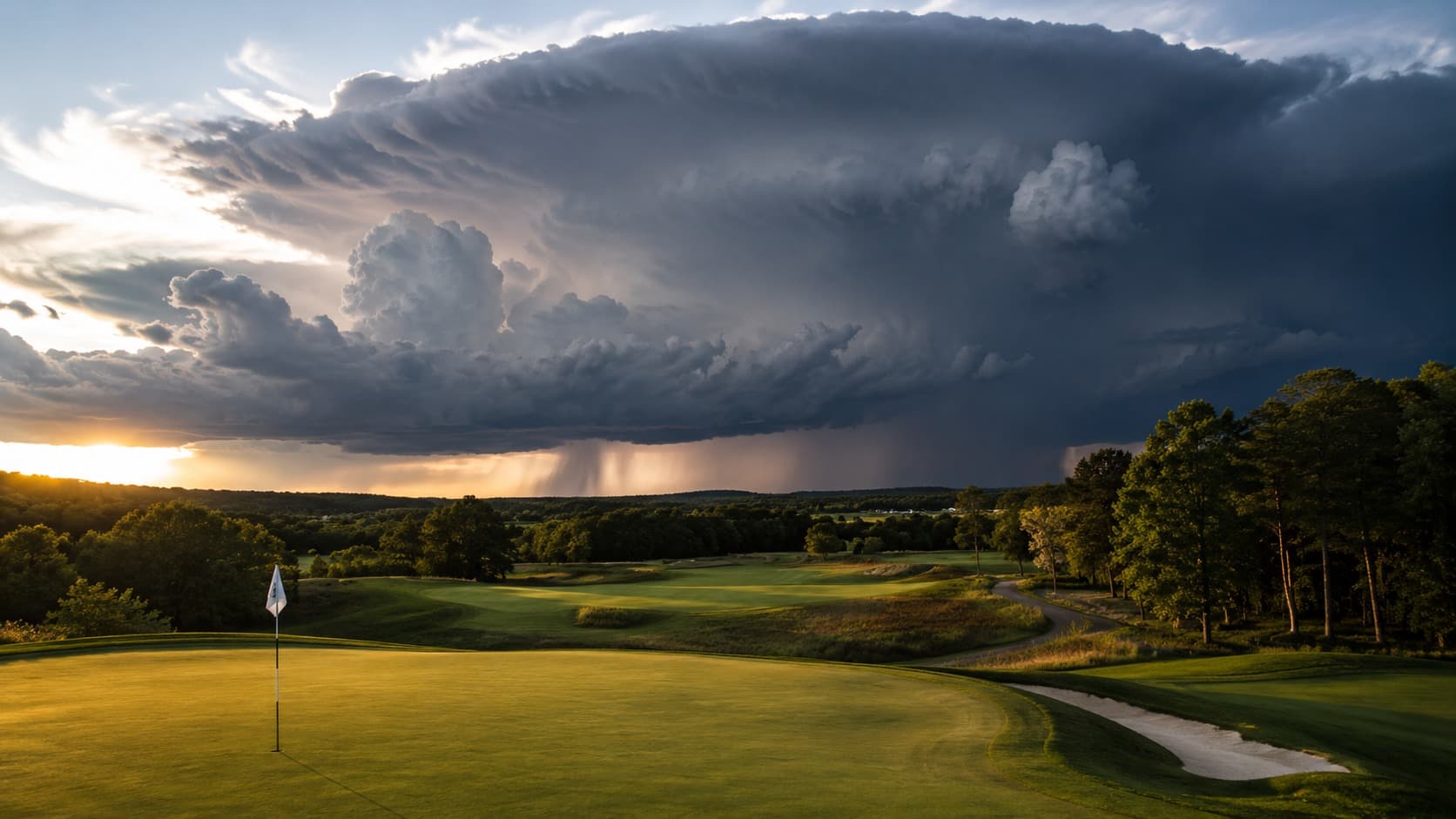
The Three O’Clock Storm: Reading Summer’s Convective Cycle to Protect Your Round
A 40% chance of afternoon thunderstorms does not mean a 40% chance of getting rained on. In the summer convective season it means the morning is nearly clear and the afternoon carries a fast-building, high-energy storm risk driven by a daily heating cycle. Here is the meteorology behind the pattern, the G-Score data on how the storm cycle punishes afternoon tee times across the Southeast, Midwest, and desert Southwest, the lightning-safety decision tree that actually matters, and the workflow that gets you off the course before the first bolt.
Read StoryMinSu Kim
Founder & Golf Data Analyst
MinSu is a data analyst and golfer with 10+ years on the course. He built Golf Weather Score to answer one question: is today a good day to play? He combines weather data, course intelligence, and the proprietary G-Score algorithm to help golfers make smarter decisions.
Every Friday Morning
When Alexandria Golf Club plays best next weekend.
Friday 6am ET: peak G-Score windows for Alexandria Golf Club, wind direction by hour, and one gear call. Three minutes to read, save you the round.
One email a week. Unsubscribe in one click.
The Caddie's Oracle
Draw your luck before the tee off