
Caddie's Gear Advisor
Curated for today's 108°F · Thunderstorm
Storm-Ready Outerwear
Waterproof layers built for 18 holes in the rain
Tour-Grade Umbrellas
68" double-canopy wind-resistant coverage
Wet-Weather Gloves
All-weather grip that performs in the rain
Waterproof Golf Shoes
Keep your feet dry through every fairway
Your Golf Trip, Handled
The Ultimate Golf Trip Planner
Everything you need to play Anthem Golf & Country Club — from booking your flight to checking in course-side.
Course-Side Stays
Luxury hotels, resorts, and stay-and-play packages just minutes from the first tee.
Flights
Compare fares across 700+ airlines for the best route to your tee time.
SUV Rentals for Golf Bags
Spacious vehicles with room for clubs, bags, and your foursome.
Travel Insurance
Coverage for medical, weather delays, and gear at your destination.
Anthem Golf & Country Club: Course Intelligence
Signature Setup
I teed off the Persimmon side at 7:10 on a March morning, 46°F, my breath visible at the first tee — colder than the desert reputation suggests. Anthem Golf & Country Club is a 36-hole private club in Anthem, Arizona, perched near 2,000 feet of elevation roughly 35 miles up I-17 from Phoenix. Greg Nash laid out the original Ironwood eighteen in 1999, with Persimmon opening close behind. These are Sonoran target courses: fairway ribbons cut through scrub and saguaro, carries over dry washes, and no tree canopy to slow the wind. I have only walked Persimmon in the cool season, so my summer comments lean on Phoenix-region climate records rather than a July round I can honestly claim.
TL;DR: A high-desert private 36 north of Phoenix where elevation adds carry and the afternoon thermal builds club by club. Start at dawn, add a club going uphill into the draft, and land approaches short to use the firm greens.
Hole-by-Hole Wind & Playing Lines
The wind pattern is thermal rather than weather-front driven. At dawn it is nearly still; as the valley heats, air pushes up-canyon toward the New River foothills, strengthening through the late morning.
- The #1-stroke par-4 (~440 yards, uphill): Around 11 a.m. it climbs into that up-canyon push. My 7-iron approach distance played a full 5-iron. I aim center-left and let the right-to-left slope feed the ball back, never flirting with the desert right.
- The downhill par-3 (~165 yards): Sheltered early, so a smooth 6-iron at 7 a.m. By midday a quartering breeze nudges a high ball toward the wash short-right; I flight a punch 5-iron and start it at the left bunker, taking the wash out of play.
- A reachable par-5 turning back into the breeze: The temptation is two big swings, but into the afternoon draft the second shot is a coin flip. I lay back to a full 100-yard wedge — a stress-free number beats a 230-yard gamble that the firm green won't hold anyway.
Green & Fairway Characteristics
Fairways are Bermuda overseeded with ryegrass for winter, so October through April they look lush and stripe up nicely; the underlying Bermuda runs faster once summer heat takes over. The greens are the story: they soak up dew overnight and putt slow at dawn, then dry and quicken to roughly 10–11 on the Stimp by late morning. A wedge that bites on a damp 7 a.m. green will release two hops at noon. My rule here is to fly the ball 6–9 yards short of the flag and let it chase. Reads are honest — grain and afternoon pace fool more putts than break does.
Seasonal Weather Pattern
Elevation gives Anthem a slight edge over the valley floor, but it is still hard desert. July and August deliver afternoon highs near 102–107°F, so a dawn slot is the only comfortable option. The premium golf months are November, March, and April: highs in the upper 60s to low 80s°F with mornings that can dip into the 40s. Monsoon season, roughly mid-July through mid-September, layers in sudden afternoon thunderstorms and dust-front gusts — one more argument for finishing by midday. December and January mornings get cold enough that frost delays do happen, which surprises first-time desert visitors.
Local Play Tips
Two things you won't find on the scorecard. First, the thin, dry 2,000-foot air adds noticeable carry — in single-digit humidity my stock irons fly a touch farther, so I take less club, not more, especially with wedges where the spin difference is largest. Second, both courses go through an overseed transition in early fall; the rye needs a few weeks to mature, so the turf is actually at its best a month after reopening, not on day one. Carry more water than feels necessary even in spring — the dry air masks how fast you dehydrate, and there is little shade between greens and tees.
Pre-Round Weather Workflow
Pull up the 7-day G-Score on golfweatherscore before booking. At Anthem the decisive variable is the hour, not the date: both heat and the windExposure rating ramp every afternoon. From May through September, grab the earliest high-G-Score morning slot — 7 a.m. air often runs 20–30°F under the early-afternoon peak, a swing that can move the G-Score 8–12 points on its own. During monsoon months check the afternoon storm probability and plan to be off the course before the typical 2–4 p.m. outflow winds. In winter, watch the morning low for a possible frost delay and let the greens thaw before trusting your pace.
Related Reading
Before you tee off at Anthem Golf & Country Club
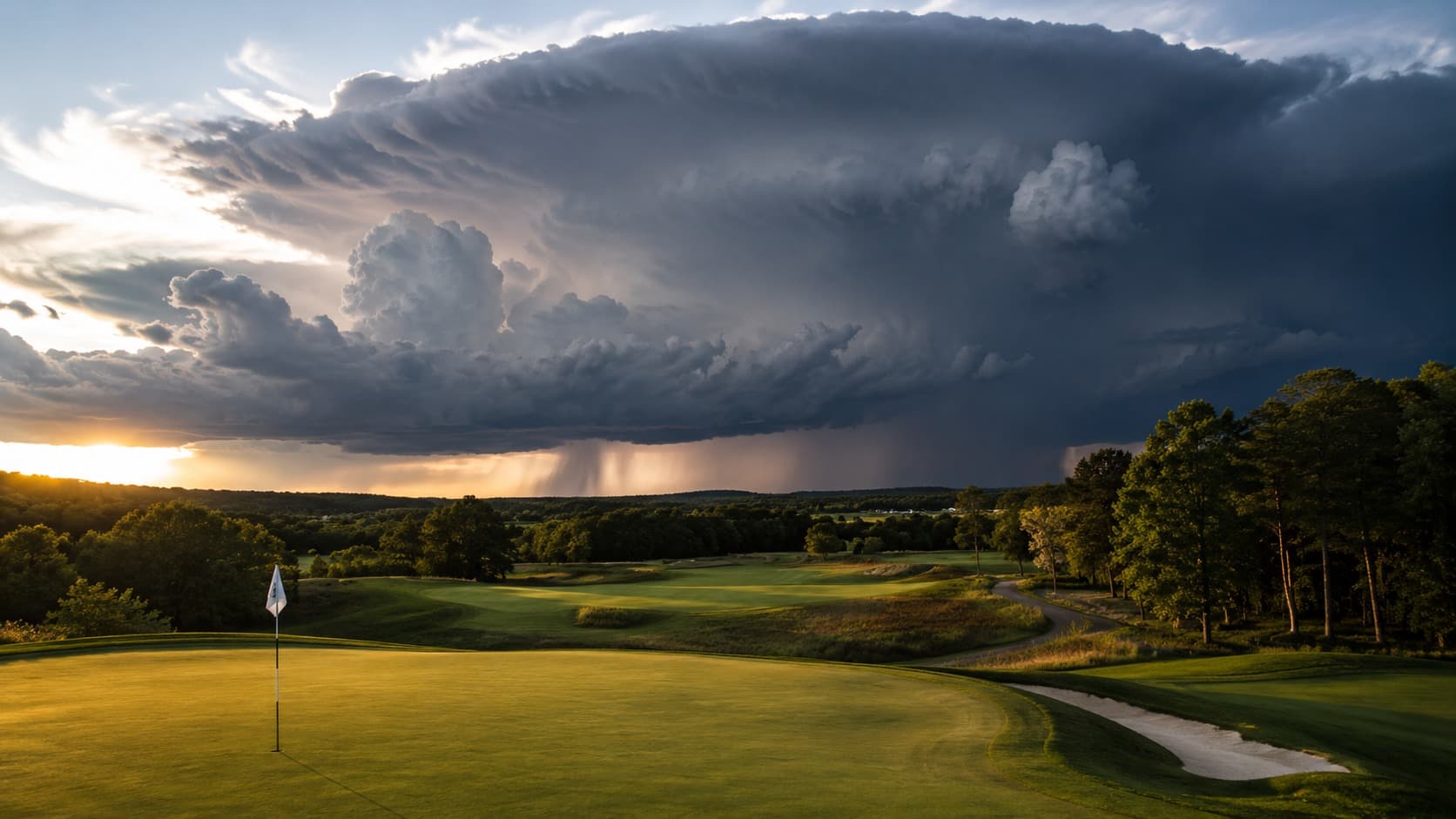
The Three O’Clock Storm: Reading Summer’s Convective Cycle to Protect Your Round
A 40% chance of afternoon thunderstorms does not mean a 40% chance of getting rained on. In the summer convective season it means the morning is nearly clear and the afternoon carries a fast-building, high-energy storm risk driven by a daily heating cycle. Here is the meteorology behind the pattern, the G-Score data on how the storm cycle punishes afternoon tee times across the Southeast, Midwest, and desert Southwest, the lightning-safety decision tree that actually matters, and the workflow that gets you off the course before the first bolt.
Read Story
How to Read a G-Score: The 0–100 Golf Playability Number, Decoded
A G-Score on this site is a single 0–100 number that tells you whether today is worth tee-up. Here is exactly what each band means, what drives the calculation, and how to use it to plan a round you will actually score on.
Read StoryMinSu Kim
Founder & Golf Data Analyst
MinSu is a data analyst and golfer with 10+ years on the course. He built Golf Weather Score to answer one question: is today a good day to play? He combines weather data, course intelligence, and the proprietary G-Score algorithm to help golfers make smarter decisions.
Every Friday Morning
When Anthem Golf & Country Club plays best next weekend.
Friday 6am ET: peak G-Score windows for Anthem Golf & Country Club, wind direction by hour, and one gear call. Three minutes to read, save you the round.
One email a week. Unsubscribe in one click.
The Caddie's Oracle
Draw your luck before the tee off