
Caddie's Gear Advisor
Curated for today's 88°F · Clear
Ultralight Distance Drivers
Maximum carry in hot, low-drag conditions
UV Protection Apparel
UPF 50+ cooling fabrics for peak-sun rounds
Precision Rangefinders
Slope-adjusted yardage in any condition
Hydration & Cooling
Insulated bottles and cooling towels
Your Golf Trip, Handled
The Ultimate Golf Trip Planner
Everything you need to play Apache Wells Golf Club — from booking your flight to checking in course-side.
Course-Side Stays
Luxury hotels, resorts, and stay-and-play packages just minutes from the first tee.
Flights
Compare fares across 700+ airlines for the best route to your tee time.
SUV Rentals for Golf Bags
Spacious vehicles with room for clubs, bags, and your foursome.
Travel Insurance
Coverage for medical, weather delays, and gear at your destination.
Apache Wells Golf Club: Course Intelligence
Signature Setup
Apache Wells opened in 1962 as the golf anchor of a 55+ community in east Mesa, and it shows its age in the best way: real trees, flat walkable ground, no manufactured desert drama. Jack Snyder laid out the original holes; Milt Coggins added the second nine in 1966. It's a par 71 measuring 6,038 yards from the blue tees, with a course rating of 67.5 and a slope of just 110 — numbers that tell you this is a scoring course, not a beast. There's no PGA Tour history here. What there is, instead, is one of the more honest mid-century parkland-in-the-desert layouts left in the Phoenix metro.
Hole-by-Hole Wind & Playing Lines
The three holes that decide your card are all on the back nine. Hole 11 (458y par-4) is the longest two-shotter and plays slightly uphill; the dominant late-morning breeze in east Mesa comes from the west, so by 11 a.m. this is a genuine three-shot hole for most players — lay up and wedge it rather than forcing a long iron. Hole 15 (228y par-3) is the signature: the card's longest one-shotter, and into that same afternoon thermal it can need a 3-wood. Take the front edge and putt; the bogey here is the smart bogey. Hole 16 (453y par-4) follows immediately — back-to-back length right when fatigue and heat stack up. On still mornings all three soften by a full club, which is the entire argument for an early tee time.
Green & Fairway Characteristics
Fairways are bermuda overseeded with perennial ryegrass from roughly October through May, the standard east-Mesa winter setup — green and lush in season, dormant tan in deep summer. The ground is flat and tree-lined rather than target-style, so you can run the ball and you can walk all 18 without a cart. Greens are mid-sized and, at a 110 slope, far more forgiving than the firm bent surfaces at the resort courses up the road. Front nine is par 34 (2,816y), back nine par 37 (3,222y) — the back carries the weight, which is why pacing your energy matters more than raw distance.
Seasonal Weather Pattern
This is Sonoran desert at about 1,300 ft, and the calendar is everything. Peak golf is November through April: morning lows in the 40s–50s°F, afternoon highs in the comfortable 65–75°F band, light wind, dry air. June through early September is brutal — highs of 105–115°F, and from early July the monsoon brings afternoon thunderstorms and dust walls that can shut a round down in minutes. I've teed off in Phoenix-area July heat and learned the hard way that 8 a.m. is the latest sane start; by 10 the ball is flying noticeably farther in the thin hot air but your body is done.
Local Play Tips
Two things I'd tell a first-timer. First, the front nine sits lower and holds dew and soft turf longer in winter mornings, so your early-round wedges will spin and check more than your back-nine ones — club accordingly. Second, because the layout returns to the clubhouse at the turn, you can legitimately split it into a 9-hole round if the monsoon stacks up on the horizon in summer; most visitors don't realize they can bail at 9 and come back. I haven't personally walked Apache Wells in summer — my read on the July monsoon timing here is from regional play and NOAA Phoenix historical records, not this specific course.
Pre-Round Weather Workflow
Use the 7-day G-Score the night before and again at dawn. For Apache Wells, the single biggest lever is tee-time hour, not the forecast headline: a calm 8 a.m. start versus a 1 p.m. start in the same day can swing holes 11, 15 and 16 by a full club each. Check windExposure for west-wind percentage on the back nine, and in July–September watch the afternoon thunderstorm probability — if monsoon risk climbs after noon, take the earliest slot and treat the clubhouse turn as your weather exit. In winter, the opposite: let the morning chill burn off an hour, and you'll find the overseeded rye at its truest.
<sub>Sources: course data — GolfLink, BlueGolf scorecard, Apache Wells Country Club; climate — NOAA Phoenix-area historical normals.</sub>
Related Reading
Before you tee off at Apache Wells Golf Club
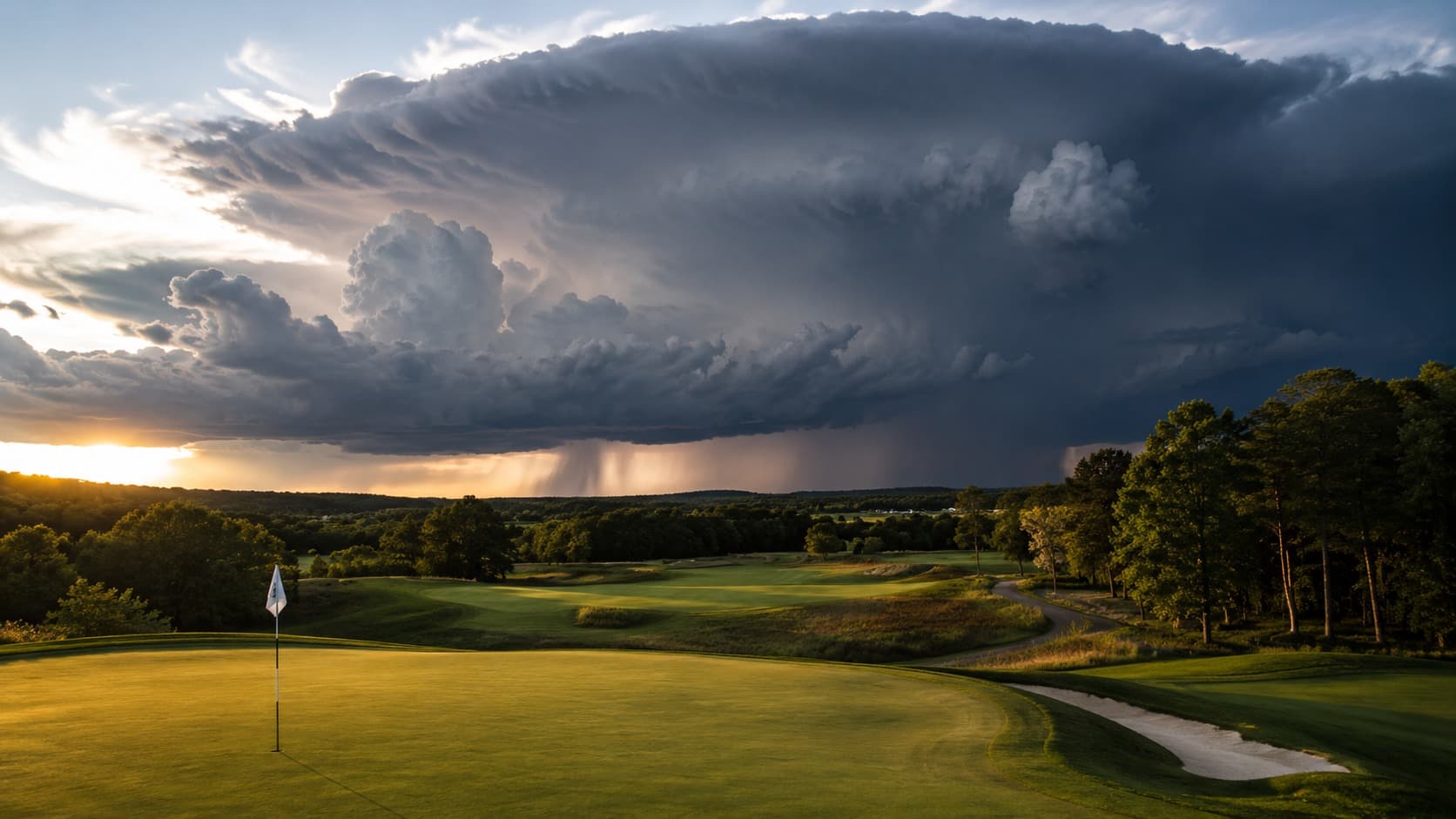
The Three O’Clock Storm: Reading Summer’s Convective Cycle to Protect Your Round
A 40% chance of afternoon thunderstorms does not mean a 40% chance of getting rained on. In the summer convective season it means the morning is nearly clear and the afternoon carries a fast-building, high-energy storm risk driven by a daily heating cycle. Here is the meteorology behind the pattern, the G-Score data on how the storm cycle punishes afternoon tee times across the Southeast, Midwest, and desert Southwest, the lightning-safety decision tree that actually matters, and the workflow that gets you off the course before the first bolt.
Read Story
How to Read a G-Score: The 0–100 Golf Playability Number, Decoded
A G-Score on this site is a single 0–100 number that tells you whether today is worth tee-up. Here is exactly what each band means, what drives the calculation, and how to use it to plan a round you will actually score on.
Read StoryMinSu Kim
Founder & Golf Data Analyst
MinSu is a data analyst and golfer with 10+ years on the course. He built Golf Weather Score to answer one question: is today a good day to play? He combines weather data, course intelligence, and the proprietary G-Score algorithm to help golfers make smarter decisions.
Every Friday Morning
When Apache Wells Golf Club plays best next weekend.
Friday 6am ET: peak G-Score windows for Apache Wells Golf Club, wind direction by hour, and one gear call. Three minutes to read, save you the round.
One email a week. Unsubscribe in one click.
The Caddie's Oracle
Draw your luck before the tee off