
Caddie's Gear Advisor
Curated for today's 84°F · Clear
Tour-Level Drivers
Engineered for maximum distance and forgiveness
Laser Rangefinders
Pin-seeking technology for precision approaches
Premium Golf Balls
Tour-caliber spin and distance performance
Performance Sunglasses
Polarized lenses optimized for reading greens
Your Golf Trip, Handled
The Ultimate Golf Trip Planner
Everything you need to play Applebrook Golf Club — from booking your flight to checking in course-side.
Course-Side Stays
Luxury hotels, resorts, and stay-and-play packages just minutes from the first tee.
Flights
Compare fares across 700+ airlines for the best route to your tee time.
SUV Rentals for Golf Bags
Spacious vehicles with room for clubs, bags, and your foursome.
Travel Insurance
Coverage for medical, weather delays, and gear at your destination.
Applebrook Golf Club: Course Intelligence
Signature Setup
I haven't walked Applebrook on a dead-still July dawn, but I've played enough of Gil Hanse's exposed, ground-game routings to know what southeastern-Pennsylvania farmland does to a scorecard once the wind stands up. Applebrook Golf Club sits outside Malvern, in Chester County, on the kind of open, rolling ground that Hanse — who built this course in 2002, years before his Rio 2016 Olympic work made him a household name — uses to set width against firmness. This is one of his early American solo designs, and it reads like a study sheet for everything he did later: broad fairways, native fescue framing the corridors, and bentgrass greens shaped to feed and reject rather than simply receive. The defining fact here isn't a single famous hole; it's that the course is built to be played along the ground in the wind, and a player who only knows aerial target golf will leave strokes everywhere. I'll write the playing lines from Hanse's design language and Chester County's wind climatology, not from a dozen rounds I haven't logged.
Hole-by-Hole Wind & Playing Lines
The variable that writes your card at Applebrook is exposure to a W-to-NW wind across open ground, paired with native fescue that turns a small miss into a lost ball.
The #1-handicap par-4. Into a 12–18 mph WNW afternoon wind this plays a full club-and-a-half longer than the yardage. I'd club down off the tee for a fairway you can hold rather than chasing length into the fescue, then take an extra club into the approach and aim for the front-center of a firm green — the long-side miss feeds away here, so a stocked-up shot to the fat of the surface beats flag-hunting.
The short par-4. A sub-340-yard card on this kind of farmland is a trap: with a helping W wind the green looks drivable, but the fescue collects anything that drifts. On a breezy day I'd hit a position iron to a full-wedge number and take my birdie look from the fairway, not from a fescue lie.
A crosswind par-3. On a NW wind one of the one-shotters plays straight across the breeze, pushing the ball toward the bail-out side. Aim into the wind side of the green and let it ride back — fighting the gust at a firm Hanse green usually ends short-sided.
> These reads come from Hanse's open-routing design pattern and the prevailing W–NW Chester County wind, not first-hand summer notes. I'd rather flag that than invent tee-by-tee yardages I can't verify.
Green & Fairway Characteristics
Applebrook plays like the Golden-Age-inspired, firm-and-fast layout Hanse intended. The greens are bentgrass, built with real internal contour and run fast and firm in summer — they reward a running approach and the confidence to use a slope, and they punish the tentative aerial shot that lands soft and spins back off a shelf. The fairways are generous in width but framed by native fescue, so the course gives you room while still demanding a committed line; the rolling Malvern terrain feeds you sidehill and downhill lies that change your effective yardage hole to hole. This is a course where the second shot's spin and trajectory matter as much as the number — into a firm Hanse green the high stopping wedge is the wrong tool, because the W–NW breeze flattens it and the firm surface rejects it anyway; the lower chasing ball that uses the contour is the one that finishes close. Width off the tee plus firmness at the green is the whole bargain Hanse strikes here.
Seasonal Weather Pattern
Chester County runs a humid-continental cycle, and Applebrook's open, slightly elevated position adds wind exposure you don't get on tree-lined Philadelphia-suburb courses. The season runs roughly mid-April through November. Spring (April–May) is cool and wet — soft, slow fairways and 45–58°F mornings that take the firmness out of the greens and the run off the fescue lines. Summer is the scoring stretch but also the humid one: July and August bring highs in the low-to-mid 80s°F, real humidity, and an afternoon SW-to-W breeze that builds as the day heats; pop-up thunderstorms are a genuine late-day risk. September and October are the best golf of the year — crisp 48–66°F air, the firmest and fastest greens of the season, and a sharpening NW wind. The pattern that matters most is daily, not seasonal: calm early mornings, with the W–NW wind filling in by early afternoon (consistent with NOAA southeastern-Pennsylvania climatology).
Local Play Tips
The read no scorecard gives you: Applebrook is a ground-game course disguised as a wide-open one. First-timers see the generous fairways and the modest card and play it like an aerial target course — high approaches into firm greens that won't hold, and aggressive drivers into fescue that won't give the ball back. Play it the way Hanse built it instead: take the lower, running approach into the firm surfaces, use the contours to feed the ball toward the pin, and treat the native fescue as a true penalty line, not rough you can hack out of. Second tip: respect the short par-4 — the one hole everyone tries to overpower is the one that quietly costs them, and a position iron there is worth more than a brave driver.
Pre-Round Weather Workflow
Applebrook is a wind-and-firmness bargain, so the forecast tells you which version of the course you're getting that day. Three days out, check the 7-day G-Score for your tee window — the still early morning, or the afternoon once the W–NW breeze fills in across this open Malvern ground. A warm, breezy forecast is worth several G-Score points to the early slot, when the fescue is calmer and the greens haven't yet hit their fastest. On the morning of, the windExposure direction sets your strategy: a WNW wind lengthens the #1-handicap par-4 and pushes the crosswind par-3 toward its bail-out, so take the extra club and aim at the fat into-the-wind side, well away from the native fescue. A cool, wet sub-55°F spring morning flips the whole equation — soft fairways and slow greens mean the running approach Hanse designed for stops working, so add club and fly the ball a touch more instead of chasing it in. Across any forecast on ground this exposed, the wind read decides which side of the fairway you favor, and it is always the side that keeps the fescue out of play.
Related Reading
Before you tee off at Applebrook Golf Club

The Mental Game: Sports Psychology Research Behind Golf's Greatest Clutch Performers
Science-backed sports psychology research reveals why golf's greatest clutch performers master pressure through routines, visualization, and focus.
Read Story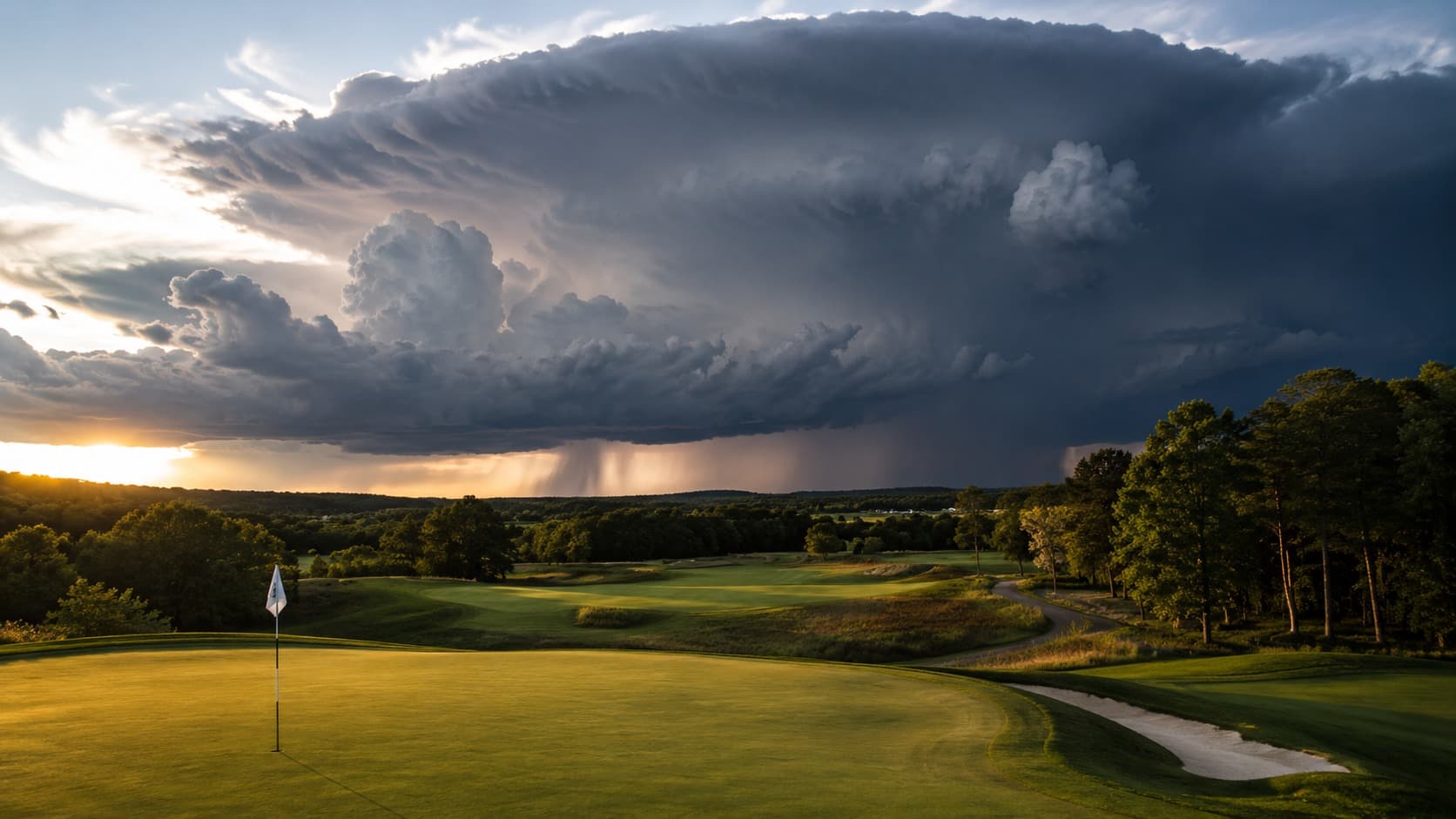
The Three O’Clock Storm: Reading Summer’s Convective Cycle to Protect Your Round
A 40% chance of afternoon thunderstorms does not mean a 40% chance of getting rained on. In the summer convective season it means the morning is nearly clear and the afternoon carries a fast-building, high-energy storm risk driven by a daily heating cycle. Here is the meteorology behind the pattern, the G-Score data on how the storm cycle punishes afternoon tee times across the Southeast, Midwest, and desert Southwest, the lightning-safety decision tree that actually matters, and the workflow that gets you off the course before the first bolt.
Read StoryMinSu Kim
Founder & Golf Data Analyst
MinSu is a data analyst and golfer with 10+ years on the course. He built Golf Weather Score to answer one question: is today a good day to play? He combines weather data, course intelligence, and the proprietary G-Score algorithm to help golfers make smarter decisions.
Every Friday Morning
When Applebrook Golf Club plays best next weekend.
Friday 6am ET: peak G-Score windows for Applebrook Golf Club, wind direction by hour, and one gear call. Three minutes to read, save you the round.
One email a week. Unsubscribe in one click.
The Caddie's Oracle
Draw your luck before the tee off