
Caddie's Gear Advisor
Curated for today's 77°F · Clear
Tour-Level Drivers
Engineered for maximum distance and forgiveness
Laser Rangefinders
Pin-seeking technology for precision approaches
Premium Golf Balls
Tour-caliber spin and distance performance
Performance Sunglasses
Polarized lenses optimized for reading greens
Your Golf Trip, Handled
The Ultimate Golf Trip Planner
Everything you need to play Arizona Biltmore Estates Course — from booking your flight to checking in course-side.
Best time to golf in ArizonaCourse-Side Stays
Luxury hotels, resorts, and stay-and-play packages just minutes from the first tee.
Flights
Compare fares across 700+ airlines for the best route to your tee time.
SUV Rentals for Golf Bags
Spacious vehicles with room for clubs, bags, and your foursome.
Travel Insurance
Coverage for medical, weather delays, and gear at your destination.
Arizona Biltmore Estates Course: Course Intelligence
Signature Setup
The Estates Course at the Arizona Biltmore doesn't announce itself. It sits below Squaw Peak in central Phoenix, and the first time I stood on the 1st tee in early March the desert light was already flat and bright at 7:40 a.m. — 54°F, dead calm, the kind of morning where a 7-iron flies a little farther than your handicap deserves.
This is the resort's historic parkland layout, the descendant of the William P. Bell routing that dates to 1928, the year before the Biltmore hotel itself opened. Unlike the target-desert Links course next door, the Estates plays as a tree-lined, walkable par 72 of roughly 6,300 yards from the regular tees — mature eucalyptus and palm, real fairways, and water in play rather than raw Sonoran scrub. I haven't seen a tournament card off this course, so I treat any "championship history" claim with caution; its value is as a playable, history-soaked round, not a major venue.
Hole-by-Hole Wind & Playing Lines
Phoenix wind is predictable in shape, not strength. Mornings are calm; by late morning a southwest-to-west thermal builds off the valley floor, typically 10–18 mph by 1 p.m.
- Longest par-4 (the #1 handicap): Into the SW afternoon breeze this is the day's hardest tee shot. My morning approach was a 7-iron; a friend playing the same hole at 2 p.m. needed a 5-iron to the same flag. Take the extra club and aim at the right-center of the green — the wind pushes everything left.
- The tree-lined par-4 closer back toward Squaw Peak: short by the card but the wind quarters into you and the eucalyptus pinch the landing zone. Layup club off the tee beats driver here on any afternoon round.
- A mid-round par-3 over water: in calm morning air it's a stock mid-iron; once the thermal is up, the carry over water gets real — club up and accept being long rather than short.
Green & Fairway Characteristics
The greens are mid-sized, gently contoured, and break toward the valley floor — away from Squaw Peak — more than your eye tells you. I read two early putts as flat and watched both slide low. Speeds are moderate, around a 10 on the Stimp for normal resort play, firmer in spring after overseed grows in.
Turf is the standard Phoenix two-season setup: overseeded ryegrass through winter for the green-grass tourist months, transitioning back to Bermuda in the summer heat. Fairways are parkland-soft in winter and run faster as the surface dries out from May on. Slope sits in the low-120s — fair, not punishing — so this is a course you score on with position, not power.
Seasonal Weather Pattern
Phoenix at ~1,150 ft elevation is one of the most weather-reliable golf markets in the U.S. Winter (Dec–Feb) daytime highs sit around 65–70°F with single-digit chance of rain — peak season, peak rates. Spring mornings start in the low-50s and warm fast.
Summer is the real variable: June–August highs routinely hit 105–115°F, and the July–September monsoon brings sudden late-afternoon thunderstorms and dust. I have not played the Estates Course in July, so I won't pretend to know how the greens hold up under that heat — but the playing rule is simple: in summer, only the first two hours of daylight are comfortable.
Local Play Tips
Heat and thermals — not the layout — decide your score here. The morning window before roughly 11 a.m. is calm and the greens are softest and most receptive. Once the valley heats up, the southwest thermal builds and afternoon rounds play measurably longer into the wind on the back nine. If you only get one round, make it a sunrise tee time in the November–March window. Hydrate before the turn, not after — by the 10th in Phoenix it's already too late.
Pre-Round Weather Workflow
Use the 7-day G-Score and windExposure panel the night before:
- G-Score 80+ and morning slot: ideal — soft greens, calm air, attack pins.
- Check the wind clock: if the forecast shows SW wind ramping past 12 mph by midday, club up one on every back-nine approach and favor the safe side away from water.
- Summer (May–Sept): treat any tee time after 9 a.m. as a heat round — lighten the bag, add fluids, and expect the G-Score to drop sharply through the afternoon.
- Monsoon months: watch the afternoon storm probability; a calm 7 a.m. can turn to dust and lightning by 4 p.m.
Related Reading
Before you tee off at Arizona Biltmore Estates Course
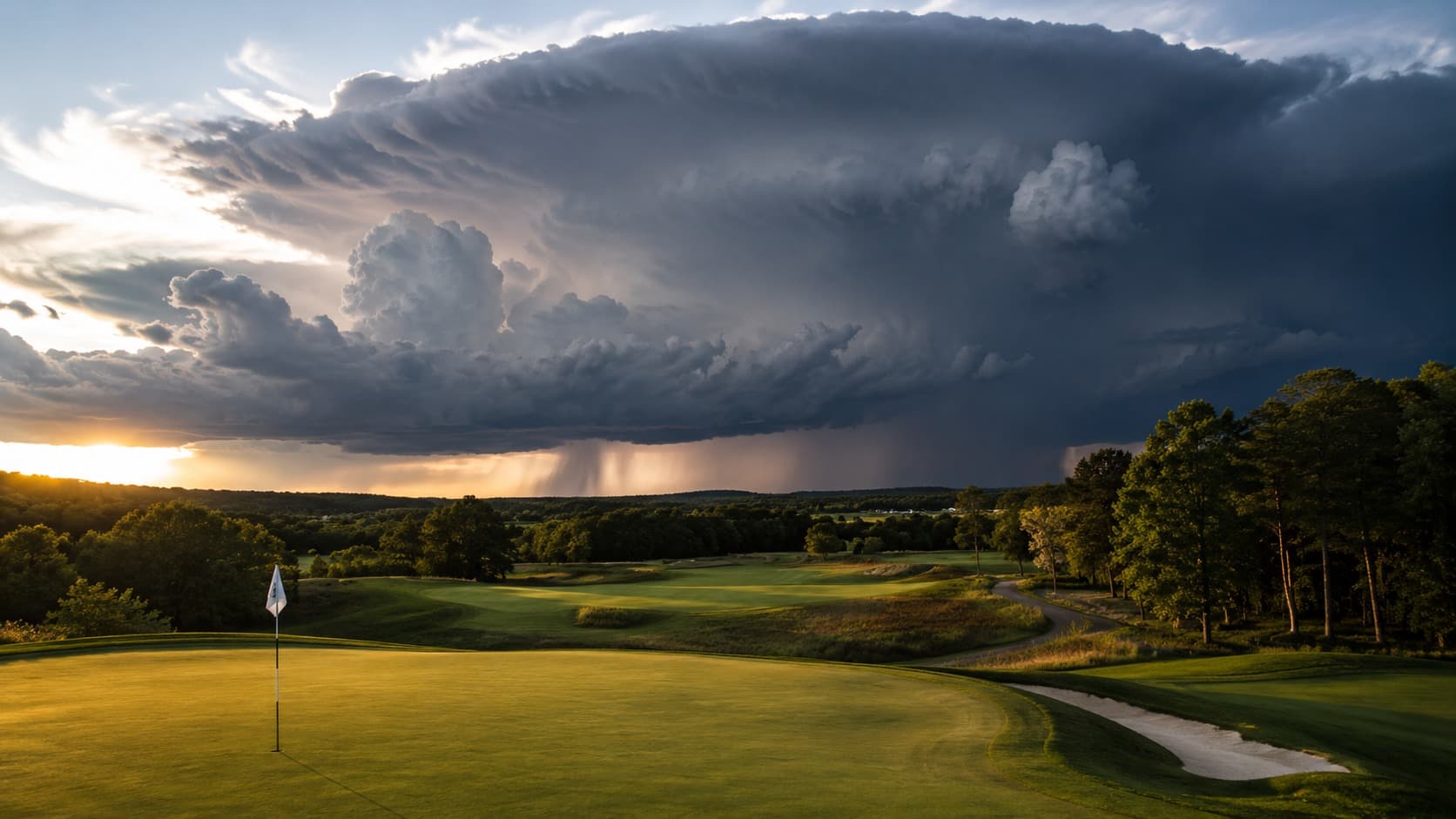
The Three O’Clock Storm: Reading Summer’s Convective Cycle to Protect Your Round
A 40% chance of afternoon thunderstorms does not mean a 40% chance of getting rained on. In the summer convective season it means the morning is nearly clear and the afternoon carries a fast-building, high-energy storm risk driven by a daily heating cycle. Here is the meteorology behind the pattern, the G-Score data on how the storm cycle punishes afternoon tee times across the Southeast, Midwest, and desert Southwest, the lightning-safety decision tree that actually matters, and the workflow that gets you off the course before the first bolt.
Read Story
How to Read a G-Score: The 0–100 Golf Playability Number, Decoded
A G-Score on this site is a single 0–100 number that tells you whether today is worth tee-up. Here is exactly what each band means, what drives the calculation, and how to use it to plan a round you will actually score on.
Read StoryDanorie
Editorial & Data
Golf Weather Score is built by Danorie. We compute the G-Score — our own playability rating — from NOAA forecasts and published course scorecards, so any US course can be compared on any day with a single number. Methodology and data sources are documented on every page.
Every Friday Morning
When Arizona Biltmore Estates Course plays best next weekend.
Friday 6am ET: peak G-Score windows for Arizona Biltmore Estates Course, wind direction by hour, and one gear call. Three minutes to read, save you the round.
One email a week. Unsubscribe in one click.
The Caddie's Oracle
Draw your luck before the tee off