
Caddie's Gear Advisor
Curated for today's 84°F · Clear
Tour-Level Drivers
Engineered for maximum distance and forgiveness
Laser Rangefinders
Pin-seeking technology for precision approaches
Premium Golf Balls
Tour-caliber spin and distance performance
Performance Sunglasses
Polarized lenses optimized for reading greens
Your Golf Trip, Handled
The Ultimate Golf Trip Planner
Everything you need to play Audubon Country Club — from booking your flight to checking in course-side.
Course-Side Stays
Luxury hotels, resorts, and stay-and-play packages just minutes from the first tee.
Flights
Compare fares across 700+ airlines for the best route to your tee time.
SUV Rentals for Golf Bags
Spacious vehicles with room for clubs, bags, and your foursome.
Travel Insurance
Coverage for medical, weather delays, and gear at your destination.
Audubon Country Club: Course Intelligence
Signature Setup
The first thing you notice driving into Audubon Country Club is that the golf course is, almost literally, a wildlife preserve with fairways cut through it — egrets in the wetland margins, the occasional gator sunning on a bank between the tees. I have not walked these fairways myself, so I will separate what I know from the course record versus regional knowledge of southwest Florida golf. What the record gives us is firm: this is a Joseph L. Lee design that opened in 1989 inside a gated community in North Naples, roughly two miles inland from the Gulf, playing 6,719 yards to a par of 72 from the back tees. It is a member-and-resident club, now under Troon management, and it plays the way Naples golf always plays — soft and benign at dawn, then progressively harder as the sea breeze and the heat take over.
Hole-by-Hole Wind & Playing Lines
The differentiator at any Naples course is the daily sea breeze, and it is more predictable than anywhere else I write about. From roughly mid-morning the Gulf breeze builds out of the W to WSW at 8–14 mph, and on the #1-handicap par-4 that puts the wind into your approach. A 150-yard shot in calm morning air becomes a 165- to 170-yard shot by noon, so club up one and play the left half of the fairway to keep the green angle open against the crossing breeze. The closing 18th — Lee's signature finish, a par-4 demanding a forced carry over water to a green pinched short-right — is the hole the breeze punishes most: into a freshening WSW wind the carry that looks routine at 7 a.m. becomes a genuine commitment by mid-afternoon, and bailing right brings the greenside hazard into play. On any hole routed back toward the Gulf, treat the card yardage as a minimum after 11 a.m. In winter, passing cold fronts swing the wind to the N–NW at 10–18 mph for a day or two behind each front, flipping the same holes from headwind to downwind and undoing every distance read you trusted in summer.
Green & Fairway Characteristics
Expect Bermuda fairways and Bermuda greens, the standard turf for this latitude (26.3°N), with the more salt-tolerant paspalum showing up along the brackish wetland edges that thread the routing. Grain is the whole game on these greens: morning putts before the surface dries hold their line, but by early afternoon the Bermuda grain into the lowering sun pushes putts noticeably off-line. Slopes sit in the low-to-mid 130s — fair for a parkland resort layout, not penal. In the dry season (December–April) the fairways firm up and you get real run-out; through the summer wet season the same fairways land soft and the wetland margins sit one bad swing away on a surprising number of holes, so course management off the tee matters more than raw length here.
Seasonal Weather Pattern
Naples weather runs on two seasons, not four, and the calendar is sharp. The wet season (June–September) brings daily highs of 90–92°F, dew points near 74–76°F, and a near-clockwork afternoon thunderstorm pattern — sea-breeze convergence fires storms inland most afternoons between 2 and 5 p.m., so a morning tee time is not a preference but a safety requirement. The dry season (December–March) is the reward: highs in the mid-70s to low-80s, low humidity, light morning wind, and the most stable, playable conditions of the year — this is when Naples earns its winter migration. October and May are the transition shoulders: still warm, lower storm frequency than midsummer, and good value if you can take the heat. Frost is essentially a non-issue at this latitude, but lightning is the real hazard — respect the afternoon clock from June through September.
Local Play Tips
The local read that does not show up on a tee sheet: Audubon's wetland-preserve routing holds heavy, moist air in the low ground at first light, and that dawn humidity costs you a few yards of carry before the sea breeze even arrives — so the calm early holes are not playing as short as they feel. Plan your first three or four holes around that, then re-club once the breeze fills in around 10–11 a.m. And because so much of the property is protected habitat, errant shots into the margins are best abandoned, not retrieved — both for the gators and because the marked hazards mean a found ball there saves you nothing.
Pre-Round Weather Workflow
Use the 7-day G-Score forecast on the course page to plan around the two things that decide your round here: the sea breeze and the summer storm clock. In the wet season, target the earliest tee time the forecast allows and treat any afternoon storm probability above 40% as a hard stop — be off the course by early afternoon. Watch the windExposure indicator: a W–WSW reading above 8 mph means clubbing up on every Gulf-facing approach and respecting the 18th's water carry. In the dry season, conditions are forgiving enough that you can play later, but still check for the occasional N–NW post-front wind that reverses your distance reads. Read the G-Score trend the night before, set your tee time to the calmest, coolest block, and let the data — not the card — pick your clubs.
Related Reading
Before you tee off at Audubon Country Club

Best Golf Weather by State: Ranking America by Average G-Score
We ranked all 50 US states by average G-Score golf playability. California tops the list, but the results beyond the top five may surprise you.
Read Story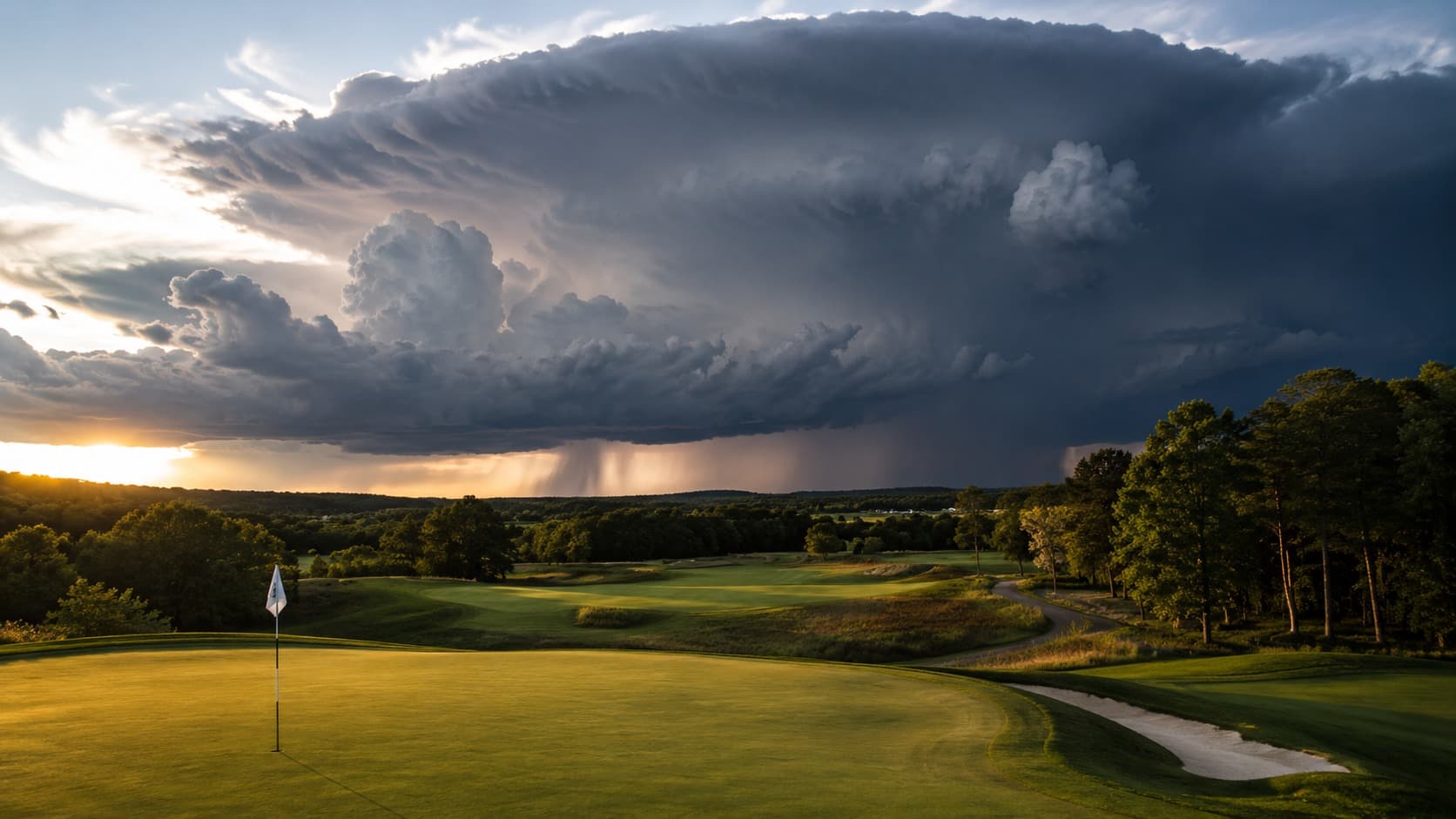
The Three O’Clock Storm: Reading Summer’s Convective Cycle to Protect Your Round
A 40% chance of afternoon thunderstorms does not mean a 40% chance of getting rained on. In the summer convective season it means the morning is nearly clear and the afternoon carries a fast-building, high-energy storm risk driven by a daily heating cycle. Here is the meteorology behind the pattern, the G-Score data on how the storm cycle punishes afternoon tee times across the Southeast, Midwest, and desert Southwest, the lightning-safety decision tree that actually matters, and the workflow that gets you off the course before the first bolt.
Read StoryMinSu Kim
Founder & Golf Data Analyst
MinSu is a data analyst and golfer with 10+ years on the course. He built Golf Weather Score to answer one question: is today a good day to play? He combines weather data, course intelligence, and the proprietary G-Score algorithm to help golfers make smarter decisions.
Every Friday Morning
When Audubon Country Club plays best next weekend.
Friday 6am ET: peak G-Score windows for Audubon Country Club, wind direction by hour, and one gear call. Three minutes to read, save you the round.
One email a week. Unsubscribe in one click.
The Caddie's Oracle
Draw your luck before the tee off