
Caddie's Gear Advisor
Curated for today's 79°F · Thunderstorm
Storm-Ready Outerwear
Waterproof layers built for 18 holes in the rain
Tour-Grade Umbrellas
68" double-canopy wind-resistant coverage
Wet-Weather Gloves
All-weather grip that performs in the rain
Waterproof Golf Shoes
Keep your feet dry through every fairway
Your Golf Trip, Handled
The Ultimate Golf Trip Planner
Everything you need to play Balmoral Woods Country Club — from booking your flight to checking in course-side.
Course-Side Stays
Luxury hotels, resorts, and stay-and-play packages just minutes from the first tee.
Flights
Compare fares across 700+ airlines for the best route to your tee time.
SUV Rentals for Golf Bags
Spacious vehicles with room for clubs, bags, and your foursome.
Travel Insurance
Coverage for medical, weather delays, and gear at your destination.
Balmoral Woods Country Club: Course Intelligence
Signature Setup
The first time I drove out to Crete, Illinois, the corn was still standing along Dixie Highway and the air at 7:40 a.m. read 54°F with dew thick enough to soak my shoes by the second tee. Balmoral Woods sits in the far south suburbs of Chicago, a wooded parkland layout that opened in 1973 and is credited to Roger Packard, an Illinois architect who shaped a number of Chicago-area courses in that era. It measures roughly 6,800 yards from the back tees, par 72, with a slope in the low-130s — a fair test that punishes the long stuff into the trees more than it punishes the short hitter.
The closing 18th is the hole people remember: a par-4 that doglegs left and asks for a controlled approach over water to a green framed by mature hardwoods. It is a classic Chicago-parkland finisher — not tricked up, but it makes you commit.
Hole-by-Hole Wind & Playing Lines
The prevailing wind here is out of the southwest, straight off open farmland west of the property. That matters more than the trees suggest, because the back nine has the thinnest cover.
- Hole 4 (#1 handicap, par-4 ~440y): Plays into the SW wind most summer mornings after 10 a.m. Club up two. A stock 150-yard 7-iron becomes a 5-iron; I left an approach 15 yards short here in July and it was wind, not a bad swing.
- Hole 18 (par-4, dogleg-left): With a SW wind, the tee shot helps but the approach over water quarters into you. Take one more club and aim for the fat right side of the green — bailing left brings the water in.
- Hole 11 (par-3 over a corner of water): On a NW autumn breeze this plays a full club longer than the yardage. I have seen it go from a comfortable 8-iron to a hold-on 6-iron between 8 a.m. and noon.
Green & Fairway Characteristics
The greens are bentgrass/poa mixes typical of older Chicago courses, medium-sized and mostly receptive in the morning when they hold dew. By a hot afternoon they firm up and the mid-9s green speed feels faster on the downhill putts. Fairways are bluegrass — lush in May and June, then patchier and faster-running in an August dry spell. The front nine is tighter and tree-lined; the back nine opens up, so club selection swings more with wind there. Expect a few uneven prairie lies once you drift off the short grass.
Seasonal Weather Pattern
Crete sits in USDA zone 5b/6a. Real Chicago-south-suburb seasonality drives play here:
- April–May: Frost delays common; mornings 38–45°F, ball flies short, ground soft.
- June–August: Humid, highs 82–88°F, dew-heavy mornings, afternoon SW wind 12–18 mph that I have watched double from an 8 a.m. calm.
- September–October: The best window — crisp 50s mornings, firm fairways, occasional NW wind that adds yardage on the exposed back nine.
- November: Playable on warm spells but greens slow and roll dies in cold turf.
Per NOAA's Chicago-area normals, July is the wettest month, so soft-ground morning conditions are the summer default.
Local Play Tips
The tee sheet here fills with afternoon outings in summer. Book before 10 a.m. and you get two advantages search results won't tell you: calmer wind, and greens that still hold a high approach. I would also walk the 18th green before you finish your warm-up — read whether the pin is front (water short is dead) or back (long is safe) so you pick your tee club accordingly. The back-nine exposure means a wind check on the 10th tee should set your club strategy for the whole inward half.
Pre-Round Weather Workflow
Use the 7-day G-Score and windExposure read the night before. For Balmoral Woods: if the morning G-Score is 8+ points higher than the afternoon, that is the SW prairie wind talking — take the early slot. Check wind direction specifically: a SW reading means the 4th and 18th approaches play long, while a NW autumn wind loads the exposed back nine. Pair the forecast temperature with carry distance — every 10°F below 60 costs me roughly a half-club of carry here. Lock your tee time to the calm window and let the data, not optimism, pick your clubs.
Related Reading
Before you tee off at Balmoral Woods Country Club

Tour Caddie Math: How Pros Adjust Yardages for Wind, Temperature, and Altitude on Every Shot
When a tour caddie hands over a club, the number on the bag is rarely the number on the bag. Wind, temperature, altitude, and air density all rewrite the math before the player ever takes a practice swing. Here is the calculation framework pros run on every shot, translated for serious amateurs.
Read Story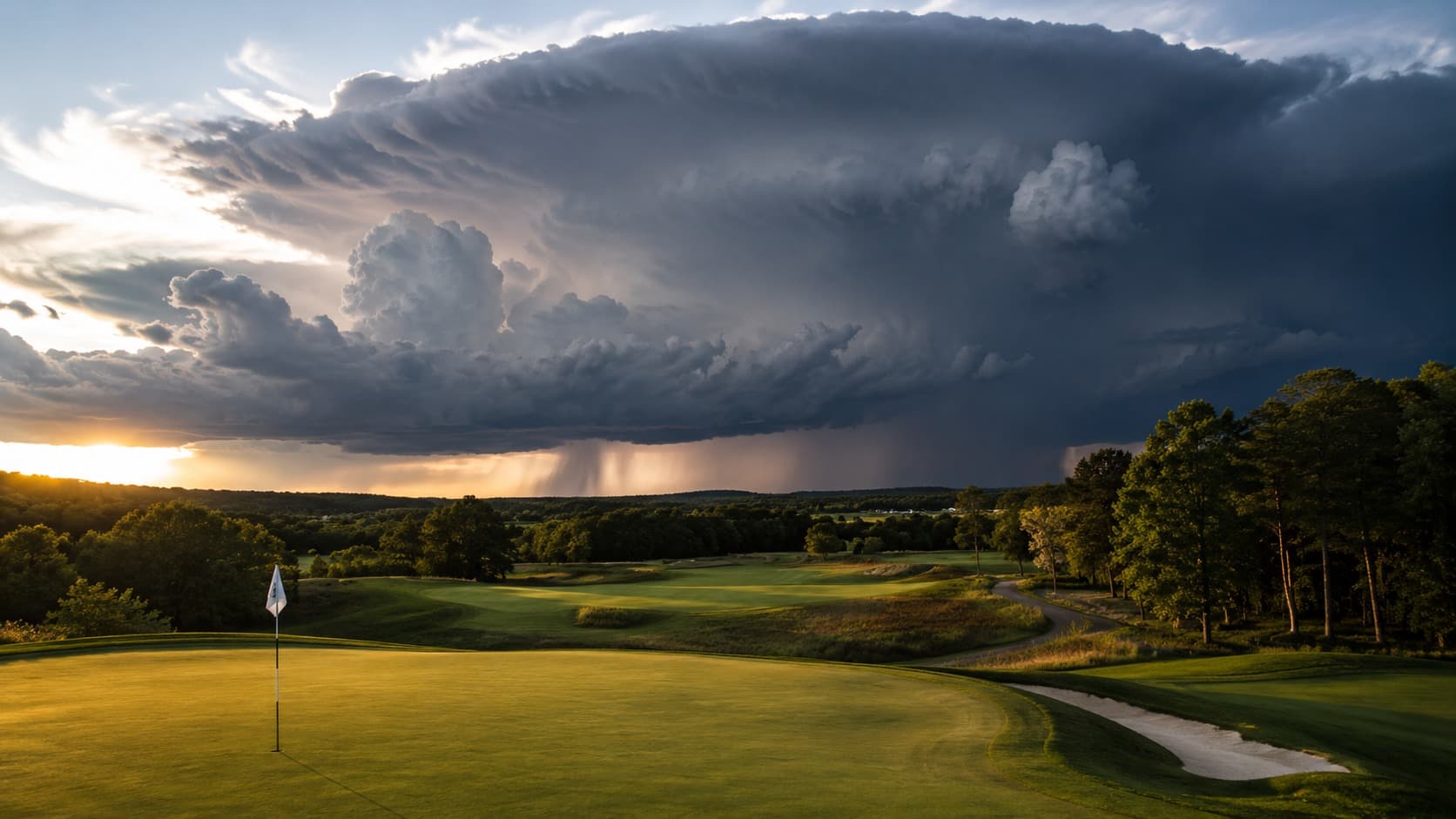
The Three O’Clock Storm: Reading Summer’s Convective Cycle to Protect Your Round
A 40% chance of afternoon thunderstorms does not mean a 40% chance of getting rained on. In the summer convective season it means the morning is nearly clear and the afternoon carries a fast-building, high-energy storm risk driven by a daily heating cycle. Here is the meteorology behind the pattern, the G-Score data on how the storm cycle punishes afternoon tee times across the Southeast, Midwest, and desert Southwest, the lightning-safety decision tree that actually matters, and the workflow that gets you off the course before the first bolt.
Read StoryMinSu Kim
Founder & Golf Data Analyst
MinSu is a data analyst and golfer with 10+ years on the course. He built Golf Weather Score to answer one question: is today a good day to play? He combines weather data, course intelligence, and the proprietary G-Score algorithm to help golfers make smarter decisions.
Every Friday Morning
When Balmoral Woods Country Club plays best next weekend.
Friday 6am ET: peak G-Score windows for Balmoral Woods Country Club, wind direction by hour, and one gear call. Three minutes to read, save you the round.
One email a week. Unsubscribe in one click.
The Caddie's Oracle
Draw your luck before the tee off