
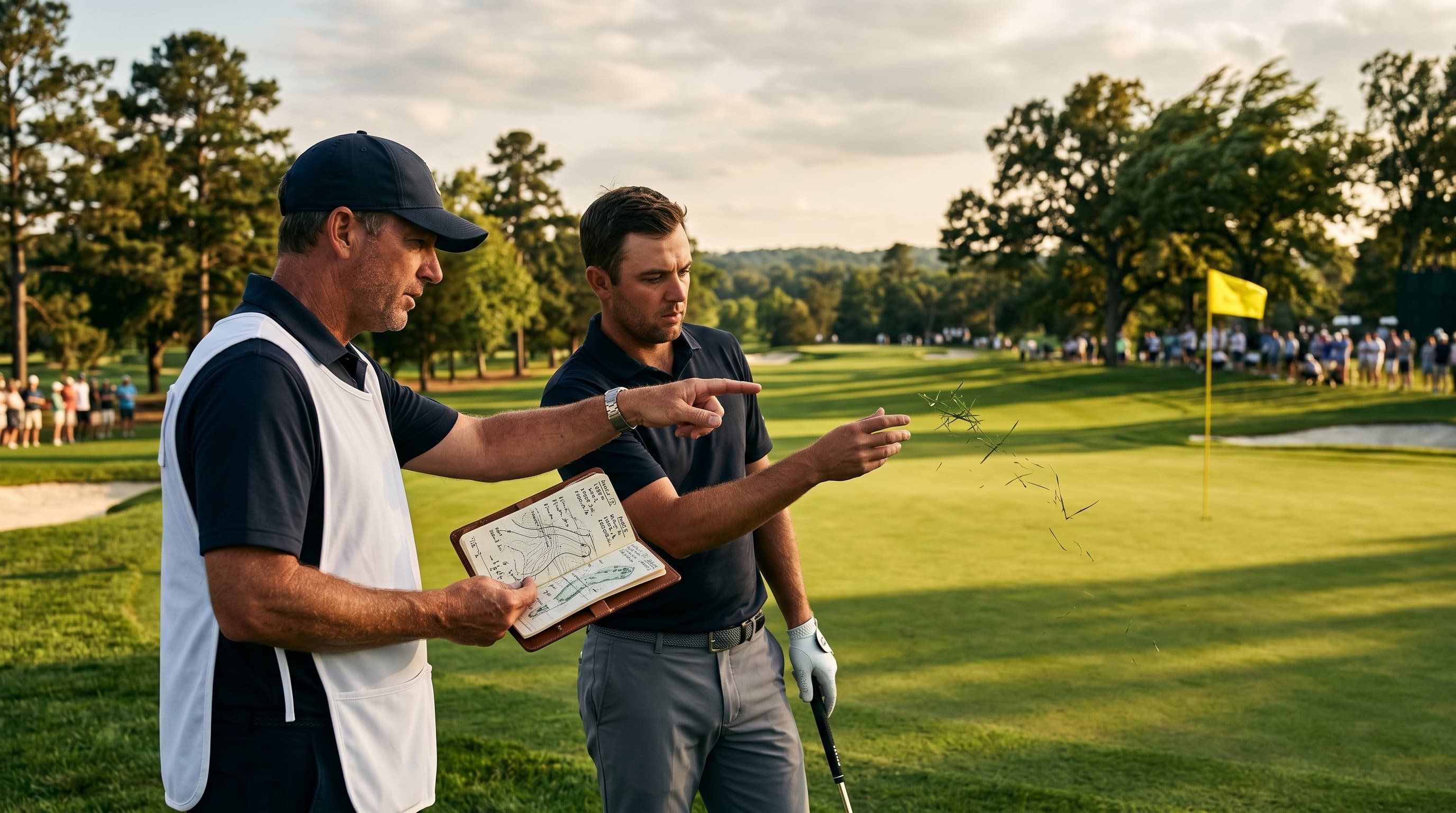
The yardage book says 168 to the front, 178 to the pin, 184 to cover the back bunker. The caddie reads off the numbers, glances up at the flag, watches a single oak leaf drift across the fairway, checks the temperature on his rangefinder, and quietly says: 'Plays 184. Smooth seven.' The player does not hesitate. He hits the seven. The ball lands two paces from the pin.
That moment looks like instinct. It is not. Behind that single number sits a multi-variable calculation that elite caddies run on every approach shot, every par-3 tee ball, and every wedge from inside 150. The number on the yardage book is a starting point. The number the caddie actually delivers to the player has been adjusted for wind speed and direction, ambient temperature, altitude above sea level, humidity, barometric pressure, slope, and sometimes even the firmness of the landing surface. The calculation itself takes about four seconds of mental math, performed under tournament pressure, and the best caddies are accurate to within a yard or two of what the ball actually does.
This is the part of the tour player's edge that almost never makes it into the broadcast. The swing gets the highlight package. The caddie math gets a quiet nod between the bag and the player. But the math is what turns a 170-yard distance into the right number for this day, this elevation, this wind, this player.
This guide pulls back the curtain. It walks through the exact framework that elite caddies use to convert a raw yardage into a playing yardage, breaks down each variable with the actual numbers used on tour, and shows how a serious amateur can adopt the same framework without a calculator, a meteorology degree, or fifteen years of looping for the world's best players. The reward is simple. You stop guessing. You start playing the actual distance the ball is going to fly. And your scoring shifts accordingly.
Why the Number on the Yardage Book Is Almost Never the Right Number
The yardages in a yardage book and the distances on a GPS device are pure geometry. They measure the linear distance from where the ball sits to a point on the green. They do not know that there is a 14 mph headwind. They do not know it is 47 degrees at altitude. They do not know the air is dense from a passing low-pressure system. They give you a true number, and a true number is rarely the number you should hit.
The gap between the geometric yardage and the playing yardage is what we will call the weather tax. On a calm 72-degree sea-level day with average humidity, the tax is roughly zero. The 168-yard shot plays 168. But step away from those exact reference conditions in any direction, and the tax begins to mount. Moderate wind, mild altitude, and a 15-degree temperature swing can each add or subtract five to ten yards on a standard mid-iron approach. Combine them, and the same shot can play meaningfully shorter or longer than the number on the screen.
The caddie's job is to compute that tax in real time and deliver one clean number to the player. The number you actually hit. The number that, executed correctly, finishes pin high.
The framework below is built around five primary variables. Each one is treated independently, then summed at the end. The order is deliberate. Wind is computed first because it has the largest and most variable effect. Temperature next. Altitude after that. Then humidity and barometric pressure, treated together as an air-density modifier. Finally, slope, which is treated separately because it is a geometric correction rather than an environmental one.
Variable 1: Wind
Wind is the single most consequential weather variable on the golf course. It is also the variable that amateurs most consistently misread, because the human eye is bad at distinguishing 8 mph from 16 mph at a glance, and because the felt wind on the body is rarely the same as the wind affecting ball flight at apex.
The Tour Rule of Thumb
The simplest version of the caddie wind rule, used in some form by nearly every elite caddie on tour, is this: multiply the wind speed by 1.5 for headwinds and 1.0 for tailwinds, then apply that as the yardage adjustment.
A 10 mph headwind plays 15 yards longer. A 10 mph tailwind plays 10 yards shorter. The asymmetry is not a typo. Headwinds suppress the ball's apex, increase backspin's effective drag, and produce a meaningfully larger penalty than the equivalent tailwind's gain. Tailwinds knock down spin, flatten trajectory, and produce a more modest distance increase than the headwind cost.
This rule of thumb works for shots in the 130 to 200 yard range hit at standard mid-iron trajectory. For wedges, the multiplier is smaller because the ball spends less time in the air. For long irons and woods, the multiplier is larger because the ball is exposed to wind for more of its flight.
Crosswind Adjustments
Crosswinds get treated as a partial headwind plus a lateral push. A 10 mph wind blowing at 90 degrees to the shot adds roughly 3 to 5 yards of lateral drift but produces almost no headwind tax. A 10 mph wind blowing at 45 degrees produces about 70 percent of the headwind effect plus about 70 percent of the lateral drift. Caddies often visualize this as a clock face. A 12 o'clock wind is pure headwind. A 6 o'clock is pure tailwind. A 9 o'clock is pure crosswind. Anything between is interpolated by feel and experience.
Reading Wind That Is Not Right at You
The hardest part of wind math is not the formula. It is correctly reading the wind that is going to affect the ball, which is rarely the same as the wind hitting the player at address. Tour caddies use four standard reference points to read wind in the air column above the fairway.
The flag. The single most reliable on-course wind indicator. The flag tells you the wind speed and direction at the green, which is where the ball is going. If the flag is dancing hard, you have at minimum 10 to 12 mph. If it is fully extended and rigid, you are likely above 15 mph.
The treetops. Caddies read the canopy of trees on the line of flight, not the ground-level trunks. The ball flies through the air column at tree height, and the wind there can be 30 to 50 percent stronger than the wind at the player's face on the tee.
Cloud movement. On par-5s and long par-4s where ball flight reaches significant altitude, caddies will glance at low cloud movement to confirm the upper-air wind. A discrepancy between ground wind and cloud wind is a tell that the upper layer is significantly different from the surface layer.
Loose grass thrown in the air. The classic caddie tell. A small handful of dry grass dropped at shoulder height shows wind speed and direction at the precise altitude the ball will be flying through during apex. This is the most reliable indicator of effective wind for a standard mid-iron.
Variable 2: Temperature
Temperature affects ball flight in two distinct ways. Cold air is denser than warm air, so the ball encounters more aerodynamic drag and carries less. Cold balls also compress less efficiently at impact, transferring less energy from clubface to ball. Together, these effects produce a meaningful yardage shift across the temperature ranges that golfers actually encounter.
The Tour Temperature Rule
The standard rule used by elite caddies is roughly 2 yards of carry distance per 10 degrees Fahrenheit on a mid-iron, with the reference point set at 72 degrees. A 50-degree day plays 4 to 5 yards shorter. A 95-degree day plays 4 to 5 yards longer. The effect is roughly linear across the playable temperature range, although it accelerates at the extremes because of compounding effects on ball compression and player flexibility.
The temperature adjustment scales with club length. A 7-iron at 72 degrees that carries 165 yards will carry roughly 160 to 161 at 50 degrees and 169 to 170 at 95 degrees. A driver at 72 degrees that carries 270 yards will lose closer to 8 yards at 50 degrees and gain closer to 8 yards at 95 degrees. The longer the club and the higher the ball speed, the larger the temperature multiplier.
The Cold-Weather Compounding Effect
Below roughly 45 degrees, additional factors compound the basic temperature tax. The ball's core compresses less efficiently. The clubface itself is fractionally less elastic. The player's muscles are tighter, producing slightly slower swing speeds. And the player is wearing additional layers that restrict rotation. The result is that a 35-degree round can play 8 to 12 yards short on a standard 7-iron, well above what the linear formula predicts.
Caddies who work tournaments in the early-season swing through the Northeast and Mid-Atlantic build a small additional buffer for any day that drops below 45. The general rule on tour: in genuinely cold conditions, club up an extra half club beyond what the simple temperature formula suggests, then trust the swing.
Variable 3: Altitude
Altitude is the variable that most dramatically reshapes ball flight, and the variable that travelers most often forget about until their second round at a new course at significant elevation. Higher altitude means lower air density. Lower air density means less aerodynamic drag on the ball. Less drag means more carry. The effect is substantial.
The Tour Altitude Rule
The standard rule on tour is roughly 2 percent of additional carry distance per 1,000 feet of elevation gain above sea level. A 165-yard 7-iron at sea level becomes a 168-yard 7-iron at 1,000 feet, a 171 at 2,000 feet, a 175 at 3,000 feet, a 178 at 4,000 feet, and a 182-yard 7-iron at 5,000 feet. By 7,000 feet, the same 7-iron is playing 188 to 189 yards. By 9,000 feet, the player is hitting 9-iron from the same distance that called for a 7-iron at sea level.
This is why altitude golf feels so different from sea-level golf. It is not just that the ball goes farther in some abstract sense. It is that the entire club selection framework shifts down. Players who normally hit 8-iron from 150 are now hitting pitching wedge from the same number. The shape of the round, the look of the approach shots, even the way pin positions are protected, all change with altitude.
Altitude Compounds With Temperature
Here is the part most amateurs miss. Altitude and temperature compound. A 50-degree morning at 5,000 feet does not produce the full 10 percent altitude bonus. The cold dense air partially offsets the altitude thinning. Conversely, a 95-degree afternoon at 5,000 feet produces more than 10 percent because the warmer air thins further. Mountain west summer afternoons, in particular, can produce truly explosive ball flight because the altitude tailwind and the temperature tailwind stack on top of each other.
Caddies in these regions do not run two separate calculations. They run an air-density estimate that captures both effects. We will treat them in the combined adjustment in Variable 4 below.
Variable 4: Humidity and Barometric Pressure
This is the variable that separates competent caddies from elite ones. Most amateurs ignore humidity and barometric pressure entirely. Most weekend golfers do not know the difference. But on tour, where the difference between hitting it pin high and short-siding yourself is measured in single yards, the air-density modifier from humidity and pressure changes is a real and exploited variable.
Counterintuitive Humidity Math
Most golfers assume humid air is heavier and produces shorter shots. The opposite is true. Humid air contains water vapor molecules, which are lighter than the nitrogen and oxygen molecules that make up dry air. So humid air is actually slightly less dense than dry air, and the ball carries marginally farther in humid conditions, all else equal.
The effect is small. A jump from 30 percent to 90 percent relative humidity at the same temperature produces roughly 1 to 2 yards of additional carry on a standard mid-iron. It is not a major variable. But it is real, it is consistent, and elite caddies factor it in, particularly in tropical or sub-tropical tournament settings where humidity sits above 80 percent for the entire week.
Barometric Pressure
Barometric pressure tells you how much air is sitting above the course at any given moment. High pressure means dense air and shorter ball flight. Low pressure, often associated with approaching storm systems, means thinner air and longer ball flight. The effect is subtle but real. A 30-millibar drop in pressure, which is roughly the difference between a high-pressure ridge and a low-pressure trough, produces about 1 to 2 yards of additional carry on a mid-iron.
The most useful application of barometric pressure for caddies is as a tiebreaker. When wind, temperature, and altitude are all close to neutral, but the player and caddie are deciding between two clubs, the pressure reading often tips the decision. Lower pressure favors the shorter club. Higher pressure favors the longer.
The Air-Density Shorthand
Rather than running humidity and pressure as two separate calculations, most elite caddies fold them into a single air-density modifier. On most days, this modifier is small enough to ignore, somewhere between minus 2 and plus 2 yards. On unusual days, the modifier can grow to 4 or 5 yards, large enough to shift a club decision. The G-Score system on this site already incorporates these density variables into its scoring, which is one reason the score correlates so cleanly with playability outcomes.
Variable 5: Slope (Elevation Change to the Target)
The fifth variable is geometric rather than environmental, and it is the easiest to miscalculate at the amateur level because the human eye consistently underestimates uphill yardage and overestimates downhill yardage on the course.
The Tour Slope Rule
The slope formula used by elite caddies is add or subtract roughly one yard of effective carry for every two feet of elevation change. A green that sits 20 feet above the player plays approximately 10 yards longer. A green that sits 20 feet below the player plays approximately 10 yards shorter. Many high-end laser rangefinders, including the Bushnell Pro XE used by most tour caddies, automatically perform this calculation in slope mode. In tournament play, slope mode is illegal under the Rules of Golf, so caddies maintain the formula manually using the contour information in their yardage books.
The slope adjustment compounds with the wind adjustment, not the other way around. A downhill shot into a 10 mph headwind does not cancel out. The headwind still adds 15 yards. The downhill still subtracts 10. The net effect is plus 5 yards of effective playing distance. Caddies treat each variable independently and then sum the deltas.
Putting It All Together: A Sample Shot Calculation
Here is how an elite caddie would walk through a real shot. The player is on a Mountain West course at 4,500 feet of elevation. The yardage book says 178 yards to the pin, with the green sitting 12 feet above the fairway. The temperature is 58 degrees. There is a 12 mph wind blowing at the player from the 1 o'clock direction. Humidity is 30 percent. Barometric pressure is mildly low at 29.85 inches of mercury, suggesting a thin air column.
Step 1: Wind. The wind is roughly 80 percent headwind, 20 percent crosswind. The headwind component is approximately 10 mph. Using the 1.5 multiplier, that adds 15 yards. The crosswind component will push the ball slightly right but does not significantly change the yardage. Wind adjustment: plus 15 yards.
Step 2: Temperature. Reference 72 degrees, actual 58 degrees, difference of 14 degrees. The 2-yards-per-10-degrees rule produces about 3 yards of additional play distance because cold air. Temperature adjustment: plus 3 yards.
Step 3: Altitude. 4,500 feet of elevation produces a 9 percent yardage gain. On a 178-yard shot, that is roughly 16 yards of distance bonus. Altitude adjustment: minus 16 yards.
Step 4: Air Density. Low humidity slightly increases air density. Low barometric pressure slightly decreases it. The two roughly cancel. Air density adjustment: 0 yards.
Step 5: Slope. 12 feet of uphill at 1 yard per 2 feet produces a 6-yard adjustment. Slope adjustment: plus 6 yards.
Net. Geometric distance 178. Plus 15 wind. Plus 3 cold. Minus 16 altitude. Plus 6 slope. Plus 0 air density. Effective playing distance: 186 yards.
The caddie does not deliver this calculation to the player. The caddie delivers a club. If the player carries his 6-iron 185 to 190, the call is a smooth 6-iron with the wind allowance baked in. If the player carries his 6-iron exactly 185, the call is a hard 6-iron or a smooth 5-iron, depending on player tendencies and the lie. The math just got the caddie to the right club. The decision between two adjacent clubs is a separate conversation.
The Caddie's Mental Shortcut
No tour caddie actually runs the full calculation above on every shot. They run it on hard shots, the par-3s, and the demanding approaches. On routine shots, they run a compressed version that captures the dominant variables and ignores the small ones.
The shortcut looks something like this. Start with the geometric yardage. Add or subtract the wind. Add or subtract the slope. Add or subtract any clear temperature or altitude effect. If anything else moves the number, fold it in. Otherwise, hand over the club.
On a 65-degree calm day at sea level with a flat green, the shortcut produces the geometric yardage. No adjustment needed. The number on the book is the number you hit. On a 50-degree windy day at altitude with elevation change, the shortcut produces a number that may be 15 yards different from the geometric yardage in either direction. The number on the book is the starting point. The number you hit is the answer to the calculation.
This is the rhythm. Most shots are simple. Some shots are not. The caddie's job is knowing which is which.
How Amateurs Can Use This Framework Without a Math Degree
The full framework above looks intimidating. It is not. The simplified version that captures 80 percent of the value can be memorized in five minutes and applied during any round. Here is the amateur-grade version.
Wind. Estimate the wind speed honestly. If the flag is dancing, it is at least 10 mph. If the trees are bending, it is at least 15. Multiply head wind speed by 1.5 and tail wind speed by 1.0 to get the yardage adjustment. Add for headwinds, subtract for tailwinds. Crosswinds, ignore for distance, account for line.
Temperature. If it is below 60, add 3 to 5 yards. If it is above 85, subtract 3 to 5 yards. Otherwise, ignore.
Altitude. At sea level, ignore. Above 3,000 feet, subtract 6 to 8 percent of the geometric yardage. Above 5,000 feet, subtract 10 to 12 percent. The thinner the air, the more the ball flies.
Slope. If the green is meaningfully uphill, add 5 to 10 yards depending on severity. If meaningfully downhill, subtract the same. If you cannot tell whether it is uphill or downhill, it does not matter.
Humidity and pressure. Ignore. They are real but small enough that for amateur scoring, they fold into the noise.
This simplified framework will get you within 2 to 3 yards of what an elite caddie would calculate on most shots. The remaining precision is the difference between professional and serious amateur, not between competent and clueless. For the average golfer, capturing 80 percent of the math captures 80 percent of the scoring benefit, and 80 percent of the math is easy to learn.
Tools That Help You Run the Calculation
You do not need to do this all in your head. Several tools shrink the calculation to a single glance.
Slope-mode rangefinders. Devices like the Bushnell Pro XE and Precision Pro NX10 perform the slope adjustment automatically. In casual play, a rangefinder in slope mode handles the elevation change for you. Many of these devices also incorporate a temperature and altitude adjustment, often labeled as a 'plays like' distance. This is the same calculation an elite caddie would run, performed by the device.
Hourly weather data with golf-specific outputs. A weather forecast designed for golf, including the G-Score system on this site, will tell you the wind speed, the temperature, and the playability adjustment for any course on any tee time. The G-Score does not replace the per-shot calculation, but it sets the baseline for what kind of weather tax you will be paying that day. Higher G-Scores mean less adjustment work. Lower G-Scores mean the math matters more on every swing.
Yardage books with elevation contours. Tour-grade yardage books include elevation contours for every green. Even a basic course planner with rough contours is enough to estimate slope to within 5 feet, which is enough to run the caddie slope formula accurately.
Smart launch monitor data. If you have used a launch monitor to record your real carry distances, those distances are your reference. Use them to anchor the calculation. The 165-yard 7-iron is your 7-iron at 72 degrees, sea level, no wind, flat green. Every adjustment is a delta off that anchor.
Conclusion: The Math Is the Edge
The reason tour players consistently leave themselves short putts is not because they swing better than skilled amateurs. They do, but the gap on the swing is smaller than people think. The bigger gap is the math. The pros, with their caddies, are hitting the right number. The amateur, without a framework, is hitting the geometric yardage and accepting the weather tax as bad luck or a bad swing.
The framework above is not new. Caddies have been running some version of this calculation for decades. What is new is that the data layer to support it, the wind speed, the temperature, the altitude-adjusted air density, the slope, all of it, is now available to every golfer who wants it. The G-Score system, an accurate rangefinder, a launch-monitor-confirmed yardage chart, and a five-minute mental framework are enough to close most of the gap.
The next time you stand over an approach shot, run the shortcut. Geometric yardage. Wind. Temperature if extreme. Altitude if at elevation. Slope. One number. Pick the club for that number. Trust the swing.
This is what tour caddies have been doing all along. Now you are doing it too.