
Caddie's Gear Advisor
Curated for today's 65°F · Clear
Tour-Level Drivers
Engineered for maximum distance and forgiveness
Laser Rangefinders
Pin-seeking technology for precision approaches
Premium Golf Balls
Tour-caliber spin and distance performance
Performance Sunglasses
Polarized lenses optimized for reading greens
Baraboo Country Club: Course Intelligence
Signature Setup
Let me be honest before anything else: I built this read from Baraboo's geography, Sauk County climate records, and the general character of early Wisconsin community clubs — I have not walked Baraboo Country Club myself, so the playing notes below are pattern reasoning, not a round I'm pretending to remember. The course sits in Baraboo, Wisconsin, tucked into the valley beneath the Baraboo Range — the same ancient quartzite bluffs that wall off nearby Devil's Lake State Park, a few miles south of the Wisconsin Dells. This is small-town, member-and-neighbor golf: a modest layout where the land does the defending. What sets it apart from a flat prairie course is exactly that land — the bluffs, the river-valley floor, and the tree cover combine to make the wind behave like terrain, not weather.
TL;DR: A long-standing community club in Baraboo, Sauk County, Wisconsin, set in the valley below the Baraboo Range. Cool-season turf, tree-lined and rolling rather than flat. The differentiator isn't yardage — it's terrain-channeled wind off the bluffs and a short, snow-bound Wisconsin season. Read each hole's wind on its own.
Hole-by-Hole Wind & Playing Lines
I could not verify an official per-hole handicap card for Baraboo CC, so I won't invent specific hole numbers or yardages and pass them off as fact. Here is how the terrain dictates play instead:
- The uphill par-4 into a W/NW front wind: When a cold front drops the dry northwest flow over the range at 12–18 mph, an uphill approach fights both gravity and gust. A flushed 150-yard club can play 165–170. Club up one, flight it low under the ridge turbulence, and aim for the safe center rather than a tucked pin.
- A ridge-sheltered hole on the same wind: The bluff that punishes one hole will shelter the next. On a hole tucked behind tree cover or under the range, the air can fall dead calm even while flags two fairways over are snapping — trust the flag in front of you, not the one you just left.
- Any crosswind hole on the valley floor: With no ocean to drive a steady breeze, the wind here is gusty and directionally fickle. A player who can hold a low, shaped ball into a swirling crosswind will out-score a longer hitter who only flies it high.
The habit that travels: re-read the wind on every tee. On a bluff-backed course one valley-wide guess is worthless.
Green & Fairway Characteristics
Expect cool-season greens — bentgrass and poa typical of the Upper Midwest — running medium-paced and holding better than a baked coastal surface. The fairways move with the glacial terrain of Sauk County: rolling, tree-lined, with genuine elevation change as the land climbs toward the range, not the table-flat parkland of a plains course. That tree cover matters twice over — it blocks wind unevenly (helping you on sheltered holes, fooling you on exposed ones) and it keeps the turf softer and slower to bake out than open ground. On a damp Wisconsin spring morning the fairways will be heavy and won't give you much roll; in a dry August stretch they'll firm up and let the ball release. I could not confirm the exact course rating or slope from a published scorecard, so treat your own stock yardages as the baseline and adjust for slope and wind by feel.
Seasonal Weather Pattern
Baraboo sits in a humid continental climate with a genuinely short golf season — there is no ocean to soften it. Spring (Apr–May): cold, wet, and slow to open; raw mornings often below 45°F, soft fairways, and shifting SW-to-NW winds behind passing systems. Summer (Jun–Aug): the prime stretch — warm and humid, highs in the upper-70s to mid-80s°F, a prevailing southerly breeze, and a real afternoon thunderstorm risk that builds against the bluffs. Fall (Sep–Oct): crisp, dry, and beautiful, with firm turf and NW air behind cold fronts — the best scoring window if you can stand the chill. Winter: the course closes under Wisconsin snow and frost; for that stretch I lean on NOAA Madison/Baraboo-area historicals rather than anything firsthand, since I have never played here off-season — or in any season, to be straight about it.
Local Play Tips
Here's the read a flatland or coastal golfer will get wrong at Baraboo: there is no lake-breeze or sea-breeze clock to outrun by teeing off early. The wind in this valley is shaped by the Baraboo Range — the bluffs channel, block, and accelerate the air depending on where you're standing. That means the single most useful skill here isn't distance control; it's terrain reading. Before your round, note which way the synoptic wind is blowing and picture how it spills over and around the ridge, then expect surprises hole to hole. A morning that feels calm on the first tee can deliver a hard gust two holes later where the layout opens toward the range. Plan for variability, not a steady number.
Pre-Round Weather Workflow
Treat golfweatherscore's 7-day G-Score and windExposure as your go/no-go and timing tools — but read them for a bluff-valley continental course, not a coastal one:
- Three days out: scan the G-Score trend for front passages. In Sauk County the gap between a great day and a washout is almost always a weather system arriving, not the hour of your tee time.
- The night before: lock in wind direction and speed. A southerly flow means warm, humid, storm-prone summer golf; a NW flow behind a front means cold, dry, firm conditions where the ball runs and the range gusts bite.
- Round morning: if windExposure flags sustained gusts over ~18 mph, accept that the terrain will swirl that wind unpredictably hole to hole — give yourself an extra club into anything climbing toward the bluffs, and let position-golf protect your number instead of forcing the hero shot.
Related Reading
Before you tee off at Baraboo Country Club
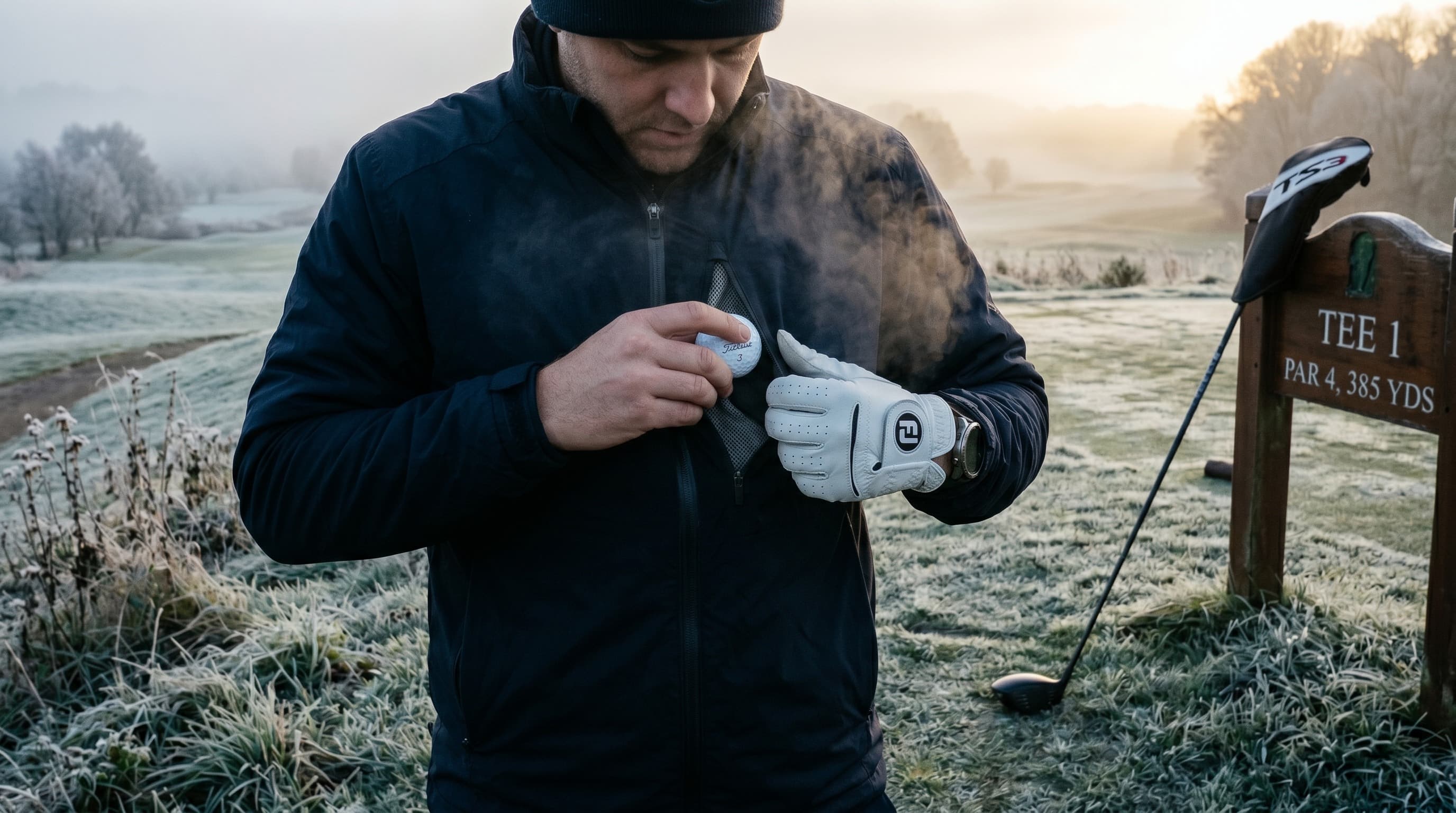
How Cold Weather Steals Distance: The Ball Compression Physics Every Golfer Should Know
Every 10°F drop costs the average golfer two to four yards of driver carry. Here is the physics — ball compression, air density, muscle temperature — and the field data we pulled from G-Score-monitored cold rounds to show exactly how distance loss compounds, and how to compensate without changing your swing.
Read Story
How to Read a G-Score: The 0–100 Golf Playability Number, Decoded
A G-Score on this site is a single 0–100 number that tells you whether today is worth tee-up. Here is exactly what each band means, what drives the calculation, and how to use it to plan a round you will actually score on.
Read StoryDanorie
Editorial & Data
Golf Weather Score is built by Danorie. We compute the G-Score — our own playability rating — from live NOAA forecasts and published course scorecards, so any US course can be compared on any day with a single number. Methodology and data sources are documented on every page.
Every Friday Morning
When Baraboo Country Club plays best next weekend.
Friday 6am ET: peak G-Score windows for Baraboo Country Club, wind direction by hour, and one gear call. Three minutes to read, save you the round.
One email a week. Unsubscribe in one click.
The Caddie's Oracle
Draw your luck before the tee off