
Caddie's Gear Advisor
Curated for today's 73°F · Clouds
Tour-Level Drivers
Engineered for maximum distance and forgiveness
Laser Rangefinders
Pin-seeking technology for precision approaches
Premium Golf Balls
Tour-caliber spin and distance performance
Performance Sunglasses
Polarized lenses optimized for reading greens
Your Golf Trip, Handled
The Ultimate Golf Trip Planner
Everything you need to play Battlefield Golf Club — from booking your flight to checking in course-side.
Course-Side Stays
Luxury hotels, resorts, and stay-and-play packages just minutes from the first tee.
Flights
Compare fares across 700+ airlines for the best route to your tee time.
SUV Rentals for Golf Bags
Spacious vehicles with room for clubs, bags, and your foursome.
Travel Insurance
Coverage for medical, weather delays, and gear at your destination.
Battlefield Golf Club: Course Intelligence
Signature Setup
The first tee at Battlefield sits low in the Chickamauga Valley, ridgelines pressing in on both sides, and on the August morning I played it the air was already thick — about 74°F at 7:40 a.m. with the dew still sitting on the bentgrass. By the turn it had climbed past 86°F and the greens had gone from quick to merely honest.
Battlefield Golf Club opened in 1970 in Ringgold, Georgia (Catoosa County, 30736), a few miles from the Chickamauga & Chattanooga National Military Park that gives the place its name. It plays to a par of 72 at 6,528 yards from the championship tees, rated 71.0 with a slope of 122; the middle tees drop to 6,301 yards (69.7 / 117). The course's original architect is not publicly documented — I'd rather say that plainly than attach a name I can't verify. What defines the round is its pair of front-side par-5s, Hole 2 (520 yards, #5 handicap) and Hole 5 (514 yards, #7 handicap), which set the scoring tone before you've settled in.
Hole-by-Hole Wind & Playing Lines
The valley runs roughly northeast–southwest, so the prevailing breeze funnels down its length rather than swirling — that channeling is the single most useful thing to know here.
Hole 2 (par-5, 520y, #5 handicap): Into a SW morning wind, this is a true three-shot hole. The wind robs maybe 15–20 yards from a driver and the green sits behind a false front, so a layup to a full wedge number beats a flushed long-iron that releases over the back. Downwind on a NE afternoon flow, stronger players can reach the front edge, but the putt back down-grain is the real defense.
Hole 5 (par-5, 514y, #7 handicap): Slightly more sheltered, but the same valley wind quarters across the second shot. I keep my layup on the upwind side of the fairway so the crosswind works the approach back toward center rather than off it.
For the rest of the card, the rule holds: when the flag is limp at the clubhouse, it's rarely limp at the green — read the ridgeline, not the pin.
Green & Fairway Characteristics
The greens are bentgrass, which is unusual this far south and changes how you putt by season. In spring and fall the surfaces firm up and run quick; under July–August heat and humidity the superintendent has to keep them soft to survive, so they slow and hold more than the slope number suggests. Read summer speed down, shoulder season up. The par-72 routing front-loads its length with those two early par-5s, so the front nine is where strokes are won; the closing holes reward position over power.
Seasonal Weather Pattern
Northwest Georgia is humid subtropical, and the valley exaggerates it. July afternoon highs sit near 89°F with thunderstorms building on roughly 4 in 10 summer afternoons — a hard ceiling on mid-day tee times. Autumn brings the best windows: cool mornings, often a low valley fog off West Chickamauga Creek that burns off by 9 a.m., then firm greens. Winters are mild but frost delays are common December–February, with highs in the low 50s°F. Spring plays beautifully once pollen settles in late April.
Local Play Tips
Metal spikes are not permitted, so pack soft-spike or spikeless shoes before you drive out. The valley floor holds moisture — after a heavy rain the fairways stay soft a day longer than ridge courses nearby, costing you roll. And because the bentgrass reads truest in cool air, a sub-9 a.m. tee time genuinely changes your putting day, not just your comfort.
Pre-Round Weather Workflow
Check the 7-day G-Score the night before and target the highest morning value — at Battlefield that almost always means the earliest slot before valley heat and storms stack up. Cross-reference the windExposure reading: a SW flow lengthens the front-nine par-5s, so plan layup clubs accordingly, while a calm fall morning is your green light to attack. If frost is flagged December–February, expect a delay and book a later block rather than fighting an icy first hour.
Related Reading
Before you tee off at Battlefield Golf Club

The May 2026 G-Score Heatmap: Where American Golf Peaks This Spring
May is the most underrated month on the American golf calendar. Five regions hit their annual peak this spring, three turn quietly hostile, and the data tells a clearer story than the brochures. Here is where to play, where to avoid, and how to time your booking window.
Read Story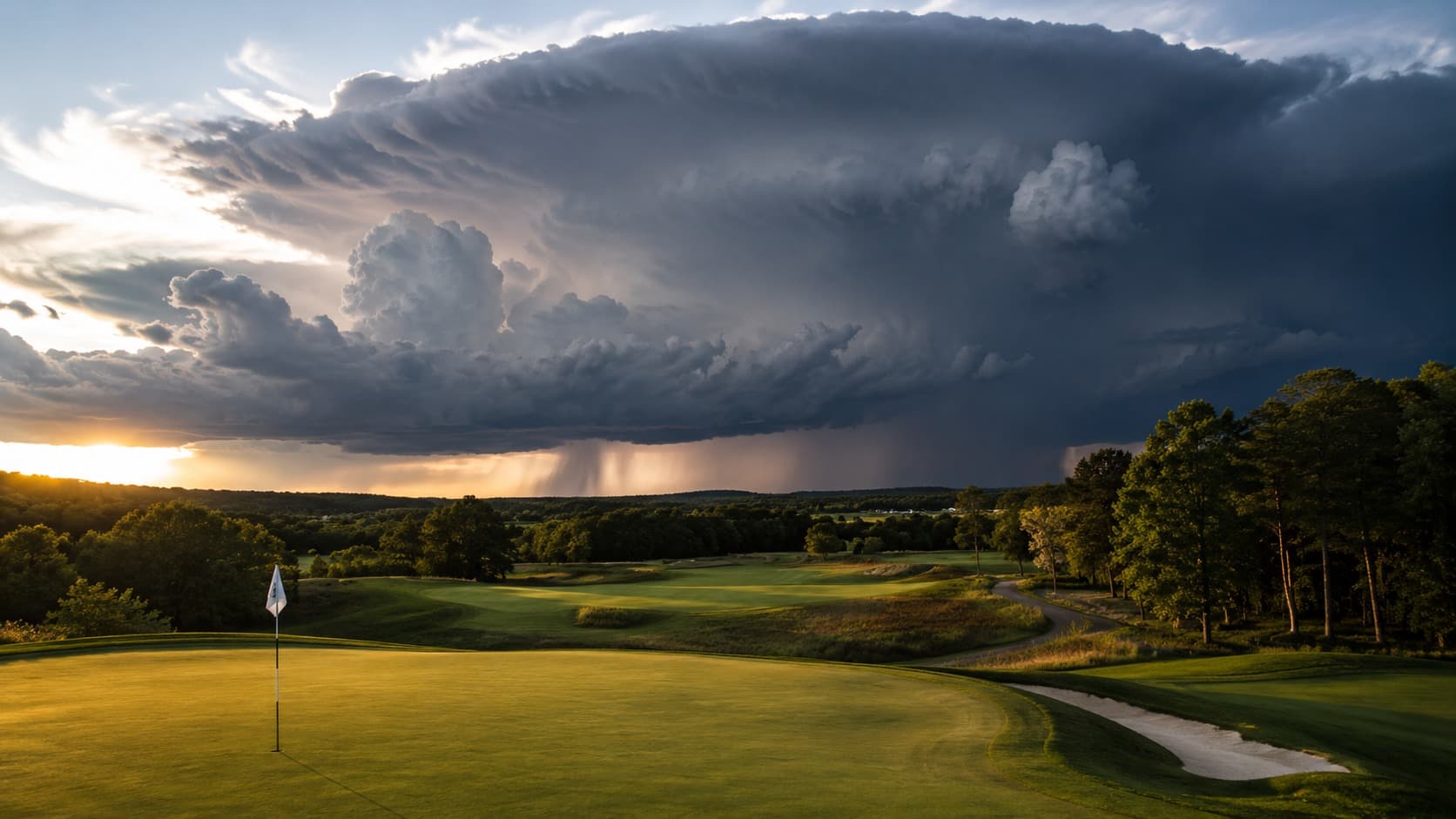
The Three O’Clock Storm: Reading Summer’s Convective Cycle to Protect Your Round
A 40% chance of afternoon thunderstorms does not mean a 40% chance of getting rained on. In the summer convective season it means the morning is nearly clear and the afternoon carries a fast-building, high-energy storm risk driven by a daily heating cycle. Here is the meteorology behind the pattern, the G-Score data on how the storm cycle punishes afternoon tee times across the Southeast, Midwest, and desert Southwest, the lightning-safety decision tree that actually matters, and the workflow that gets you off the course before the first bolt.
Read StoryMinSu Kim
Founder & Golf Data Analyst
MinSu is a data analyst and golfer with 10+ years on the course. He built Golf Weather Score to answer one question: is today a good day to play? He combines weather data, course intelligence, and the proprietary G-Score algorithm to help golfers make smarter decisions.
Every Friday Morning
When Battlefield Golf Club plays best next weekend.
Friday 6am ET: peak G-Score windows for Battlefield Golf Club, wind direction by hour, and one gear call. Three minutes to read, save you the round.
One email a week. Unsubscribe in one click.
The Caddie's Oracle
Draw your luck before the tee off