
Caddie's Gear Advisor
Curated for today's 80°F · Clear
Low-Spin Wind-Cheating Balls
Penetrating ball flight that holds its line in the gusts
Wind-Blocking Layers
Cut the chill and drag without choking your swing
Low-Launch Drivers
Lower spin off the tee for control in a crosswind
Secure-Fit Caps
Stay-put headwear built for a blustery round
Your Golf Trip, Handled
The Ultimate Golf Trip Planner
Everything you need to play Bay Forest Golf Club — from booking your flight to checking in course-side.
Course-Side Stays
Luxury hotels, resorts, and stay-and-play packages just minutes from the first tee.
Flights
Compare fares across 700+ airlines for the best route to your tee time.
SUV Rentals for Golf Bags
Spacious vehicles with room for clubs, bags, and your foursome.
Travel Insurance
Coverage for medical, weather delays, and gear at your destination.
Bay Forest Golf Club: Course Intelligence
Signature Setup
Bay Forest sits about a mile off Galveston Bay in La Porte, Texas, and you feel the water before you ever reach the lakes — the Gulf air comes in thick and warm off the bay from the first tee. I played here on a humid June morning, 79°F at 7:30 a.m. with the SE breeze already nudging the flags, and the front nine lulled me into thinking it was a quiet muni round before the back side opened up onto open water.
Jay Riviere designed Bay Forest in 1988 as a La Porte municipal course. It plays par 72 at 6,756 yards from the back tees, with a slope of 126 (135 from the blues). The routing has a split personality: a tight, tree-lined front nine, then a back nine dominated by lakes where water comes into play on 16 of the 18 holes overall. The signature is the 11th — a dogleg-right par-4 that bends around a pond to a well-bunkered green.
Hole-by-Hole Wind & Playing Lines
Hole 11 (par-4, dogleg right). The hardest decision on the course. The pond guards the inside of the dogleg and the green, and the prevailing SE bay wind blows across the line of play toward the water. Cutting the corner is tempting but the breeze pushes a fade right into the pond — I aimed at the left-center of the fairway and let the wind work the ball back. On the approach, take one extra club: golfers bail short to avoid the long carry and leave themselves a downwind chip from a bad angle.
Hole 6 (short par-3). Normally only a 9-iron to carry the bunker fronting the green. But on a stiff SE morning that same shot needs a 7-iron — the wind off the bay turns a wedge number into a mid-iron, and the front bunker eats anything that comes up soft. Club up and swing easy.
Hole 10 (par-5). The most birdie-friendly hole here, and the wind decides whether you go for it. Downwind off the SE breeze the green is reachable; into a north wind on a winter front, lay back and wedge it. I made my only birdie of the day here riding the bay breeze home.
Green & Fairway Characteristics
Bay Forest is Bermuda through and through — fairways and greens — so grain reads matter as much as slope, never more so than on an afternoon putt where the grass leans toward the setting sun. The June humidity keeps the surfaces soft and quick to stop a ball, which is the one break this course gives you: a high wedge flown at the flag actually holds here, where a firm-links runner would skitter through. The front nine is the tighter, tree-lined half where accuracy off the tee beats distance; the back opens up around the lakes and rewards a player who can shape the ball away from the water. Slope climbs from 126 on the back tees to 135 from the blues — that jump is the water tax on the longer, more aggressive lines. And on the back-nine greens, factor the bay wind into your read: a downhill, downgrain putt toward a lake runs out faster than the contour alone suggests.
Seasonal Weather Pattern
La Porte's weather is pure upper-Texas-Gulf-Coast: hot, humid summers with daytime highs in the low-to-mid 90s°F from June through September, and a near-daily SE sea breeze off Galveston Bay that builds through late morning. Spring and fall are the sweet spots — highs in the 70s, lower humidity, and steadier air for scoring. Winter brings the wildcard: northern cold fronts swing the wind hard from the south to a stiff north overnight, flipping the playing direction of the open back-nine holes. This is hurricane country too, with peak storm risk August through October, so check the bay forecast before committing to a fall trip. I've played the Houston area in summer but not Bay Forest in deep winter, so for January playing conditions I'd lean on NOAA bay-station records rather than claim firsthand feel.
Local Play Tips
Here's the read no scorecard gives you: the Galveston Bay sea breeze is a clock, not a constant. Early — before about 10 a.m. — the air is comparatively calm and the lake-lined back nine plays fair. By late morning the SE breeze is up, and with water on 16 of 18 holes that wind is the difference between an aimed approach and a wet one. Book the earliest tee time you can; on this course an early slot is worth roughly two clubs of accuracy on the back side. Second tip: respect the soft summer Bermuda — it grabs your wedge, so plan to fly approaches to the pin rather than running them up.
Pre-Round Weather Workflow
With water on 16 of 18 holes, your whole strategy at Bay Forest hangs on the bay-breeze clock. Three days out, look at the 7-day G-Score and find whether your tee time falls before or after the late-morning SE build — at a course this water-heavy that one swing is worth 8–12 points. On the morning of, the windExposure direction tells you where the trouble is: a SE bay wind blows across the open back-nine holes, so on 10 and 11 plan a club extra and an aim point on the dry side of every lakeside pin. In winter, watch the forecast for a north-wind front — it flips the back nine's playing direction, and the par-5 10th that rides home downwind on a SE breeze becomes an upwind grind. The scoring window is a calm, humid sub-80°F morning: get out early and fly your wedges at the flags into that soft summer Bermuda before the breeze and the heat both arrive.
Related Reading
Before you tee off at Bay Forest Golf Club
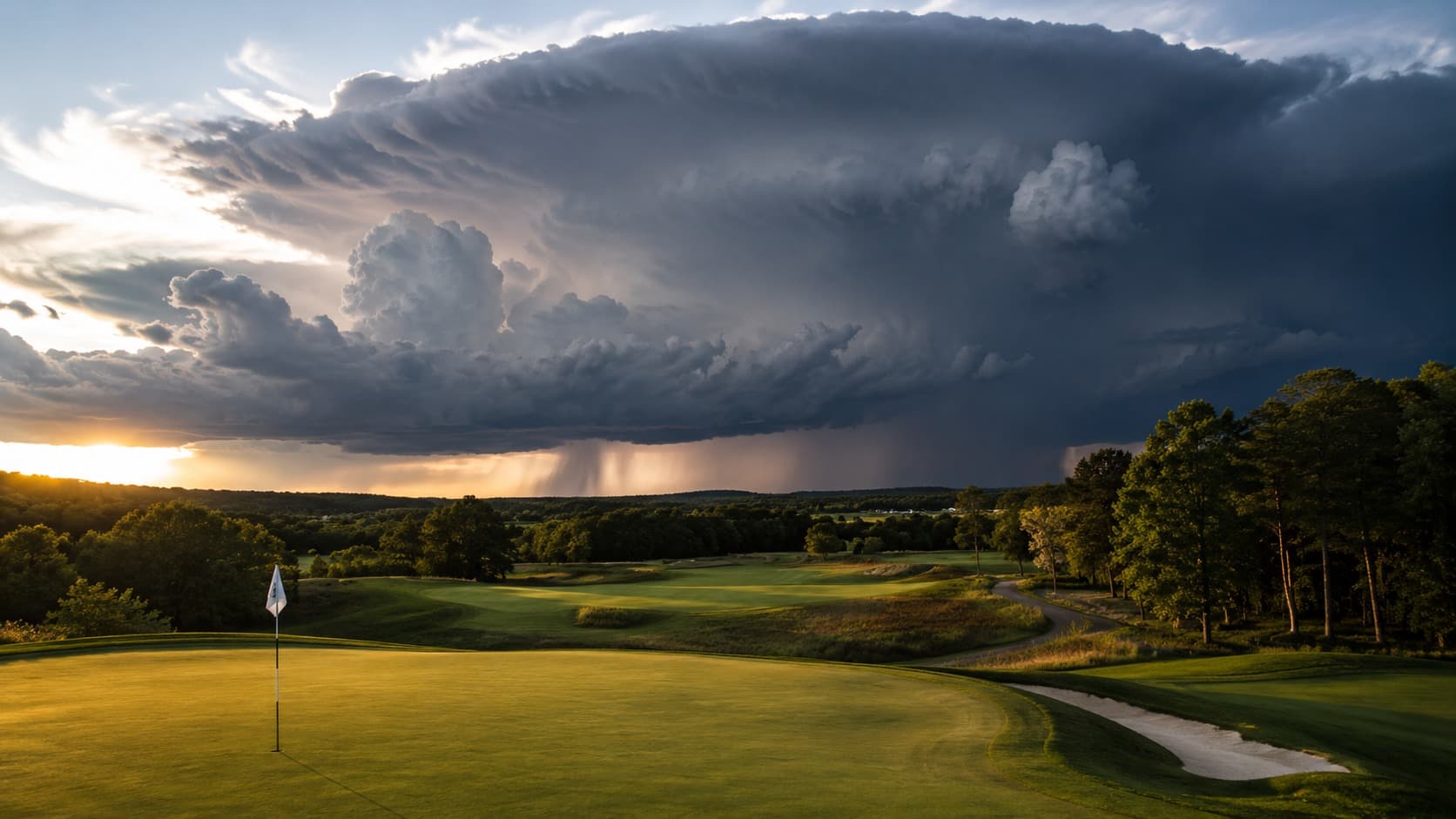
The Three O’Clock Storm: Reading Summer’s Convective Cycle to Protect Your Round
A 40% chance of afternoon thunderstorms does not mean a 40% chance of getting rained on. In the summer convective season it means the morning is nearly clear and the afternoon carries a fast-building, high-energy storm risk driven by a daily heating cycle. Here is the meteorology behind the pattern, the G-Score data on how the storm cycle punishes afternoon tee times across the Southeast, Midwest, and desert Southwest, the lightning-safety decision tree that actually matters, and the workflow that gets you off the course before the first bolt.
Read Story
The May 2026 G-Score Heatmap: Where American Golf Peaks This Spring
May is the most underrated month on the American golf calendar. Five regions hit their annual peak this spring, three turn quietly hostile, and the data tells a clearer story than the brochures. Here is where to play, where to avoid, and how to time your booking window.
Read StoryMinSu Kim
Founder & Golf Data Analyst
MinSu is a data analyst and golfer with 10+ years on the course. He built Golf Weather Score to answer one question: is today a good day to play? He combines weather data, course intelligence, and the proprietary G-Score algorithm to help golfers make smarter decisions.
Every Friday Morning
When Bay Forest Golf Club plays best next weekend.
Friday 6am ET: peak G-Score windows for Bay Forest Golf Club, wind direction by hour, and one gear call. Three minutes to read, save you the round.
One email a week. Unsubscribe in one click.
The Caddie's Oracle
Draw your luck before the tee off