
Caddie's Gear Advisor
Curated for today's 73°F · Clouds
Tour-Level Drivers
Engineered for maximum distance and forgiveness
Laser Rangefinders
Pin-seeking technology for precision approaches
Premium Golf Balls
Tour-caliber spin and distance performance
Performance Sunglasses
Polarized lenses optimized for reading greens
Your Golf Trip, Handled
The Ultimate Golf Trip Planner
Everything you need to play Bear's Best Atlanta — from booking your flight to checking in course-side.
Course-Side Stays
Luxury hotels, resorts, and stay-and-play packages just minutes from the first tee.
Flights
Compare fares across 700+ airlines for the best route to your tee time.
SUV Rentals for Golf Bags
Spacious vehicles with room for clubs, bags, and your foursome.
Travel Insurance
Coverage for medical, weather delays, and gear at your destination.
Bear's Best Atlanta: Course Intelligence
Signature Setup
I walked the first few holes here on a late-April morning, 61°F just after 8 a.m. with the Bermuda fairways still cool underfoot and the Gwinnett County hills throwing long shadows. What makes this place unusual hits you on the second or third tee: every hole is a recreation of a different Jack Nicklaus design from somewhere else in the world, so the round never settles into one rhythm — the look and the demand change hole to hole.
Bear's Best Atlanta opened in 2002 in Suwanee, Georgia, about 35 miles northeast of downtown Atlanta, built by Nicklaus Design as one of two "Bear's Best" collections (the other is in Las Vegas). The concept: 18 holes, each a replica of a hole Nicklaus himself picked as a favorite from courses he designed across the U.S. and abroad. From the championship tees it measures roughly 7,046 yards at par 72, with the rolling terrain of north Georgia standing in for deserts, coastlines, and mountains that the original holes were carved into.
Hole-by-Hole Wind & Playing Lines
Hole 9 (one of the hardest two-shotters, long par-4 ~440y). Into the prevailing southwest summer breeze this is the hole that quietly wrecks a card — a 150-yard approach plays closer to 170, and the green is built to reject a stock number. Club up, aim center, and accept a 30-foot putt.
Hole 15 (signature par-3, ~175y over water). The replica short hole. Wind off the right turns the carry into pure nerve; there is no bail-out short, only water. On a calm morning it is a mid-iron; by mid-afternoon with a SW wind into your face it can be two clubs more. Aim at the fattest part of the green, never the tucked pin.
A long par-5 on the back (~560y). With a helping SW wind the second shot tempts you to reach, but the replica greens here are small relative to their approach length. Lay back to a full wedge number rather than chunking a long iron into trouble.
Green & Fairway Characteristics
The greens are bentgrass — the north-Georgia standard for the era — and for daily play they run firm and quick in the low 11s on the Stimp, with more internal movement than the replica framing lets on; because each green imitates a different original, the contouring shifts character from hole to hole rather than following one designer's habit. The fairways are Bermuda and use the natural Gwinnett elevation change, so uneven lies and downhill kicks are common, and back-nine yardages stretch as the routing climbs and falls through the hills. Roll is generous in the warm months and almost nonexistent on a cold, damp morning.
Seasonal Weather Pattern
Suwanee sits inland in Georgia's humid subtropical zone, so it reads nothing like a coastal track. Spring (April–May) is the prime window — 62–78°F, firm turf, calm early air, though spring rain softens the Bermuda and the Atlanta pollen is relentless. Summer (June–August) is hot and humid, often 87–92°F, with afternoon thunderstorms that build off the heat between 2 and 4 p.m. and a steady SW wind of 6–12 mph by midday. Autumn (October–November) is the quiet best season: 54–72°F, dry, with still mornings. Winters are mild but the Bermuda goes dormant — 44–57°F by day, occasional morning frost delays that push early tee times back 30–60 minutes. NOAA north-Georgia records show summer afternoon gusts commonly out of the southwest, lighter than a coastal course but enough to add a club on the exposed replica par-3s.
Local Play Tips
Honest limitation first: I've walked Bear's Best on a spring morning rather than logged a full season of rounds here, so I lean on regional weather data for the summer and winter reads rather than claiming I've played them. The thing no yardage book tells you: because the holes are replicas of designs from very different climates, the wind matters more than the scorecard suggests — a hole modeled on a sheltered original sits fully exposed on a Georgia hilltop, so the "easy" replica can play hardest on a breezy afternoon. And the round is a race against the storm clock in summer; the thunderstorms here form off the afternoon heat, not a front, so a morning group finishes in dry calm while the 1 p.m. wave gets chased in.
Pre-Round Weather Workflow
Use the 7-day G-Score on this page the way I do. Three days out, check whether your summer tee window clears the 2–4 p.m. storm build — on a 7,046-yard par 72 with exposed replica par-3s, beating that window can move your score 6–10 points and save the round outright. The morning of, read the windExposure panel: a SW or W reading means the 9th and the over-water 15th both play longer, so club up one and aim at the fat side. And if it reads below 50°F with overnight rain, expect the dormant Bermuda to give back almost no roll — take an extra club into every green and let the firm bentgrass surfaces, not your driver, be the part of this round you respect.
Related Reading
Before you tee off at Bear's Best Atlanta
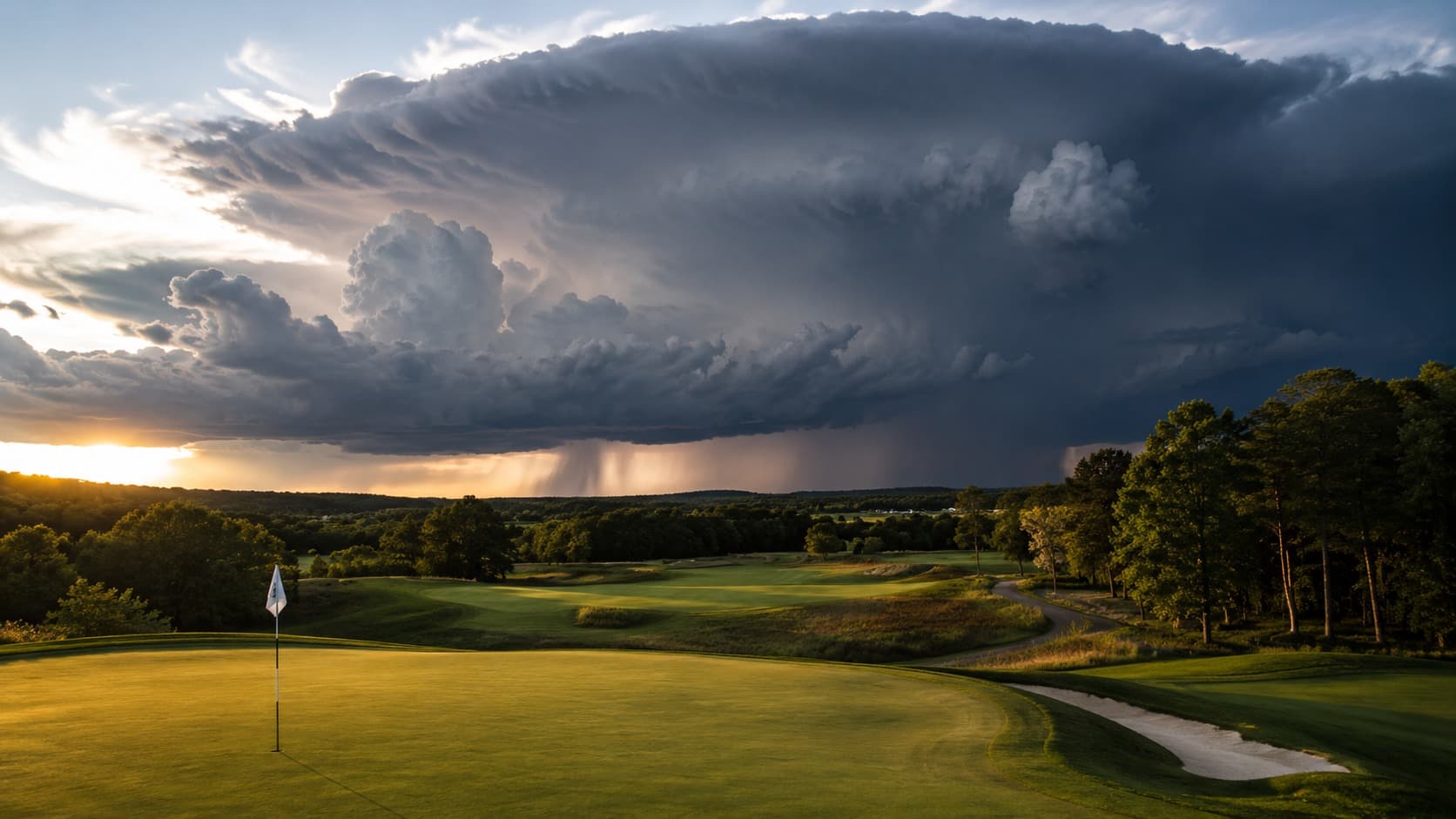
The Three O’Clock Storm: Reading Summer’s Convective Cycle to Protect Your Round
A 40% chance of afternoon thunderstorms does not mean a 40% chance of getting rained on. In the summer convective season it means the morning is nearly clear and the afternoon carries a fast-building, high-energy storm risk driven by a daily heating cycle. Here is the meteorology behind the pattern, the G-Score data on how the storm cycle punishes afternoon tee times across the Southeast, Midwest, and desert Southwest, the lightning-safety decision tree that actually matters, and the workflow that gets you off the course before the first bolt.
Read Story
Best Golf Weather by State: Ranking America by Average G-Score
We ranked all 50 US states by average G-Score golf playability. California tops the list, but the results beyond the top five may surprise you.
Read StoryMinSu Kim
Founder & Golf Data Analyst
MinSu is a data analyst and golfer with 10+ years on the course. He built Golf Weather Score to answer one question: is today a good day to play? He combines weather data, course intelligence, and the proprietary G-Score algorithm to help golfers make smarter decisions.
Every Friday Morning
When Bear's Best Atlanta plays best next weekend.
Friday 6am ET: peak G-Score windows for Bear's Best Atlanta, wind direction by hour, and one gear call. Three minutes to read, save you the round.
One email a week. Unsubscribe in one click.
The Caddie's Oracle
Draw your luck before the tee off