
Caddie's Gear Advisor
Curated for today's 95°F · Clear
Ultralight Distance Drivers
Maximum carry in hot, low-drag conditions
UV Protection Apparel
UPF 50+ cooling fabrics for peak-sun rounds
Precision Rangefinders
Slope-adjusted yardage in any condition
Hydration & Cooling
Insulated bottles and cooling towels
Your Golf Trip, Handled
The Ultimate Golf Trip Planner
Everything you need to play Bentwater — from booking your flight to checking in course-side.
Course-Side Stays
Luxury hotels, resorts, and stay-and-play packages just minutes from the first tee.
Flights
Compare fares across 700+ airlines for the best route to your tee time.
SUV Rentals for Golf Bags
Spacious vehicles with room for clubs, bags, and your foursome.
Travel Insurance
Coverage for medical, weather delays, and gear at your destination.
Bentwater: Course Intelligence
Signature Setup
I stood on the first tee at Bentwater on a October morning, 64°F at 7:30 a.m., the lake flat and the flags hanging dead — and I have learned not to trust that calm on Lake Conroe past mid-morning. Bentwater is a private club on the west shore of Lake Conroe, about an hour north of Houston near Montgomery, Texas, and it carries three 18-hole courses. The best known is the Miller Course, designed by Johnny Miller and the namesake of the property; the club also fields the Weiskopf Course (Tom Weiskopf) and the Grey Oaks Course. From the back tees the Miller layout stretches into the low-7,000s, par 72, and its character is defined less by length than by how much of it runs along, or toward, the water. I have played the Miller Course; I have not walked Weiskopf or Grey Oaks, so this article speaks mainly to the Miller.
Hole-by-Hole Wind & Playing Lines
Bentwater's scorecard is decided by where the wind sits relative to Lake Conroe, and in spring and summer that wind comes off the lake from the south to southeast by late morning.
- The long lakeside par 4 (~440y): Into the prevailing SSE breeze, the approach plays a full club longer and the lake pressures the aggressive side. Take one extra club, start it to the dry side, and treat the longer putt as the smart miss — wet is a guaranteed bogey-or-worse here.
- The water-carry par 3: On a still dawn it is a mid-iron; on a freshening south wind by 11 a.m. it becomes two clubs more, and the green sheds a ball that lands long on firm Bermuda. I have clubbed up from a 7-iron to a 5-iron on the same flag between an early and a late nine.
- The reachable-looking par 5 along the shore: With a helping south wind the green tempts you, but the water hugs one side the whole way. Lay back to a 100-yard third rather than chase a carry the breeze is pushing toward the lake.
Green & Fairway Characteristics
The greens are Bermuda, kept firm and quick — on a dry Texas afternoon they release hard, and a ball that carries two paces long runs off the back edge. The complexes are mid-sized and gather toward their lower collars, so short-siding yourself near the water leaves a putt that wants to feed back. Fairways are Bermuda as well, generous off most tees but framed by the lake and by mature pines and live oaks exactly where the bold line wants to go. The Miller Course opens a touch more forgiving and tightens as it bends back toward the shoreline; slope from the back tees sits in the mid-130s, which tells you the trouble is real once you leave the short grass.
Seasonal Weather Pattern
Lake Conroe's golf year is split by Gulf moisture, not by frost. March through May brings comfortable mornings near 58–66°F with afternoon highs in the upper 70s to mid-80s, and a south-southeast breeze that freshens after 10 a.m. as the lake heats. June through September flips the script: mornings are muggy and near-still, the heat index climbs past 100°F, and near-daily afternoon thunderstorms build off the heat by 2–3 p.m., often shutting play for an hour. Late fall and winter are the calm windows, broken by the occasional "blue norther" — a cold front that swings the wind hard to the north-northwest and drops the temperature 20–30°F in an afternoon, turning every lakeside approach into a different shot. I have played here only in fall, so I write the summer storm timing from local pattern and NOAA records rather than my own card.
Local Play Tips
The detail the scorecard will not tell you: the holes that run along Lake Conroe sit lowest and most exposed, so they catch the lake breeze first and hold it longest. A round that feels benign through the early holes can become a fight wherever the layout returns to the water. If you have a choice of tee time, take the earliest one — not for the temperature, but to play the shoreline holes before the south wind sets up. And carry an extra towel in summer: the morning humidity off the lake leaves grips and golf balls damp well past sunrise.
Pre-Round Weather Workflow
Pull the 7-day G-Score for Bentwater the night before and again at dawn. Watch two things: wind direction and the afternoon storm probability in summer. If the forecast shows a south-southeast wind above 10 mph, plan to reach the lakeside holes by mid-morning and add a club on every approach near the water. From June through September, treat any afternoon tee time as provisional and check radar before you make the turn — the windExposure flag on the shoreline holes is the one to trust here. On a winter norther, the wind flips to the north-northwest: re-club the water-carry par 3 in the other direction and do not short-side yourself anywhere on these firm Bermuda greens.
Related Reading
Before you tee off at Bentwater
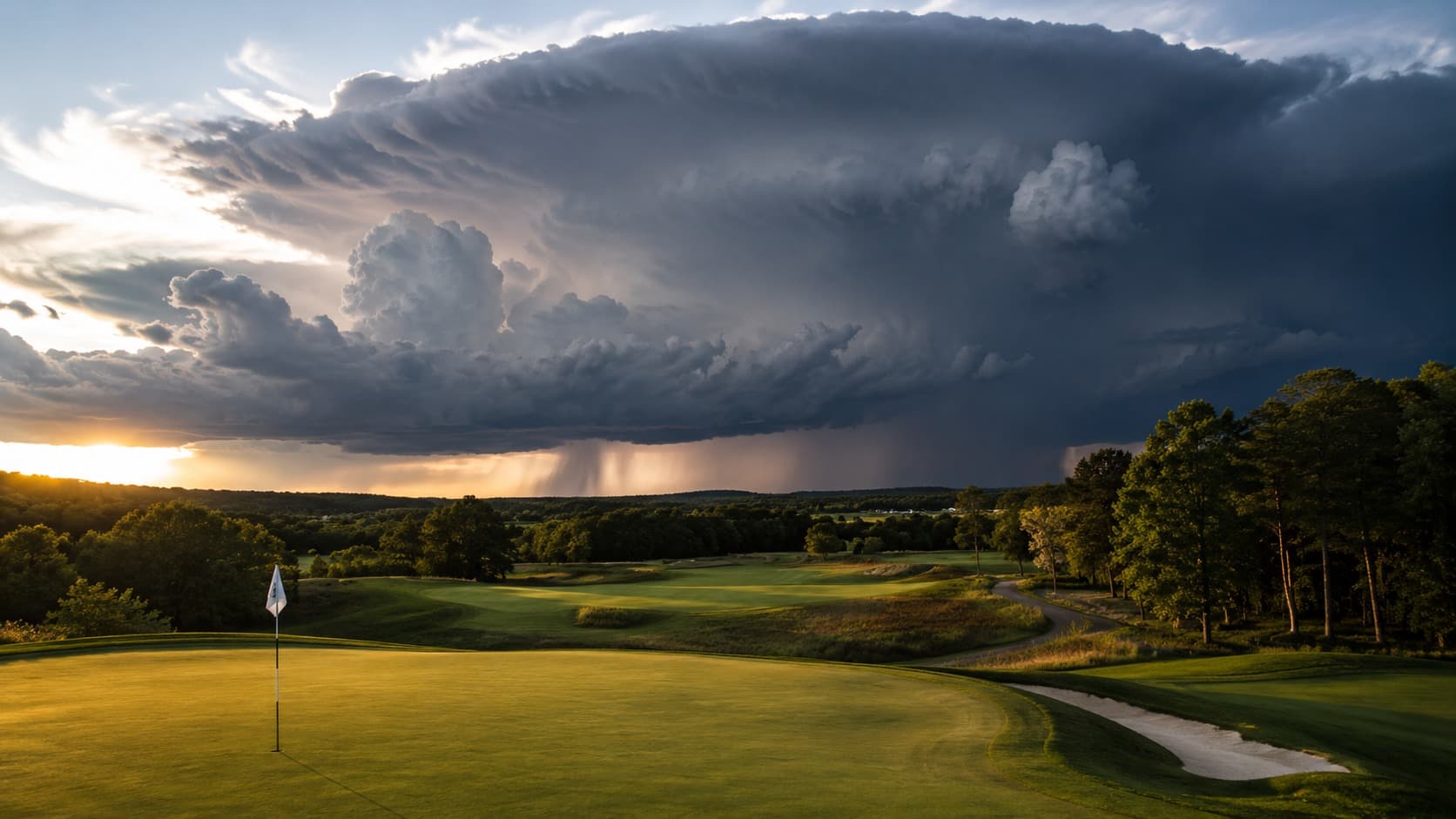
The Three O’Clock Storm: Reading Summer’s Convective Cycle to Protect Your Round
A 40% chance of afternoon thunderstorms does not mean a 40% chance of getting rained on. In the summer convective season it means the morning is nearly clear and the afternoon carries a fast-building, high-energy storm risk driven by a daily heating cycle. Here is the meteorology behind the pattern, the G-Score data on how the storm cycle punishes afternoon tee times across the Southeast, Midwest, and desert Southwest, the lightning-safety decision tree that actually matters, and the workflow that gets you off the course before the first bolt.
Read Story
The May 2026 G-Score Heatmap: Where American Golf Peaks This Spring
May is the most underrated month on the American golf calendar. Five regions hit their annual peak this spring, three turn quietly hostile, and the data tells a clearer story than the brochures. Here is where to play, where to avoid, and how to time your booking window.
Read StoryMinSu Kim
Founder & Golf Data Analyst
MinSu is a data analyst and golfer with 10+ years on the course. He built Golf Weather Score to answer one question: is today a good day to play? He combines weather data, course intelligence, and the proprietary G-Score algorithm to help golfers make smarter decisions.
Every Friday Morning
When Bentwater plays best next weekend.
Friday 6am ET: peak G-Score windows for Bentwater, wind direction by hour, and one gear call. Three minutes to read, save you the round.
One email a week. Unsubscribe in one click.
The Caddie's Oracle
Draw your luck before the tee off