
Caddie's Gear Advisor
Curated for today's 100°F · Clear
Ultralight Distance Drivers
Maximum carry in hot, low-drag conditions
UV Protection Apparel
UPF 50+ cooling fabrics for peak-sun rounds
Precision Rangefinders
Slope-adjusted yardage in any condition
Hydration & Cooling
Insulated bottles and cooling towels
Your Golf Trip, Handled
The Ultimate Golf Trip Planner
Everything you need to play BlackHorse Golf Club — from booking your flight to checking in course-side.
Course-Side Stays
Luxury hotels, resorts, and stay-and-play packages just minutes from the first tee.
Flights
Compare fares across 700+ airlines for the best route to your tee time.
SUV Rentals for Golf Bags
Spacious vehicles with room for clubs, bags, and your foursome.
Travel Insurance
Coverage for medical, weather delays, and gear at your destination.
BlackHorse Golf Club: Course Intelligence
Signature Setup
The thing you notice first at BlackHorse isn't a hole — it's the air. Cypress sits northwest of Houston, far enough inland to dodge the coast yet close enough that the morning hangs heavy and wet on your shirt before the sun is fully up. The humidity deadens the ball; the afternoon Gulf wind wakes it back up. That swing, calm-and-soft to breezy-and-firm, is the round.
TL;DR: Jacobsen Hardy Golf Design (Peter Jacobsen and Jim Hardy), opened 2000, a 36-hole daily-fee in Cypress, TX. The North Course tips at roughly 7,301 yards, par 72, slope in the mid-130s, with a quarry stretch on the back nine. The defense is the prevailing south-southeast Gulf wind plus summer firmness — book the calm early window and club up into the afternoon flow.
BlackHorse opened in 2000 with two full 18s, North and South, routed by Jacobsen Hardy across reclaimed gravel-pit land. The North Course is the one people talk about: its closing stretch runs through an old quarry, with cut rock walls and forced carries that give a flat corner of Texas some genuine vertical drama. I'll be straight with you — I haven't walked both nines of the South in summer, so I'll keep this to what the North and the Houston weather actually do.
Hole-by-Hole Wind & Playing Lines
I won't pin yardages to hole numbers I can't read off a card in front of me, so here is the wind logic that decides scoring on a Houston layout this exposed:
- The North quarry carries on the back nine: These are the holes where a misjudged wind costs you a ball, not a stroke. Into the prevailing SSE breeze, a forced carry you'd clear easily on a calm day comes up wet — take the longer read, fly it lower, and aim for the safe quarry-side bailout rather than flirting with the rock wall.
- The long par-4s playing into the south wind: Into a 12–15 mph Gulf flow, a flushed 150-yard club behaves like 165–170. Club up, knock it down under the wind, and favor the fat middle of the large Bermuda greens — a ballooned high shot into this wind dies short and spins off the firm surface.
- Any hole turning downwind to the north: The breeze that fought you all front now adds carry. Take less club than your eyes want and land it short of the firm fronts, because a downwind Bermuda green in July won't hold a hot long iron.
The habit that travels here: read the flag on the first open hole, gauge how hard the Gulf breeze has filled in, and re-club into the wind for the rest of the round.
Green & Fairway Characteristics
Everything underfoot is Bermuda — fairways and greens both — which means the surfaces firm up fast once the summer sun is on them. A flushed drive that lands on a baked Bermuda fairway in August will chase well past where a spring shot stops. The greens are generously sized but carry real internal movement, and the tips slope sits in the mid-130s. They hold a soft, humid morning honestly and turn slick and unreceptive by a hot, windy afternoon. Approach below the hole and respect the grain: late in the day, a long iron landing hot releases straight off the back, and the up-and-down from a short-sided Bermuda lie is a coin-flip bogey.
Seasonal Weather Pattern
Cypress runs hot and humid for much of the golf year, with the Gulf driving both the moisture and the wind. Spring (Mar–May): the sweet spot — mild mornings in the 60s°F, softer surfaces, and a steady but manageable south breeze before the real heat lands. Summer (Jun–Aug): brutal humidity and highs in the low-to-mid 90s°F, with heat-index readings often pushing past 100°F by early afternoon; firm Bermuda, an afternoon Gulf wind, and pop-up thunderstorms that can shut the course down for an hour. Fall (Sep–Nov): the second-best window — cooling, drier, still green, with the occasional early cold front. Winter (Dec–Feb): mild but variable, 50s–60s°F most days until a "blue norther" cold front swings the wind hard to the NNW, drops the temperature 30°F in an afternoon, and reverses the playing direction of every hole.
Local Play Tips
The instinct a dry-climate golfer gets wrong here is the ball flight. Houston's heavy, humid air deadens carry in the calm of the morning — your stock numbers can come up genuinely short before the wind even factors — and then the afternoon Gulf breeze flips the math the other way. Two specifics worth knowing before you book: the summer threat isn't only heat, it's the afternoon thunderstorm cell that builds off the Gulf moisture, so an early tee time dodges both the worst heat index and the lightning delay. And on a winter blue-norther day, throw your normal wind plan out — the wind reverses from south to hard north, and the holes that played downwind all season suddenly play into a cold, stiff breeze.
Pre-Round Weather Workflow
Use the 7-day G-Score the way I do for a Gulf-Coast course like this. First, target the calm early window: scan for the morning slot before the south breeze fills in and before the heat index climbs past 100°F — that's your high-G-Score tee time, often a full band above a gusty mid-afternoon. Second, read the windExposure flag for the North Course quarry holes specifically; a 12–15 mph reading that's a non-event on a sheltered layout is a club-and-a-half swing across those forced carries. Third, in summer check the afternoon thunderstorm probability before you commit, and in winter check for an incoming cold front — a blue norther doesn't just cool things down, it reverses which holes play hard. Book the calm morning, and let the wind chart set your clubs before you reach the first open tee.
Related Reading
Before you tee off at BlackHorse Golf Club
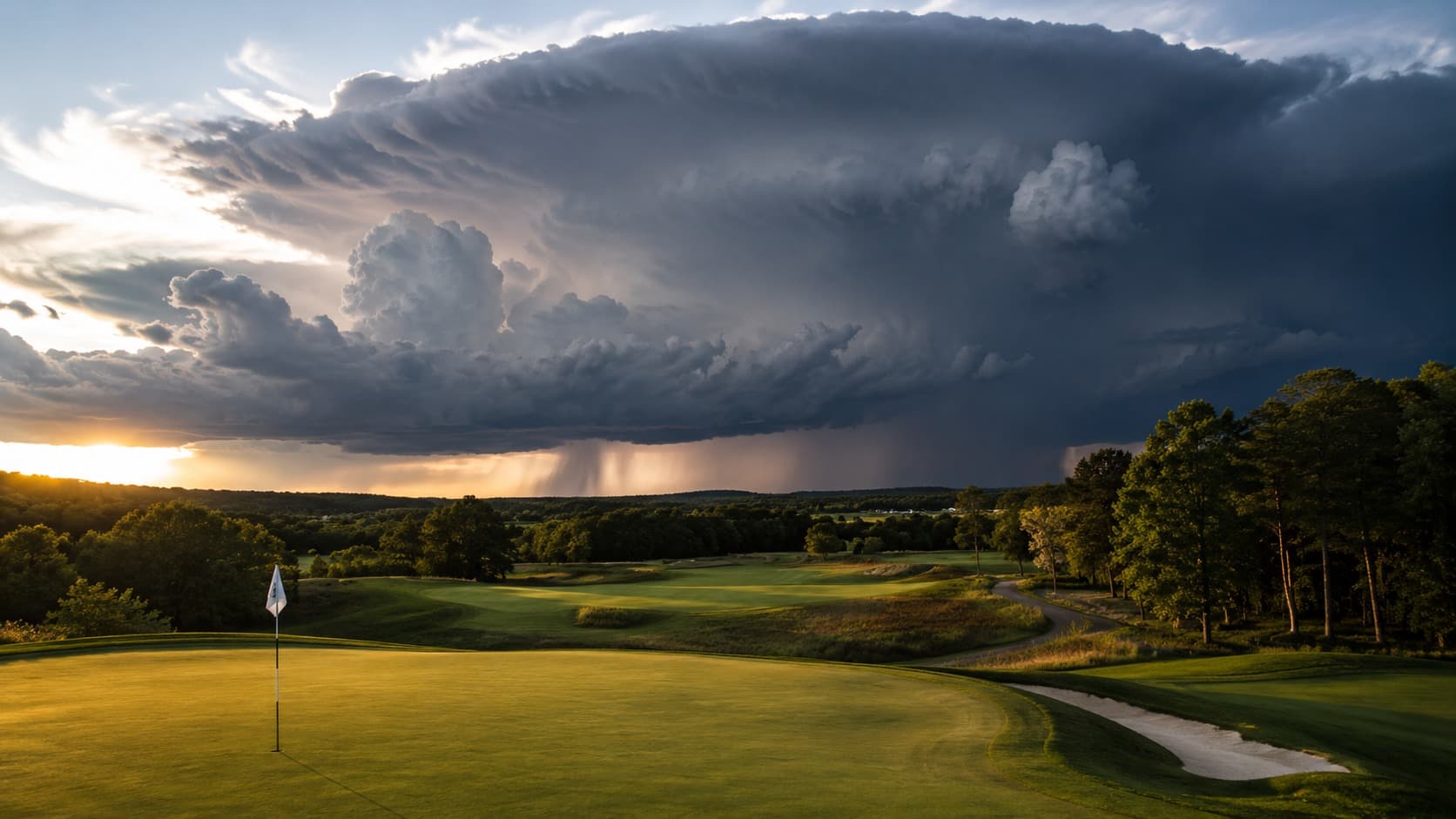
The Three O’Clock Storm: Reading Summer’s Convective Cycle to Protect Your Round
A 40% chance of afternoon thunderstorms does not mean a 40% chance of getting rained on. In the summer convective season it means the morning is nearly clear and the afternoon carries a fast-building, high-energy storm risk driven by a daily heating cycle. Here is the meteorology behind the pattern, the G-Score data on how the storm cycle punishes afternoon tee times across the Southeast, Midwest, and desert Southwest, the lightning-safety decision tree that actually matters, and the workflow that gets you off the course before the first bolt.
Read Story
The May 2026 G-Score Heatmap: Where American Golf Peaks This Spring
May is the most underrated month on the American golf calendar. Five regions hit their annual peak this spring, three turn quietly hostile, and the data tells a clearer story than the brochures. Here is where to play, where to avoid, and how to time your booking window.
Read StoryMinSu Kim
Founder & Golf Data Analyst
MinSu is a data analyst and golfer with 10+ years on the course. He built Golf Weather Score to answer one question: is today a good day to play? He combines weather data, course intelligence, and the proprietary G-Score algorithm to help golfers make smarter decisions.
Every Friday Morning
When BlackHorse Golf Club plays best next weekend.
Friday 6am ET: peak G-Score windows for BlackHorse Golf Club, wind direction by hour, and one gear call. Three minutes to read, save you the round.
One email a week. Unsubscribe in one click.
The Caddie's Oracle
Draw your luck before the tee off