
Caddie's Gear Advisor
Curated for today's 78°F · Thunderstorm
Storm-Ready Outerwear
Waterproof layers built for 18 holes in the rain
Tour-Grade Umbrellas
68" double-canopy wind-resistant coverage
Wet-Weather Gloves
All-weather grip that performs in the rain
Waterproof Golf Shoes
Keep your feet dry through every fairway
Your Golf Trip, Handled
The Ultimate Golf Trip Planner
Everything you need to play Blacklick Woods Golf Course — from booking your flight to checking in course-side.
Course-Side Stays
Luxury hotels, resorts, and stay-and-play packages just minutes from the first tee.
Flights
Compare fares across 700+ airlines for the best route to your tee time.
SUV Rentals for Golf Bags
Spacious vehicles with room for clubs, bags, and your foursome.
Travel Insurance
Coverage for medical, weather delays, and gear at your destination.
Blacklick Woods Golf Course: Course Intelligence
Signature Setup
The honest caveat first: I built this from Blacklick Woods' location, the central-Ohio golf calendar, and Franklin County climate records — I have not teed it up, so the wind reads below are pattern reasoning, not a round I'm recalling. The course sits in Reynoldsburg, on the east side of Columbus in Franklin County, at roughly 40°N and near 760 feet of elevation. It's one of the older metro-park courses in the Columbus system, opened in 1958 and credited to Jack Kidwell, the central-Ohio architect whose name is attached to dozens of Ohio layouts. What I can stand behind is the geography: a mature, tree-lined inland parkland course sitting in a humid-continental corridor where the wind answers to passing fronts, not to any land-sea cycle.
TL;DR: Mature 1958 Columbus metro-park course (Reynoldsburg, ~40°N, ~760 ft), tree-lined and inland. The defining test is a prevailing SW summer wind funneling through wooded corridors, inside an April–October season squeezed by Ohio winters. Read the front, use the tree shelter, ignore the clock.
Hole-by-Hole Wind & Playing Lines
Blacklick Woods is a two-course metro-park facility and I can't independently verify a per-hole stroke-index card, so rather than inventing hole numbers I'll explain how the wind dictates play on a tree-lined parkland layout like this:
- The longer par-4s into a SW afternoon wind: with the prevailing southwesterly at 12–18 mph — common on summer afternoons in central Ohio — a 150-yard shot plays closer to 170. Take two more clubs and keep the flight beneath the tree line rather than launching it into the gust.
- The downwind holes after a NW post-front shift: once a cold front clears Columbus, the dry tailwind shortens the card and the fairways start running. Land short and let the ball release rather than flying a hot pitch onto a surface that won't hold it.
- The corridor holes between mature trees: the tree line both shelters and confuses the wind — a gust felt at the tee can die in the chute and return at the green, so trust the flag over the feel on your cheek.
The carryover habit: on the opening exposed hole, work out whether this is system wind off a front or a light daytime drift, and let that single read set your clubbing through the green.
Green & Fairway Characteristics
Expect cool-season turf typical of central Ohio — bentgrass-and-poa greens over bluegrass-and-fescue fairways. At this latitude the surfaces firm up under a dry July high and soften fast under the region's summer thunderstorms, so your stock yardages only hold in a genuinely settled window. The metro-park layout is mature and gently rolling rather than dramatic, with the tree corridors doing most of the defending; on a calm morning the fairways flatter a straight hitter, but in central Ohio a dead-calm round is the exception, not the rule.
Seasonal Weather Pattern
Columbus sits in a humid continental climate — cold winters, warm humid summers, and no maritime moderation. Spring (Apr–May) opens wet and variable; shifting winds and saturated ground are common into mid-May, and the course can stay soft early. Summer (Jun–Aug) is the prime window — highs in the mid-80s°F, a prevailing SW breeze, and the firmest turf of the year between thunderstorm systems that can blow up on a humid afternoon. Fall (Sep–Oct) brings crisp, often excellent golf, but the first hard cold snaps arrive by late October. Winter effectively closes the season for cold and snow; for that stretch I lean on NOAA Columbus historicals rather than anything firsthand.
Local Play Tips
Here's where a seaside golfer's playbook fails inland: an early tee time buys you no wind advantage on this parkland ground. The wind is fed by passing fronts, not a land-sea cycle that turns over each afternoon — so the deciding factor is the state of the nearest system, not the position of the sun. A stable summer high can stay near-calm dawn to dusk; a front rolling across central Ohio can sit 20-plus-mph gusts on the course for the whole round regardless of when you started. The one timing edge that is real here is thunderstorm avoidance — summer cells tend to fire in the afternoon heat, so a dawn nine genuinely lowers your odds of a lightning hold, not your wind.
Pre-Round Weather Workflow
For a tree-lined inland course like this, lean on golfweatherscore's 7-day G-Score and windExposure front-first, not clock-first. Three days out, the G-Score curve mostly tells you when the next system lands; at 40°N a slide from 9 down to 4 is a front moving in, almost never the time of day. The night before, settle the wind: a SW flow points to warmer, firmer summer golf, while a post-front NW shift brings dry, fast turf that swallows the downwind holes. And on the tee, if windExposure is calling steady 20-mph-plus gusts, plan for the exposed corridors to demand a club or two more into the wind — and in July, check the convective outlook before you book an afternoon slot, because a Columbus thunderstorm cares nothing for your tee time.
Related Reading
Before you tee off at Blacklick Woods Golf Course

Tour Caddie Math: How Pros Adjust Yardages for Wind, Temperature, and Altitude on Every Shot
When a tour caddie hands over a club, the number on the bag is rarely the number on the bag. Wind, temperature, altitude, and air density all rewrite the math before the player ever takes a practice swing. Here is the calculation framework pros run on every shot, translated for serious amateurs.
Read Story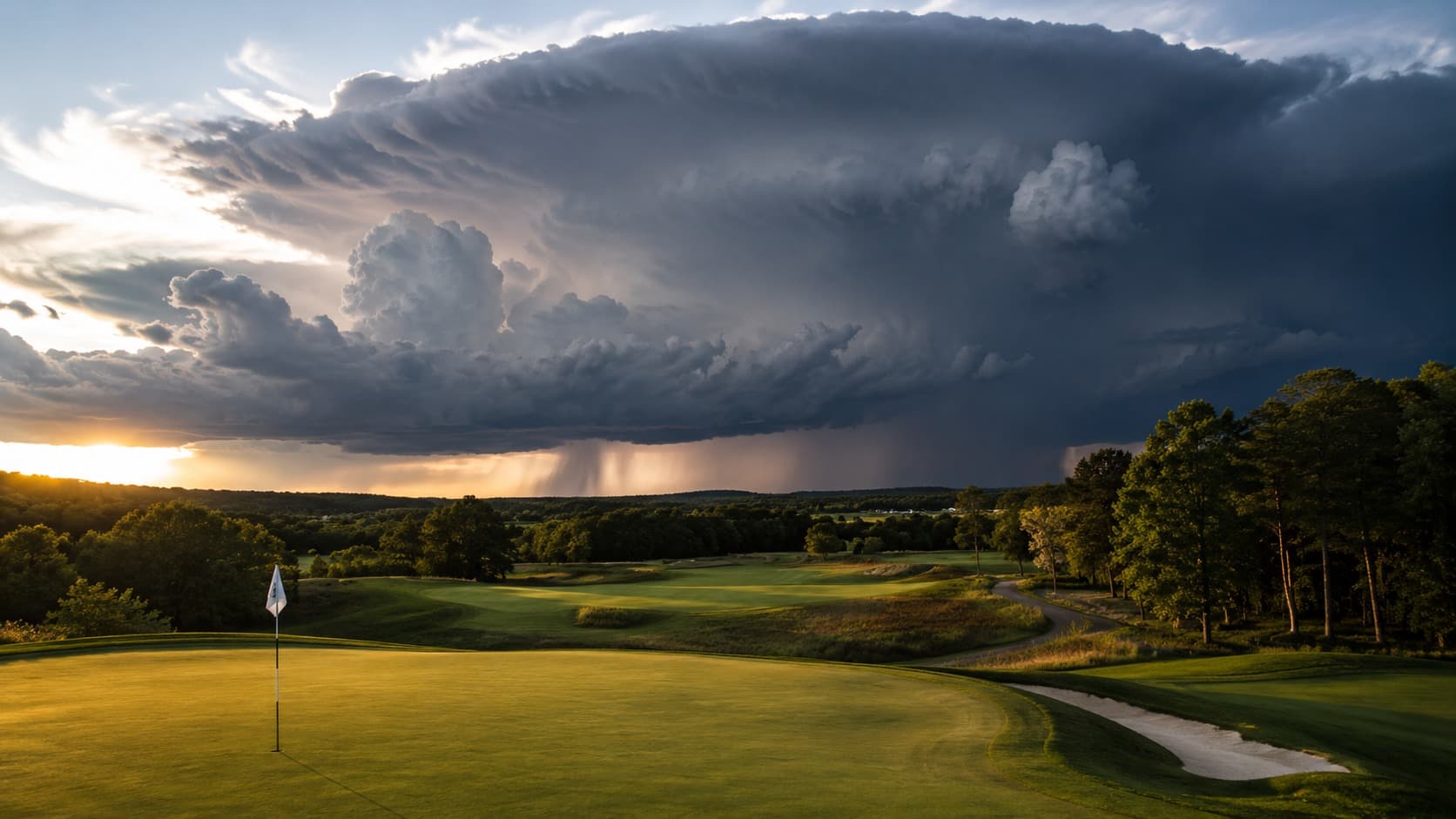
The Three O’Clock Storm: Reading Summer’s Convective Cycle to Protect Your Round
A 40% chance of afternoon thunderstorms does not mean a 40% chance of getting rained on. In the summer convective season it means the morning is nearly clear and the afternoon carries a fast-building, high-energy storm risk driven by a daily heating cycle. Here is the meteorology behind the pattern, the G-Score data on how the storm cycle punishes afternoon tee times across the Southeast, Midwest, and desert Southwest, the lightning-safety decision tree that actually matters, and the workflow that gets you off the course before the first bolt.
Read StoryMinSu Kim
Founder & Golf Data Analyst
MinSu is a data analyst and golfer with 10+ years on the course. He built Golf Weather Score to answer one question: is today a good day to play? He combines weather data, course intelligence, and the proprietary G-Score algorithm to help golfers make smarter decisions.
Every Friday Morning
When Blacklick Woods Golf Course plays best next weekend.
Friday 6am ET: peak G-Score windows for Blacklick Woods Golf Course, wind direction by hour, and one gear call. Three minutes to read, save you the round.
One email a week. Unsubscribe in one click.
The Caddie's Oracle
Draw your luck before the tee off