
Caddie's Gear Advisor
Curated for today's 108°F · Clear
Ultralight Distance Drivers
Maximum carry in hot, low-drag conditions
UV Protection Apparel
UPF 50+ cooling fabrics for peak-sun rounds
Precision Rangefinders
Slope-adjusted yardage in any condition
Hydration & Cooling
Insulated bottles and cooling towels
Your Golf Trip, Handled
The Ultimate Golf Trip Planner
Everything you need to play Blackstone Country Club — from booking your flight to checking in course-side.
Course-Side Stays
Luxury hotels, resorts, and stay-and-play packages just minutes from the first tee.
Flights
Compare fares across 700+ airlines for the best route to your tee time.
SUV Rentals for Golf Bags
Spacious vehicles with room for clubs, bags, and your foursome.
Travel Insurance
Coverage for medical, weather delays, and gear at your destination.
Blackstone Country Club: Course Intelligence
Signature Setup
Let me be straight before any strategy: this read is built on Blackstone's design pedigree, the Sonoran Desert climate record, and how Jim Engh layouts typically play — I have not teed it up, so what follows is pattern reasoning, not a recalled round. Blackstone Country Club sits inside the Vistancia community in Peoria, Arizona, on the northwest edge of the Phoenix metro, and it is a Jim Engh design that opened in 2007 as the private centerpiece of that development. Engh's name tells you most of what you need: dramatic elevation movement, deep "muscle" bunkers carved into the desert wash, bold green contours, and risk-reward short holes that tempt the aggressive line. The routing runs through high Sonoran desert terrain and stretches past 7,100 yards from the back — a genuine championship test, not a residential filler course.
TL;DR: Private Jim Engh desert course (2007) in Peoria, Arizona, in the Phoenix metro. Bermuda turf, firm and fast, bold Engh bunkering and greens, over 7,100y from the tips. No sea breeze — the variables are heat, dry afternoon wind, and the summer monsoon. Play dawn in the hot months and respect the storm window.
Hole-by-Hole Wind & Playing Lines
Blackstone is a private club and I won't invent a hole-by-hole handicap card I can't verify, so instead I'll lay out how desert wind dictates play on an Engh build of this length:
- The longest par-4s into a dry SW afternoon wind: at 12–18 mph, a flushed 150-yard club plays to roughly 165 on the number, and into firm Bermuda the ball checks little — the answer is an extra club and a flatter flight, not a high ball that the surface won't hold.
- The drivable risk-reward par-4: wherever Engh dangles a short two-shotter over the wash, a crossing canyon wind is the real defense. Club for the gusting read off a single tee-ball decision — short-siding into one of his deep bunkers is exactly how a birdie putt becomes a double.
- The downwind desert holes in the morning calm: before the heat builds the thermals, the air sits quiet and the firm fairways run forever. Land short and release into these tilted greens rather than flying a hot wedge that skips past a back pin.
The habit to carry: read on the first exposed hole whether the desert wind has come up for the day or it's still the dawn calm, and let that one call set your clubbing the rest of the way.
Green & Fairway Characteristics
Expect Bermuda from tee to green — standard for premium Arizona desert golf — overseeded with ryegrass through the winter season for color and a tighter lie. The defining elements are Engh's signatures: firm, fast putting surfaces with bold internal contour, and the deep "muscle" bunkers he sculpts into the terrain so a slightly missed approach is genuinely penalized. The side you miss on matters as much as the line. From the championship tees past 7,100 yards the course asks for length off the tee, but the scoring pressure lives on the second shot and the putt. Firmness swings hard with the weather — baking rock-hard under a summer ridge, only softening briefly after a monsoon cell — so your stock yardages hold mainly in the settled cool-season windows.
Seasonal Weather Pattern
Peoria lies in the hot Sonoran Desert climate, and the calendar here is the opposite of most U.S. courses. Winter (Dec–Feb) is the prime season — highs commonly in the 60s–70s°F, dry air, firm greens, and the steadiest scoring conditions of the year. Spring (Mar–Apr) stays excellent but warms quickly, with afternoon wind picking up. Summer (May–Sep) is brutal: highs regularly clear 105–110°F, and play moves to dawn out of necessity. The monsoon (roughly Jul–Aug) layers in afternoon and evening thunderstorms with dust gusts and sudden wind shifts that can shut a round down fast. For the deep-summer heat windows I'd lean on NOAA Phoenix-area historicals rather than anything firsthand.
Local Play Tips
The coastal reflex that misfires at Blackstone: there's no daily sea breeze to outrun, and no lake to read. This is desert golf, and the two variables that decide your round are heat and the monsoon. From May through September the only sane tee time is at or near dawn — not for the wind, but to finish before the surface and the air turn punishing. In the monsoon stretch, watch the afternoon storm window: a clear morning can give way to a dust-front gust line by early evening that swings wind direction 90 degrees in minutes. Plan around the heat curve and the storm outlook rather than the morning-versus-afternoon habit, and you'll manage this course far better than a golfer booking on instinct.
Pre-Round Weather Workflow
On a hot-desert course, golfweatherscore's 7-day G-Score and windExposure earn their keep when you read them around the heat and the monsoon. In the cool season the G-Score trend mostly flags wind and the occasional Pacific system; in summer a high number at dawn collapsing to a low one by afternoon is the heat-and-storm curve, not a change you can wait out. The night before, nail down two things: the high temperature and the afternoon storm probability. A dry, hot SW flow means firm, fast turf and a hard ceiling on tee-time options; a monsoon setup means watching the radar for the gust front. Then on the tee, if windExposure is calling steady 15–18 mph desert gusts, expect this 7,100-yard Engh card to stretch a club or more into the wind — favor the broad side of his contoured greens, leave the deep-bunkered pins alone, and let position protect the number.
Related Reading
Before you tee off at Blackstone Country Club
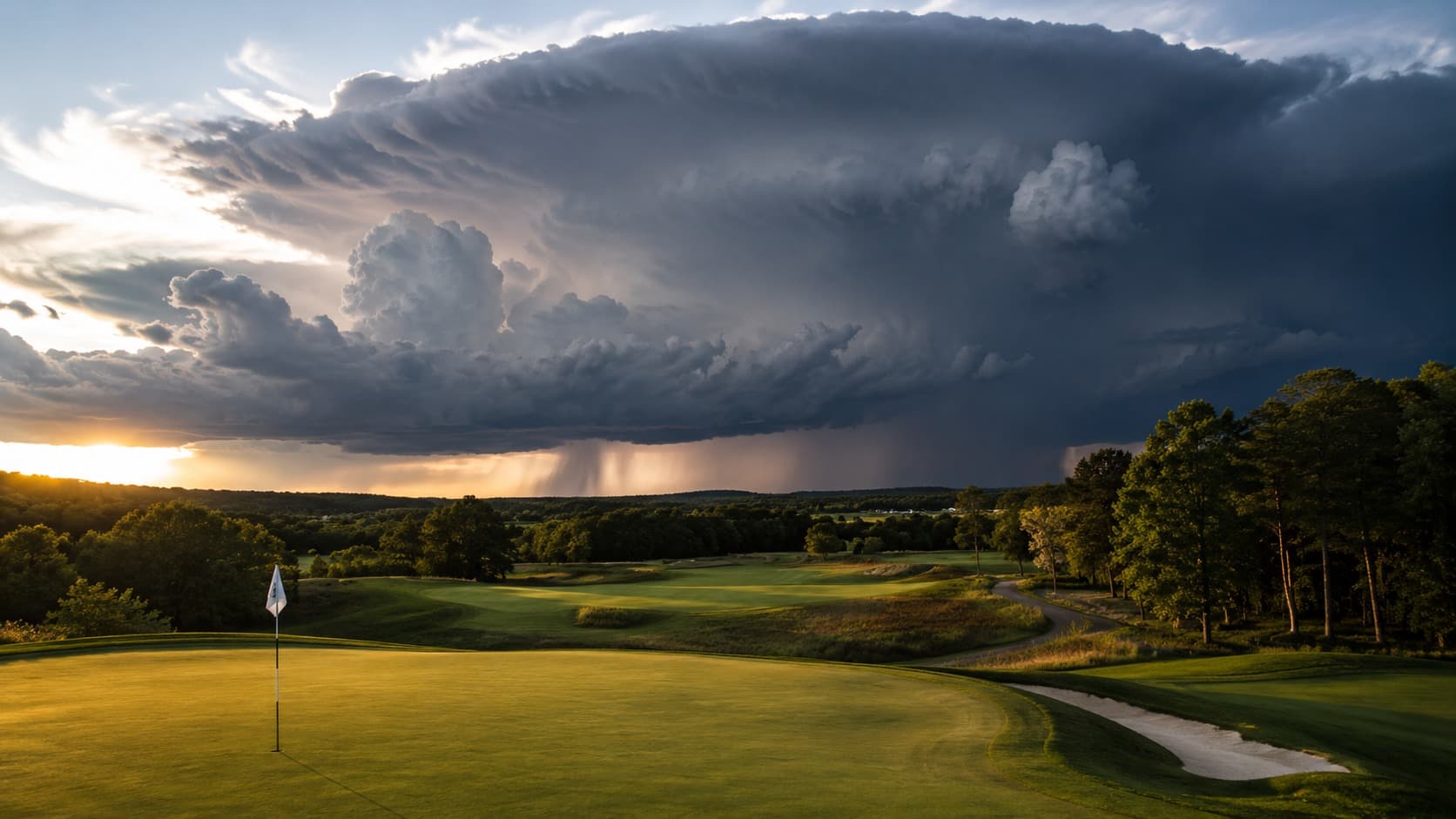
The Three O’Clock Storm: Reading Summer’s Convective Cycle to Protect Your Round
A 40% chance of afternoon thunderstorms does not mean a 40% chance of getting rained on. In the summer convective season it means the morning is nearly clear and the afternoon carries a fast-building, high-energy storm risk driven by a daily heating cycle. Here is the meteorology behind the pattern, the G-Score data on how the storm cycle punishes afternoon tee times across the Southeast, Midwest, and desert Southwest, the lightning-safety decision tree that actually matters, and the workflow that gets you off the course before the first bolt.
Read Story
How to Read a G-Score: The 0–100 Golf Playability Number, Decoded
A G-Score on this site is a single 0–100 number that tells you whether today is worth tee-up. Here is exactly what each band means, what drives the calculation, and how to use it to plan a round you will actually score on.
Read StoryMinSu Kim
Founder & Golf Data Analyst
MinSu is a data analyst and golfer with 10+ years on the course. He built Golf Weather Score to answer one question: is today a good day to play? He combines weather data, course intelligence, and the proprietary G-Score algorithm to help golfers make smarter decisions.
Every Friday Morning
When Blackstone Country Club plays best next weekend.
Friday 6am ET: peak G-Score windows for Blackstone Country Club, wind direction by hour, and one gear call. Three minutes to read, save you the round.
One email a week. Unsubscribe in one click.
The Caddie's Oracle
Draw your luck before the tee off