
Caddie's Gear Advisor
Curated for today's 78°F · Clear
Low-Spin Wind-Cheating Balls
Penetrating ball flight that holds its line in the gusts
Wind-Blocking Layers
Cut the chill and drag without choking your swing
Low-Launch Drivers
Lower spin off the tee for control in a crosswind
Secure-Fit Caps
Stay-put headwear built for a blustery round
Your Golf Trip, Handled
The Ultimate Golf Trip Planner
Everything you need to play Blades Golf Lounge — from booking your flight to checking in course-side.
Best time to golf in ArizonaCourse-Side Stays
Luxury hotels, resorts, and stay-and-play packages just minutes from the first tee.
Flights
Compare fares across 700+ airlines for the best route to your tee time.
SUV Rentals for Golf Bags
Spacious vehicles with room for clubs, bags, and your foursome.
Travel Insurance
Coverage for medical, weather delays, and gear at your destination.
Blades Golf Lounge: Course Intelligence
Signature Setup
I'll be honest up front, the way I'd want a reader to be honest with me: Blades Golf Lounge is an indoor golf simulator venue, not an 18-hole course. There is no opening-year architect to credit, no signature par-3 over water, no slope rating — and I won't invent one. What it is is a row of climate-controlled simulator bays where you hit real shots into a screen while software models the ball flight. I've spent enough winter hours in lounges like this to treat it for what it genuinely is: a year-round practice lab, and specifically a weather lab. So that's how I'll cover it — as the place golfers go because the weather outside has shut the real courses down.
Hole-by-Hole Wind & Playing Lines
There are no holes to map, so I'll map the gap that actually matters: the difference between simulator numbers and real-course wind. A launch monitor gives you carry distance in dead-still air. That is the cleanest reference number you will ever get — and it lies to you the moment you step outside.
- Headwind translation: a 150-yard stock 7-iron in the bay can play 165–175 yards into a 15–20 mph breeze on a real course. Learn your carry, then build a personal wind chart from it.
- Crosswind: the simulator won't teach you to start the ball at the wind and hold it — that's an outdoor skill. Use the bay for the swing, the course for the read.
- Elevation and lie: modeled courses give you a flat mat every time. Your worst real-course misses come from sidehill and downhill lies the sensor floor can't reproduce. Don't over-trust a "scratch" simulator round.
Green & Fairway Characteristics
The hitting surface is a mat over a sensor floor, and the putting strip is flat and true — which is exactly the problem for transferring putting skill. Real greens have grain, slope, and a speed that swings from a soft 9 on the Stimpmeter after rain to a firm 11 in late-summer drought. A dead-level indoor strip grooves a pure stroke but teaches you nothing about reading break. Use the bays for full-swing and start-line work; do your green-reading homework on real turf.
Seasonal Weather Pattern
This is where an indoor lounge earns its place in a weather site, because its whole value is inverse to the outdoor season:
- Winter (Dec–Feb): prime time. When real courses are frozen, snow-covered, or sitting below 40°F, the bay holds a steady ~72°F. This is the season a simulator lounge keeps your swing alive.
- Spring (Mar–Apr): the bridge. Cold, wet mornings still push players indoors; use this stretch to carry winter swing changes into early outdoor rounds.
- Summer (Jun–Aug): the slow season indoors — almost everyone is outside. Worth it only for midday heat refuge or a rain-out.
- Fall (Oct–Nov): demand climbs again as daylight shortens and the first hard frosts close the early-morning tee windows.
Local Play Tips
The single most valuable habit at a lounge like Blades is to write down your true carry distance for every club in zero-wind conditions, then never confuse it with total distance again. Most amateurs quote their "good" total number — the one that rolled out on firm fairway — and then come up short all over a real course. Spend one session logging carry, club by club, on the launch monitor. That notebook is the bridge between the perfect indoor box and the messy outdoor day, and it's worth more than any swing tip.
Pre-Round Weather Workflow
A simulator lounge and the 7-day forecast are partners, not rivals — the lounge is your fallback when the G-Score says don't bother going out:
- Check the 7-day G-Score first. If your target outdoor day reads poor — cold, wet, or 20 mph+ wind — book a bay instead of forcing a miserable round.
- Use windExposure to plan, then rehearse it indoors. If your next playable day shows a strong prevailing wind, load a modeled course and groove the knockdown before you face it for real.
- Calibrate, don't escape. Treat each indoor session as data collection: log carry numbers you'll adjust for wind and temperature once you're back outside.
- Watch the shoulder-season frost line. When mornings dip below freezing and afternoons recover, the lounge covers the dawn window while you wait for the real course to thaw.
Related Reading
Before you tee off at Blades Golf Lounge
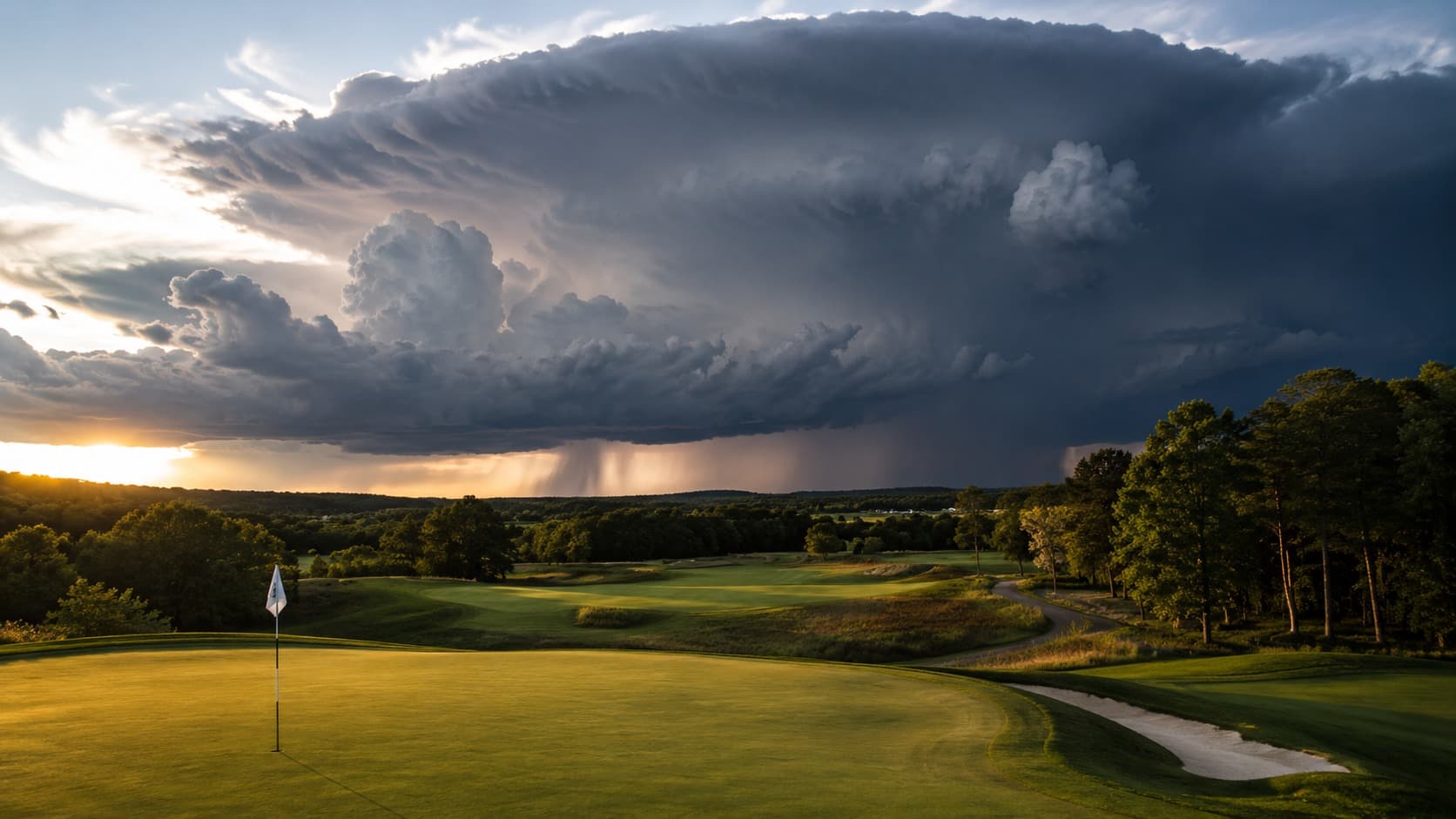
The Three O’Clock Storm: Reading Summer’s Convective Cycle to Protect Your Round
A 40% chance of afternoon thunderstorms does not mean a 40% chance of getting rained on. In the summer convective season it means the morning is nearly clear and the afternoon carries a fast-building, high-energy storm risk driven by a daily heating cycle. Here is the meteorology behind the pattern, the G-Score data on how the storm cycle punishes afternoon tee times across the Southeast, Midwest, and desert Southwest, the lightning-safety decision tree that actually matters, and the workflow that gets you off the course before the first bolt.
Read Story
How to Read a G-Score: The 0–100 Golf Playability Number, Decoded
A G-Score on this site is a single 0–100 number that tells you whether today is worth tee-up. Here is exactly what each band means, what drives the calculation, and how to use it to plan a round you will actually score on.
Read StoryDanorie
Editorial & Data
Golf Weather Score is built by Danorie. We compute the G-Score — our own playability rating — from live NOAA forecasts and published course scorecards, so any US course can be compared on any day with a single number. Methodology and data sources are documented on every page.
Every Friday Morning
When Blades Golf Lounge plays best next weekend.
Friday 6am ET: peak G-Score windows for Blades Golf Lounge, wind direction by hour, and one gear call. Three minutes to read, save you the round.
One email a week. Unsubscribe in one click.
The Caddie's Oracle
Draw your luck before the tee off