
Caddie's Gear Advisor
Curated for today's 79°F · Thunderstorm
Storm-Ready Outerwear
Waterproof layers built for 18 holes in the rain
Tour-Grade Umbrellas
68" double-canopy wind-resistant coverage
Wet-Weather Gloves
All-weather grip that performs in the rain
Waterproof Golf Shoes
Keep your feet dry through every fairway
Your Golf Trip, Handled
The Ultimate Golf Trip Planner
Everything you need to play Blue Ash Golf Course — from booking your flight to checking in course-side.
Course-Side Stays
Luxury hotels, resorts, and stay-and-play packages just minutes from the first tee.
Flights
Compare fares across 700+ airlines for the best route to your tee time.
SUV Rentals for Golf Bags
Spacious vehicles with room for clubs, bags, and your foursome.
Travel Insurance
Coverage for medical, weather delays, and gear at your destination.
Blue Ash Golf Course: Course Intelligence
Signature Setup
The closing 535-yard par-5 at Blue Ash is the kind of hole that decides your card after you've already mentally signed it. I walked the 18th on a humid June morning, 71°F and dead still at 8 a.m., and the pond short-right of that shallow green looked exactly as greedy as the locals warned. Blue Ash Golf Course is a City of Blue Ash municipal track in the northern Cincinnati suburbs, opened in 1973 to a Jack Kidwell routing. It plays par 72 at roughly 6,700 yards from the tips, slope around 123 — modest on paper, but the Ohio Valley wind and a few water holes give it more teeth than the yardage admits.
Hole-by-Hole Wind & Playing Lines
Hole 4 (par-4, ~440y, #1 handicap): The longest two-shotter and the hardest. Cincinnati's prevailing summer breeze comes out of the southwest, and on those mornings this hole plays into and slightly across — a 440-yard hole that eats like 465. I stopped trying to bomb it down the right. A 3-wood to the flat left side leaves a full long-iron, which beats a flyer out of the right rough every time.
Hole 9 (par-3, ~200y): Wind exposure is the whole story here. With nothing blocking a west-southwest gust, a 200-yard one-club wind turns this into a hybrid. On a calm morning it's a clean 4-iron; by mid-afternoon in August I'd club up and aim at the fat center, not the flag.
Hole 18 (par-5, 535y): Reachable only on a still morning, and even then the pond short-right and the shallow green punish a forced second. Into any SW breeze, lay back to a full wedge number rather than gambling — bogey is fine, double from the water is what wrecks a round.
Green & Fairway Characteristics
The greens are bentgrass and run mid-9s on the Stimpmeter on a typical municipal mowing schedule — true but not glassy, and they slow noticeably as the day's foot traffic packs them. Fairways are bluegrass/rye and hold a fair amount of roll once Cincinnati summer dries them out, but in spring they stay soft and your carry number is your total. The front nine is the flatter, more open half; the back works through more tree-lined corridors where accuracy off the tee matters more than length. I haven't played it in deep winter, so I can't speak to how the bent surfaces hold up under frost-delay conditions — that read I'd leave to the historical data.
Seasonal Weather Pattern
Blue Ash sits in the humid continental Ohio Valley, and the seasons swing hard. Summer (Jul–Aug) brings highs near 86°F with thick humidity; the ball flies a touch farther in the warm, heavy air, but afternoon storms build fast off the river valley. The best scoring window is the May–June and September shoulder, when highs sit in the upper 70s and the air is calmer. Late October through March turns cold and wet — January highs near 38°F, frequent overnight freezes, and frost delays that push tee times back. Spring is playable but soggy underfoot until the fairways firm in late May.
Local Play Tips
The morning sequence is everything here. The greens are at their truest and quickest right after first mow, before the day's groups compact them, so an early weekend tee time buys you a full club of break and a smoother roll. As a city muni the twilight rate is genuinely cheap, and the course thins out after 5 p.m. — a summer evening nine with long Ohio daylight is the quiet local move. One thing I learned: don't trust the still air on the first tee. The west-southwest breeze usually fills in by the time you reach the exposed 9th, so plan the back-side wind holes for the conditions you'll have then, not the calm you start in.
Pre-Round Weather Workflow
Check the 7-day G-Score before you book. For Blue Ash, the two signals that matter most are afternoon humidity/storm risk in summer and frost delays in the cold months. If the forecast shows a calm, dry morning, target a tee time before 9 a.m. so the greens are fresh and the SW wind hasn't built on the 9th and 18th. Use the windExposure read for the open holes — a southwest afternoon reshapes both the long par-4 4th and the closing par-5. In spring, assume little fairway roll and club up; in July–August, expect the firmest, longest-flying conditions but watch the radar for afternoon cells off the valley.
Related Reading
Before you tee off at Blue Ash Golf Course
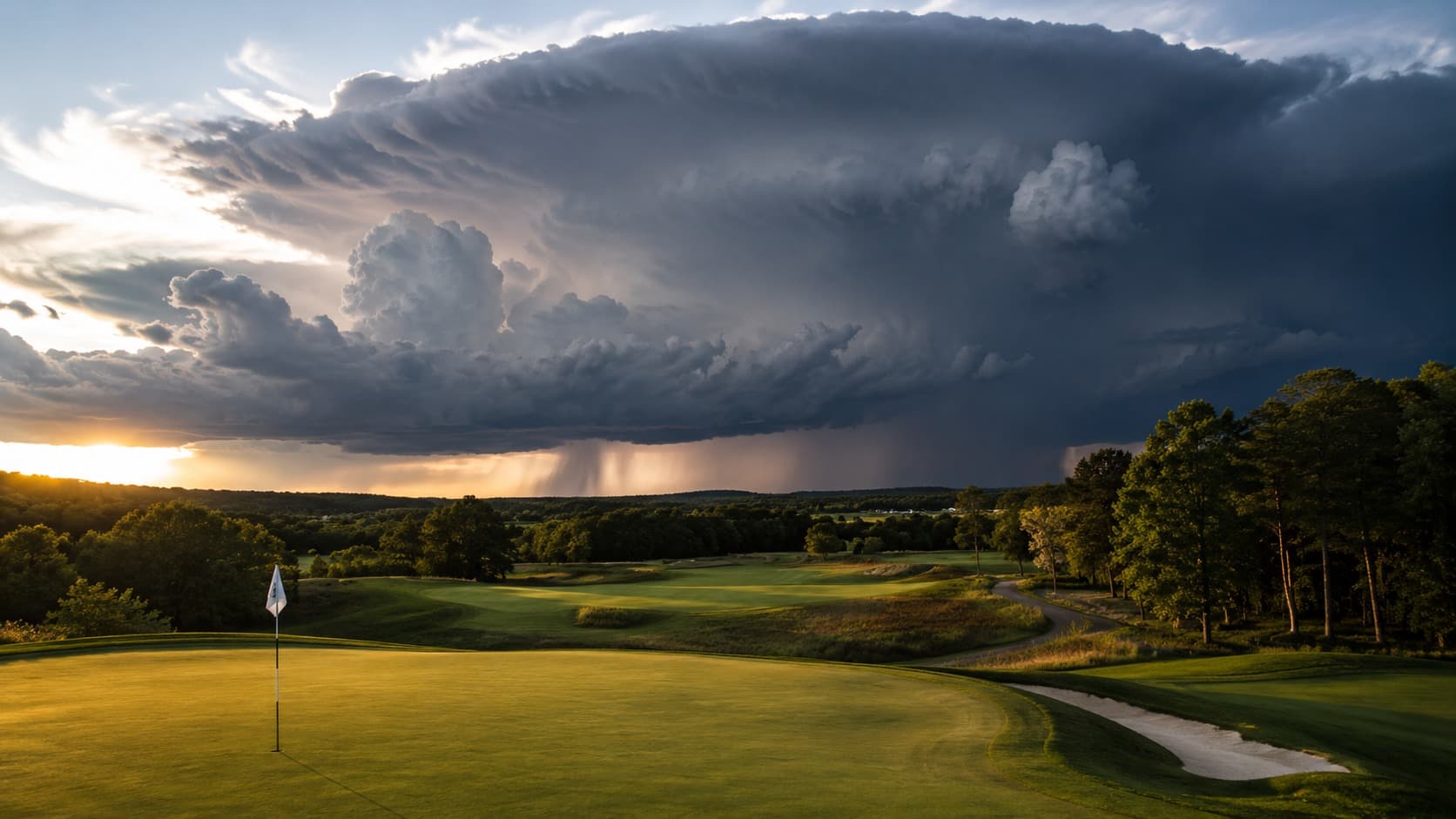
The Three O’Clock Storm: Reading Summer’s Convective Cycle to Protect Your Round
A 40% chance of afternoon thunderstorms does not mean a 40% chance of getting rained on. In the summer convective season it means the morning is nearly clear and the afternoon carries a fast-building, high-energy storm risk driven by a daily heating cycle. Here is the meteorology behind the pattern, the G-Score data on how the storm cycle punishes afternoon tee times across the Southeast, Midwest, and desert Southwest, the lightning-safety decision tree that actually matters, and the workflow that gets you off the course before the first bolt.
Read Story
Best Golf Weather by State: Ranking America by Average G-Score
We ranked all 50 US states by average G-Score golf playability. California tops the list, but the results beyond the top five may surprise you.
Read StoryMinSu Kim
Founder & Golf Data Analyst
MinSu is a data analyst and golfer with 10+ years on the course. He built Golf Weather Score to answer one question: is today a good day to play? He combines weather data, course intelligence, and the proprietary G-Score algorithm to help golfers make smarter decisions.
Every Friday Morning
When Blue Ash Golf Course plays best next weekend.
Friday 6am ET: peak G-Score windows for Blue Ash Golf Course, wind direction by hour, and one gear call. Three minutes to read, save you the round.
One email a week. Unsubscribe in one click.
The Caddie's Oracle
Draw your luck before the tee off