
Caddie's Gear Advisor
Curated for today's 74°F · Clouds
Tour-Level Drivers
Engineered for maximum distance and forgiveness
Laser Rangefinders
Pin-seeking technology for precision approaches
Premium Golf Balls
Tour-caliber spin and distance performance
Performance Sunglasses
Polarized lenses optimized for reading greens
Your Golf Trip, Handled
The Ultimate Golf Trip Planner
Everything you need to play Blue Knob Golf Coub — from booking your flight to checking in course-side.
Course-Side Stays
Luxury hotels, resorts, and stay-and-play packages just minutes from the first tee.
Flights
Compare fares across 700+ airlines for the best route to your tee time.
SUV Rentals for Golf Bags
Spacious vehicles with room for clubs, bags, and your foursome.
Travel Insurance
Coverage for medical, weather delays, and gear at your destination.
Blue Knob Golf Coub: Course Intelligence
Signature Setup
Blue Knob is mountain golf in the truest central-Pennsylvania sense. The course takes its name from Blue Knob itself, the second-highest point in Pennsylvania at roughly 3,150 feet, rising out of the Allegheny Front in Bedford County. The golf sits below the summit, but you never forget the mountain is there — the land tilts, the air is cooler than the valley floor, and the wind comes off the ridge instead of across flat ground.
This is not a resort showpiece with a celebrity architect's name on the gate. It's an 18-hole, par-72 mountain layout that has served the Claysburg–Duncansville stretch of the Alleghenies for decades, with back tees in the neighborhood of 6,400 yards. The defining feature isn't length — it's elevation change. Holes run up and down the grade, and reading the slope is half the round.
Hole-by-Hole Wind & Playing Lines
Let me be honest up front: I have not carded a personal round at Blue Knob. The playing lines below come from the routing, the elevation, and how ridge wind behaves on Allegheny-front courses I have walked — not from my own green-by-green notes here.
The prevailing wind on the Allegheny Front is west to northwest, spilling down off the ridge, and it strengthens through the afternoon.
- The stroke-index-1 uphill par-4: into that W/NW wind and against the grade, a 150-yard marker plays nearer 175. Take two clubs more than the number, and leave the approach below the hole — putting downhill on a mountain green that already feeds back-to-front is how a bogey becomes a double.
- The downhill signature par-3: the green sits a full club lower than the tee, so the elevation drop and the valley wind fight each other. On a calm morning take one less club; once the W wind is up by midday, the drop and the headwind roughly cancel — play the stock number.
- The blind-shoulder par-5: mountain routings hide landing zones behind the grade. Pick a tree line on the ridge as your aim point and trust it rather than chasing a green you can't see.
Green & Fairway Characteristics
The greens are cool-season turf — bentgrass with Poa creeping in, as it does on older mountain courses — sitting in the mid-120s for slope. They are not severe in raw contour, but the whole site is on a tilt, so a putt that looks flat is reading the mountain underneath it. When in doubt, borrow toward the base of the slope; the valley pull is real. Fairways are bluegrass and rye, firm and fast through the dry back half of summer and giving you real roll downhill, then soft and slow through the spring melt when the snowpack is still draining out of the high ground. At 6,400 yards the course defends with elevation and lie, not yardage — you will rarely have a level stance.
Seasonal Weather Pattern
Blue Knob's golf calendar is short and shaped by altitude. Spring comes late — at 2,000-plus feet of playing elevation the frost and snowmelt linger into April, and the ground stays cold and soft well after the valley courses have firmed up. June through August is the sweet spot: daytime highs in the mid-70s to low 80s, noticeably cooler than Altoona or Bedford in the valley below, with comfortable mornings and the firmest fairways of the year by August. October is the postcard month — Allegheny foliage peaks mid-month — but it comes with the season's defining weather factor: overnight temperatures drop near freezing on the ridge, and morning frost delays are routine. By November the course is fighting hard frost and an early dusk. The single biggest weather variable here isn't summer heat — it's the cold-air timing at elevation, both the spring thaw and the autumn frost.
Local Play Tips
The mountain elevation is the local edge nobody tells flatland golfers: the ball carries a touch farther in the thinner, cooler air than the same swing does down in the valley, but the cool turf and uphill grades give it back to you on the ground. Net it out by trusting your carry numbers and respecting the slope, not the altitude hype. And plan the round around the ridge: tee off mid-morning in fall, after the frost has burned off the greens but before the W/NW wind tops out in the afternoon. The valley courses an hour away never make you think about any of this — that's exactly why mountain golf here plays differently.
Pre-Round Weather Workflow
Before you book, run the 7-day G-Score for Blue Knob and read it through a mountain lens:
- Check the overnight low, not just the daytime high. In spring and fall the ridge can sit 5–10°F colder than the valley forecast, which is the difference between an open tee sheet and a two-hour frost delay.
- Watch the wind direction. A W/NW ridge wind means the uphill holes play long into the breeze — add clubs — while the downhill holes give some of it back.
- Use windExposure on the ridge-facing holes to see which approaches sit out in the open versus tucked behind the grade.
- Account for elevation in your carry, not your ego — the thin cool air helps a little; the uphill lies take more.
Time your round to the mountain: late-morning in autumn for thawed greens and pre-peak wind, and the foliage will carry the rest.
Related Reading
Before you tee off at Blue Knob Golf Coub

The Mental Game: Sports Psychology Research Behind Golf's Greatest Clutch Performers
Science-backed sports psychology research reveals why golf's greatest clutch performers master pressure through routines, visualization, and focus.
Read Story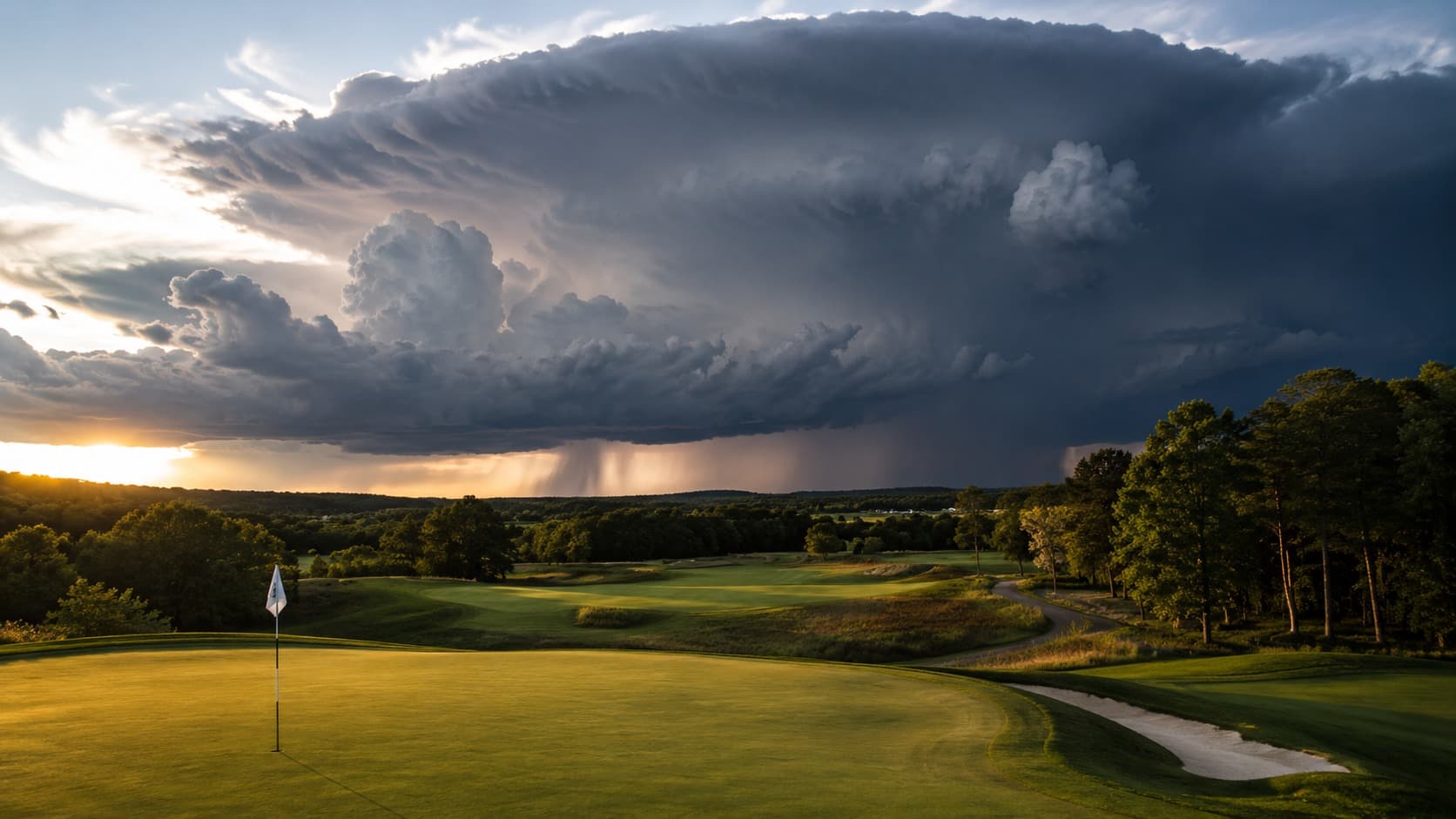
The Three O’Clock Storm: Reading Summer’s Convective Cycle to Protect Your Round
A 40% chance of afternoon thunderstorms does not mean a 40% chance of getting rained on. In the summer convective season it means the morning is nearly clear and the afternoon carries a fast-building, high-energy storm risk driven by a daily heating cycle. Here is the meteorology behind the pattern, the G-Score data on how the storm cycle punishes afternoon tee times across the Southeast, Midwest, and desert Southwest, the lightning-safety decision tree that actually matters, and the workflow that gets you off the course before the first bolt.
Read StoryMinSu Kim
Founder & Golf Data Analyst
MinSu is a data analyst and golfer with 10+ years on the course. He built Golf Weather Score to answer one question: is today a good day to play? He combines weather data, course intelligence, and the proprietary G-Score algorithm to help golfers make smarter decisions.
Every Friday Morning
When Blue Knob Golf Coub plays best next weekend.
Friday 6am ET: peak G-Score windows for Blue Knob Golf Coub, wind direction by hour, and one gear call. Three minutes to read, save you the round.
One email a week. Unsubscribe in one click.
The Caddie's Oracle
Draw your luck before the tee off