
Caddie's Gear Advisor
Curated for today's 85°F · Clear
Tour-Level Drivers
Engineered for maximum distance and forgiveness
Laser Rangefinders
Pin-seeking technology for precision approaches
Premium Golf Balls
Tour-caliber spin and distance performance
Performance Sunglasses
Polarized lenses optimized for reading greens
Your Golf Trip, Handled
The Ultimate Golf Trip Planner
Everything you need to play Blue Ridge Trail Golf Club — from booking your flight to checking in course-side.
Course-Side Stays
Luxury hotels, resorts, and stay-and-play packages just minutes from the first tee.
Flights
Compare fares across 700+ airlines for the best route to your tee time.
SUV Rentals for Golf Bags
Spacious vehicles with room for clubs, bags, and your foursome.
Travel Insurance
Coverage for medical, weather delays, and gear at your destination.
Blue Ridge Trail Golf Club: Course Intelligence
Signature Setup
Straight talk first: what follows comes from the scorecard picture, the club's public description, and Pocono-region weather records — I have not walked Blue Ridge Trail myself, and I'd rather say that plainly than invent a round I never played. What the record gives me cleanly is the location, and up here location is the test. The course sits in Mountain Top, Pennsylvania, in Luzerne County on the northern edge of the Pocono Plateau, at roughly 1,900–2,000 feet of elevation. It's a public, daily-fee club that has grown to 27 holes of rolling, tree-lined mountain golf. The designer of record isn't something I can confirm from published sources, so I won't guess at a name. What I can tell you with confidence is the thing most golf write-ups skip: at this altitude, in this climate, the air and the ridge wind do more to your scorecard than any single hole on the property.
TL;DR: A 27-hole public mountain course in Mountain Top, PA, sitting near 2,000 ft on the Pocono Plateau. Thin upland air adds a few yards of carry; ridge-and-valley wind, not a sea breeze, rewrites club selection. Cool, four-season Northeast climate — short summer, sharp fall, closed winter. Read the fronts, respect the dew.
Hole-by-Hole Wind & Playing Lines
Blue Ridge Trail doesn't publish a per-hole stroke index I can verify, so instead of inventing hole numbers I'll lay out how Pocono ridge wind reshapes a card on terrain like this:
- Long two-shotters into a NW post-frontal wind: behind a cold front the dry northwesterly funnels along the ridgelines. A 150-yard uphill number can play like 170. The thinner air buys you a little carry back, but the gust takes more than the altitude gives — take the extra club and flatten the flight.
- Downhill holes running with the wind: drop-shot holes off the plateau shoulders play shorter than the card twice over — once for the elevation drop, once for the tailwind. The miss here is flying the green; land it short and let the slope feed.
- Crossing holes through the trees: the timber blunts the wind in pockets and then lets it rip through the gaps. Don't trust a single flag reading — watch the treetops two holes ahead, because a sheltered tee can open into a fully exposed green.
The portable lesson: on a tree-lined mountain layout the wind is gusty and directional, not steady. Commit to a knockdown you can repeat rather than chasing the perfect number.
Green & Fairway Characteristics
The greens read as cool-season bentgrass/poa surfaces typical of upland Pennsylvania golf, set on terrain with genuine hole-to-hole elevation change — uphill approaches, downhill tee shots, and side-slope lies you won't find on a flat parkland course. Firmness is the variable that swings most. Mountain mornings here hold heavy dew well past sunrise, so early greens stay receptive and fairways play soft and slow off the tee; by mid-afternoon on a dry day the same surfaces firm up and start releasing. Because the property climbs and falls, your stock yardages need an elevation adjustment on nearly every approach — uphill plays longer, downhill plays shorter, and the thin air nudges everything a touch farther than your sea-level book says.
Seasonal Weather Pattern
Mountain Top lives in a cool, four-season Northeast climate, and its plateau elevation makes it measurably colder and shorter-seasoned than the Pennsylvania valleys below. Spring (Apr–May) comes late and damp up here — soft turf, lingering chill, and gusty frontal passages; greens are slow and the ground won't give you much roll. Summer (Jun–Aug) is the prime window: highs commonly in the upper-70s to mid-80s°F, noticeably cooler than Philadelphia or the coast, with afternoon thunderstorms a real risk on humid days. Fall (Sep–Oct) is the best golf of the year — crisp, dry NW air behind departing fronts, firm surfaces, and the Poconos' famous foliage; mornings can dip near or below 40°F. Winter effectively closes the course for snow and hard cold; for that stretch I lean on NOAA northeastern-PA historicals rather than any firsthand memory.
Local Play Tips
The habit a lowland or coastal golfer brings that misfires here: there's no daily thermal sea breeze to outrun by teeing off at dawn. Up on the plateau the wind is ridge-and-valley flow tied to whatever weather system is crossing the region, so the question isn't morning versus afternoon — it's whether a front has just passed or is still coming. What an early tee time does buy you at this elevation is different: you'll play the soft, dew-laden version of the course, where greens hold and fairways are slow. Tee off late on a dry afternoon and you get a firmer, faster, more releasing course that rewards a lower ball flight. Pick your tee time for the turf condition you want, then read the synoptic chart for the wind — that's the order that works on a mountain course.
Pre-Round Weather Workflow
Use golfweatherscore's 7-day G-Score and windExposure as your decision tools — but interpret them for a high-elevation mountain layout:
- Three days out: scan the G-Score curve for frontal timing. Up here a strong score collapsing to a weak one almost always signals an incoming system, and at 2,000 feet that often means earlier rain, lower temps, and lingering soft turf compared to the valley forecast.
- The evening before: lock in wind direction and gust speed. A NW flow behind a front means firm, dry, faster surfaces where downhill and downwind holes shrink; a humid S/SW flow means storm risk and soft, receptive greens.
- Round morning: check temperature and dew. If it's a cool, dew-heavy start, expect slow early greens and almost no fairway roll — club up and aim for ball flight. If windExposure shows sustained ridge gusts, accept that the thin-air carry bonus won't save an under-clubbed shot into the wind, and let placement carry your score.
Related Reading
Before you tee off at Blue Ridge Trail Golf Club
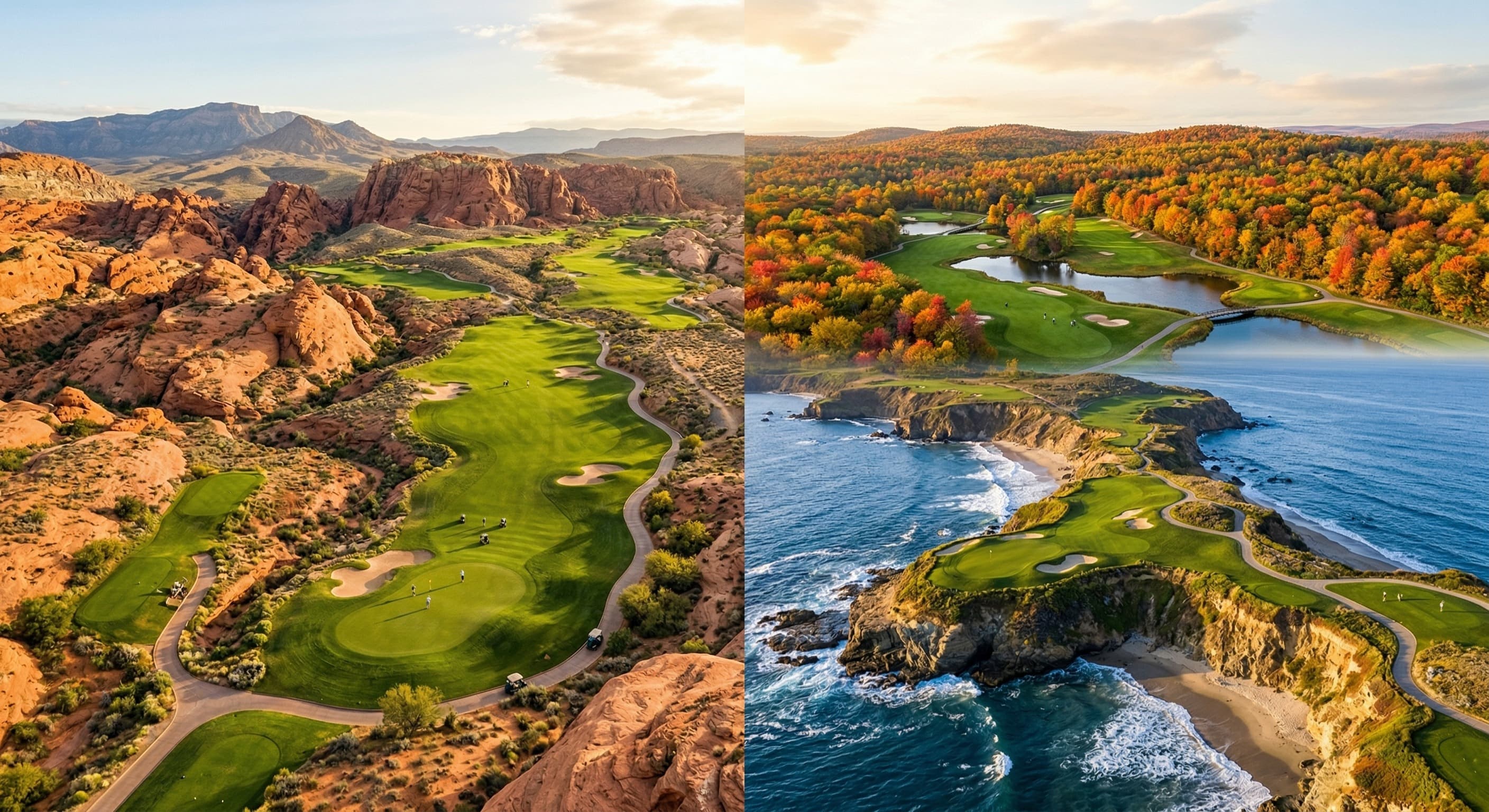
Best Golf Weather by State: Ranking America by Average G-Score
We ranked all 50 US states by average G-Score golf playability. California tops the list, but the results beyond the top five may surprise you.
Read Story
The Mental Game: Sports Psychology Research Behind Golf's Greatest Clutch Performers
Science-backed sports psychology research reveals why golf's greatest clutch performers master pressure through routines, visualization, and focus.
Read StoryMinSu Kim
Founder & Golf Data Analyst
MinSu is a data analyst and golfer with 10+ years on the course. He built Golf Weather Score to answer one question: is today a good day to play? He combines weather data, course intelligence, and the proprietary G-Score algorithm to help golfers make smarter decisions.
Every Friday Morning
When Blue Ridge Trail Golf Club plays best next weekend.
Friday 6am ET: peak G-Score windows for Blue Ridge Trail Golf Club, wind direction by hour, and one gear call. Three minutes to read, save you the round.
One email a week. Unsubscribe in one click.
The Caddie's Oracle
Draw your luck before the tee off