
Caddie's Gear Advisor
Curated for today's 57°F · Mist
Tour-Level Drivers
Engineered for maximum distance and forgiveness
Laser Rangefinders
Pin-seeking technology for precision approaches
Premium Golf Balls
Tour-caliber spin and distance performance
Performance Sunglasses
Polarized lenses optimized for reading greens
Your Golf Trip, Handled
The Ultimate Golf Trip Planner
Everything you need to play Bradford Golf Club — from booking your flight to checking in course-side.
Course-Side Stays
Luxury hotels, resorts, and stay-and-play packages just minutes from the first tee.
Flights
Compare fares across 700+ airlines for the best route to your tee time.
SUV Rentals for Golf Bags
Spacious vehicles with room for clubs, bags, and your foursome.
Travel Insurance
Coverage for medical, weather delays, and gear at your destination.
Bradford Golf Club: Course Intelligence
Signature Setup
Honesty first: I have never played Bradford Golf Club, and I'm not going to write as if I have. What follows is reasoning from the club's geography and the documented character of English moorland golf, not a round I'm recalling. The club dates to 1891 — one of the older clubs in Yorkshire — and sits out on Hawksworth Moor near Guiseley, on high open ground above the Aire valley in West Yorkshire. The ground runs around 1,000 feet, the latitude is near 53.9°N, and the surrounding moor offers little shelter from weather rolling in off the Pennines. I found no single architect attribution I could verify for the current layout, so I've left that line honest rather than inventing a name.
TL;DR: Historic 1891 moorland club on Hawksworth Moor, West Yorkshire (~53.9°N, ~1,000 ft), high and exposed. One force dominates everything: wind off the Pennines with nothing to break it. Read direction and gust speed before you read the yardage — flight control, not power, is the currency up here.
Hole-by-Hole Wind & Playing Lines
Bradford's per-hole stroke index isn't something I can independently confirm, so instead of inventing hole numbers I'll describe how wind dictates play on exposed moorland like this:
- The long climbing par-4 into a W/SW flow: the prevailing wind on this part of the Pennines runs from the west and southwest. Add the uphill grade and a 15 mph headwind and a 150-yard shot can play closer to 170. Take two clubs more than the plate, start the ball low under the gust, and take the front edge — the flag is the wind's to defend, not yours to attack.
- The downwind hole on the same axis: turn around and that same 15 mph is now a tailwind on firm fescue. The ball flies and then runs; landing at the pin sends it long. Land it well short and let the moor's firmness do the rest.
- The exposed crosswind holes: out on open heather there's no tree line to lean on. A player who can hold a low fade or draw into the wind beats one who only hits it high — height is the enemy on a crossing breeze up here.
The habit that carries the round: on the first exposed hole, lock in two readings at once — wind direction and gust strength — and let that pairing club you on every shot that follows.
Green & Fairway Characteristics
Expect classic cool-season moorland turf: fine fescue and bent through the green, with heather framing the corridors and punishing the wayward. At this altitude and in this maritime-but-upland climate, the surfaces firm up and run fast only inside a genuinely settled summer dry spell; they go heavy and slow within a day of the rain the Pennines collect so reliably. Moor ground tilts and rolls more than a sheltered valley course, so awkward stances and half-blind lines are part of the test, and your "flat" yardage is the exception rather than the rule. When it's dry and firm, the fescue lets the ball release for yards after landing — plan to land short and feed it in rather than flying everything to the flag.
Seasonal Weather Pattern
This is upland West Yorkshire, cooler and wetter than the valley floor below it. Spring (Apr–May) is slow to dry and often raw — wind chills the high moor well after the lowlands have warmed, and the ground stays soft and long. Summer (Jun–Aug) is the prime window: highs commonly in the upper-60s to low-70s°F, the firmest fescue of the year between weather systems, and the steadiest light for scoring — though the W/SW breeze rarely fully drops. Autumn (Sep–Oct) can give crisp, clear, low-scoring days, but the first cold, wet Atlantic fronts arrive early at this elevation and the moor turns heavy fast. Winter is playable on the right day but cold, wet and wind-scoured; for that stretch I lean on UK Met Office upland-Pennine historicals rather than anything firsthand.
Local Play Tips
Here's where an American inland golfer's instinct misfires. Back in the States I'll tee off at dawn to catch the dead-calm window before the day's wind builds — on a course like this, that reflex buys you very little. Exposed Pennine moor doesn't hand you a reliably still morning; the wind is the baseline condition, not an afternoon event. The bigger lever here is direction and firmness, not the clock. A dry summer spell with a steady W/SW breeze gives you fast fescue and predictable ball-flight to plan around; a wet front turns the same course heavy and unpredictable overnight. So don't chase a calm hour that may never come — pick a settled, dry stretch in the forecast and commit to flighting the ball low. That single adjustment matters more than any tee time.
Pre-Round Weather Workflow
For an exposed moorland course like this, use golfweatherscore's 7-day G-Score and windExposure the way a Hawksworth Moor local would — wind-and-front first, never clock-first. Three days out, a G-Score sliding from 9 toward 4 at this latitude almost always marks an incoming Atlantic system, not a time-of-day effect. The night before, pair two reads: the expected wind direction (a settled W/SW flow points to firm summer fescue; a post-front NW shift means cold, scoured, fast ground) and recent rainfall (a dry run firms the moor, a wet front softens it within hours). On the tee, if windExposure is calling steady 15-plus-mph gusts on the open holes, add two clubs into the wind, subtract on the way back, and keep the ball under the gust — a low, well-placed shot does the work up here that swinging harder never will.
Related Reading
Before you tee off at Bradford Golf Club

Best Golf Weather by State: Ranking America by Average G-Score
We ranked all 50 US states by average G-Score golf playability. California tops the list, but the results beyond the top five may surprise you.
Read Story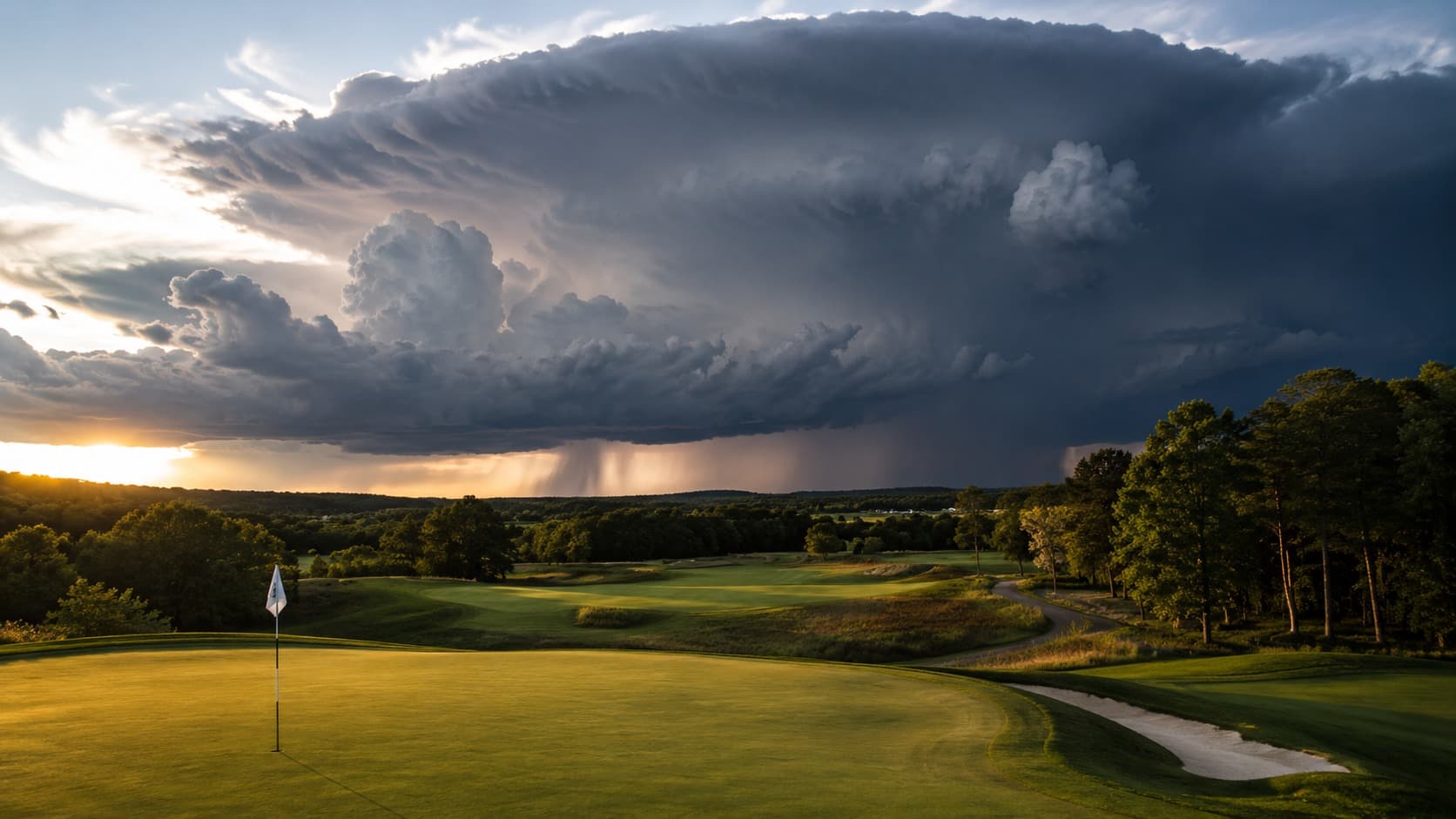
The Three O’Clock Storm: Reading Summer’s Convective Cycle to Protect Your Round
A 40% chance of afternoon thunderstorms does not mean a 40% chance of getting rained on. In the summer convective season it means the morning is nearly clear and the afternoon carries a fast-building, high-energy storm risk driven by a daily heating cycle. Here is the meteorology behind the pattern, the G-Score data on how the storm cycle punishes afternoon tee times across the Southeast, Midwest, and desert Southwest, the lightning-safety decision tree that actually matters, and the workflow that gets you off the course before the first bolt.
Read StoryMinSu Kim
Founder & Golf Data Analyst
MinSu is a data analyst and golfer with 10+ years on the course. He built Golf Weather Score to answer one question: is today a good day to play? He combines weather data, course intelligence, and the proprietary G-Score algorithm to help golfers make smarter decisions.
Every Friday Morning
When Bradford Golf Club plays best next weekend.
Friday 6am ET: peak G-Score windows for Bradford Golf Club, wind direction by hour, and one gear call. Three minutes to read, save you the round.
One email a week. Unsubscribe in one click.
The Caddie's Oracle
Draw your luck before the tee off