
Caddie's Gear Advisor
Curated for today's 67°F · Thunderstorm
Storm-Ready Outerwear
Waterproof layers built for 18 holes in the rain
Tour-Grade Umbrellas
68" double-canopy wind-resistant coverage
Wet-Weather Gloves
All-weather grip that performs in the rain
Waterproof Golf Shoes
Keep your feet dry through every fairway
Your Golf Trip, Handled
The Ultimate Golf Trip Planner
Everything you need to play Britt Country Club — from booking your flight to checking in course-side.
Course-Side Stays
Luxury hotels, resorts, and stay-and-play packages just minutes from the first tee.
Flights
Compare fares across 700+ airlines for the best route to your tee time.
SUV Rentals for Golf Bags
Spacious vehicles with room for clubs, bags, and your foursome.
Travel Insurance
Coverage for medical, weather delays, and gear at your destination.
Britt Country Club: Course Intelligence
Signature Setup
Britt Country Club sits at 2360 James Ave on the edge of Britt, Iowa — a small Hancock County town in the flat-to-rolling country north of Clear Lake, at roughly 43.11°N and about 1,210 feet of elevation. It is a nine-hole club course, the kind that small Iowa farm towns built for their members rather than for a name architect, and there is no formal designer of record that I can confirm. I want to be honest about that up front: I haven't played Britt itself, so the course-specific reads below lean on its published location, its parkland water features, and on what I know from rounds at comparable nine-hole layouts across north-central Iowa. What I can speak to with confidence is the weather, because in this part of the state the wind and the cool-season turf decide your score more than the yardage book does.
Hole-by-Hole Wind & Playing Lines
Britt's yardages aren't published in the sources I have, so instead of inventing numbers I'll give you the wind logic, which travels from hole to hole on an open Iowa parcel like this one. North-central Iowa has two prevailing regimes: a soft SSE-to-S flow on summer mornings, and a hard NW push on cold fronts and through the shoulder months. On the #1-handicap par-4, the smart play is to start the tee ball up the left side and let a NW crossbreeze drift it back to center — bailing right leaves you blocked by the tree line that frames most of these holes. The pond-guarded short par-4 is the one to respect: into any northerly component the green plays a full club longer than it looks, and short-siding yourself over water on a firm cool-season green is the quickest way to a double. On the holes that turn back toward town, you'll often have that same wind helping — trust the extra carry instead of fighting it.
Green & Fairway Characteristics
This is cool-season golf: expect bentgrass-and-poa greens and bluegrass-ryegrass fairways, the standard Upper-Midwest setup that grows green in May and goes dormant after the first hard freeze. At member maintenance, greens here roll in the low-to-mid 9s on the stimp — quick enough that downhill putts toward the water features get away from you, slow enough that you have to make a confident stroke uphill. Fairways are parkland and tree-lined, so the premium is on position over power; a stinger that finds the short grass beats a big drive in the trees every time. After a Midwest rain the bluegrass holds water and plays soft and long, while a dry August week firms everything up and adds roll.
Seasonal Weather Pattern
Britt's golf season runs roughly mid-April through October. Using the nearby Mason City climate normals as a proxy: July averages a high near 84°F with humid afternoons, while April and October mornings sit in the 40s and 50s and demand a layer. January, for context, averages a high around 22°F — this course is closed and frozen for a long winter, which is why the turf is entirely cool-season. The real seasonal story is wind: spring and fall fronts bring sustained NW winds of 15–25 mph that turn a benign nine into a grind, while midsummer mornings are often dead calm before the SSE breeze builds after lunch. Plan your tee time around that, not around the temperature.
Local Play Tips
The single most useful piece of local knowledge for a course like this: get out before 9 a.m. On these open north-Iowa parcels the morning air is still and the greens hold dew-softened, then the wind clocks around and freshens every afternoon — your G-Score will read meaningfully better on an early sheet than a 2 p.m. one. Carry one extra mid-iron club than the yardage suggests on any hole working toward the pond, and read every putt as breaking toward the lowest water on the property; on subtle Iowa parkland greens, gravity toward the drainage is the tiebreaker your eyes will miss.
Pre-Round Weather Workflow
Before you drive to Britt, pull the 7-day G-Score and the windExposure forecast for Britt, IA (43.11°N, -93.80°W) on golfweatherscore. Here's how I'd use it: (1) Scan the wind direction and speed first — a NW day above 15 mph means add a club on every exposed approach and aim your misses away from the water. (2) Check the morning-vs-afternoon G-Score split; if the morning rates 8–12 points higher, book the earliest tee time you can. (3) Watch the dew point and overnight rain — a wet bluegrass fairway plays long and offers little roll, so club up off the tee. (4) On a calm, dry forecast, that's your green light to be aggressive on the short par-4s. Let the forecast set your strategy before you ever tee it up.
Related Reading
Before you tee off at Britt Country Club
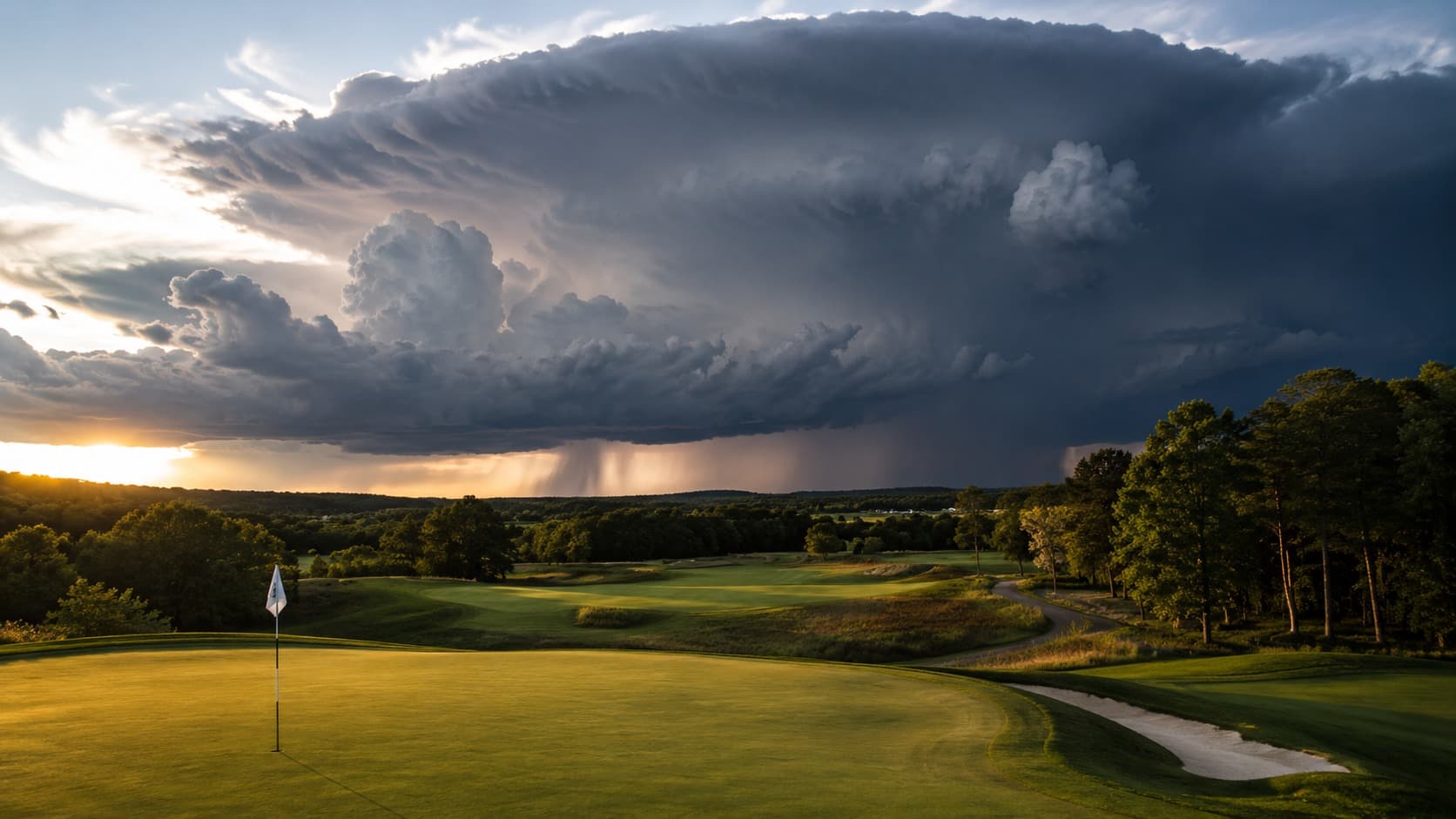
The Three O’Clock Storm: Reading Summer’s Convective Cycle to Protect Your Round
A 40% chance of afternoon thunderstorms does not mean a 40% chance of getting rained on. In the summer convective season it means the morning is nearly clear and the afternoon carries a fast-building, high-energy storm risk driven by a daily heating cycle. Here is the meteorology behind the pattern, the G-Score data on how the storm cycle punishes afternoon tee times across the Southeast, Midwest, and desert Southwest, the lightning-safety decision tree that actually matters, and the workflow that gets you off the course before the first bolt.
Read Story
How to Read a G-Score: The 0–100 Golf Playability Number, Decoded
A G-Score on this site is a single 0–100 number that tells you whether today is worth tee-up. Here is exactly what each band means, what drives the calculation, and how to use it to plan a round you will actually score on.
Read StoryMinSu Kim
Founder & Golf Data Analyst
MinSu is a data analyst and golfer with 10+ years on the course. He built Golf Weather Score to answer one question: is today a good day to play? He combines weather data, course intelligence, and the proprietary G-Score algorithm to help golfers make smarter decisions.
Every Friday Morning
When Britt Country Club plays best next weekend.
Friday 6am ET: peak G-Score windows for Britt Country Club, wind direction by hour, and one gear call. Three minutes to read, save you the round.
One email a week. Unsubscribe in one click.
The Caddie's Oracle
Draw your luck before the tee off