
Caddie's Gear Advisor
Curated for today's 104°F · Clear
Ultralight Distance Drivers
Maximum carry in hot, low-drag conditions
UV Protection Apparel
UPF 50+ cooling fabrics for peak-sun rounds
Precision Rangefinders
Slope-adjusted yardage in any condition
Hydration & Cooling
Insulated bottles and cooling towels
Your Golf Trip, Handled
The Ultimate Golf Trip Planner
Everything you need to play Brook Hollow Golf Club — from booking your flight to checking in course-side.
Course-Side Stays
Luxury hotels, resorts, and stay-and-play packages just minutes from the first tee.
Flights
Compare fares across 700+ airlines for the best route to your tee time.
SUV Rentals for Golf Bags
Spacious vehicles with room for clubs, bags, and your foursome.
Travel Insurance
Coverage for medical, weather delays, and gear at your destination.
Brook Hollow Golf Club: Course Intelligence
Signature Setup
Brook Hollow Golf Club sits just northwest of downtown Dallas, on rolling ground near the Trinity River. It is an A.W. Tillinghast design that opened in 1920, and it carries a genuine footnote in American golf history: when it was built on what was then largely barren North Texas prairie, it was among the first fully irrigated golf courses in the United States — Tillinghast and the founders engineered watering into a site that would not otherwise have held turf through a Texas summer. That detail tells you everything about the place: it is a man-made classic, willed onto difficult land.
I want to be straight here. Brook Hollow is one of the most private clubs in Texas, and I have not played a round inside its gates. So I will not invent hole-by-hole memories I do not have. What I can speak to honestly is two things I do know well: Tillinghast's design vocabulary, and Dallas golf weather, which I have played plenty of over the years.
Hole-by-Hole Wind & Playing Lines
The single most important playing variable in Dallas is the wind, and it runs predictably from the south to south-southeast for much of the spring and summer. On a classic Tillinghast routing that turns through several compass directions, that one prevailing flow rewrites club selection hole by hole.
- The #1 handicap par-4 (into the prevailing S/SSE wind): This is the hole that decides the card on a typical afternoon. A 10–20 mph headwind plus 95°F-plus air does not help carry the way thin mountain air would — heat softens spin and distance feels inconsistent. Treat it as a club-and-a-half longer than the yardage reads, club up off the tee, and aim for the fat center of the green rather than a tucked flag.
- A downwind par-4 or par-5 turning north: When the same south wind is at your back, firm bermudagrass fairways run out fast. The tee shot is not the problem; the approach is. Land it short and let it release, because a downwind ball into a firm green will not hold a back pin.
- A signature short hole across the wind: A Tillinghast par-3 is defended by deep flashed bunkers, not water. A crosswind off the south turns the whole green into a moving target, so favor the wide side and accept a 25-foot putt over a short-sided bunker shot.
Green & Fairway Characteristics
The surfaces are bermudagrass tee-to-green, standard for North Texas, with the cool-season overseed that many Dallas clubs run through winter to keep the fairways green. The ground drains hard and plays firm — this is prairie soil, not Northeast loam — so the course rewards a ball that runs. I would put the greens in the stimp 10–11 range on a normal members' day and quicker for events; the defense is bunkering, tilt and wind more than raw yardage, with the full layout sitting around 6,700 yards from the back. Dallas elevation is only about 430 feet, so there is no altitude help — what you see is what the ball flies.
Seasonal Weather Pattern
Dallas golf weather is a year of extremes squeezed into a narrow window. April and May are the best playing months but also the storm months — North Texas is squarely in spring severe-weather country, and a calm morning can turn into 30 mph gusts and lightning by late afternoon. June through early September is brutal heat: daytime highs routinely sit at 96–100°F, and the smart round is over before 11 a.m. October and November are the quiet reward — mild, drier, lighter wind. Winters are mild but punctuated by the occasional ice event that closes the course for a day or two. Plan the season around the morning, every month but fall.
Local Play Tips
The piece of advice no yardage book gives you: in a Dallas summer, dew and a still dawn are your only soft greens of the day. Firm bermudagrass plus afternoon south wind means the course gets a full shot harder between 7 a.m. and 3 p.m. on the same day — not because the setup changed, but because the air did. If you ever get the invitation here, take the earliest tee time offered, walk the front nine before the wind stands up, and keep the ball under the hole on greens that only get faster as they dry.
Pre-Round Weather Workflow
Use the 7-day G-Score the way a Dallas member would. First, check the wind direction and speed for your tee window — a south/SSE flow above 12 mph means the into-wind holes need a full club more and the downwind greens will not hold. Second, read the heat: above 95°F, hydrate hard and expect distance to feel soft and erratic. Third, watch the spring storm risk — if afternoon convection is forecast in April or May, move your tee time earlier rather than gambling on a back nine. Check the windExposure flag on the open holes; on this kind of routing the exposed stretches are where a forecast turns into strokes.
Related Reading
Before you tee off at Brook Hollow Golf Club
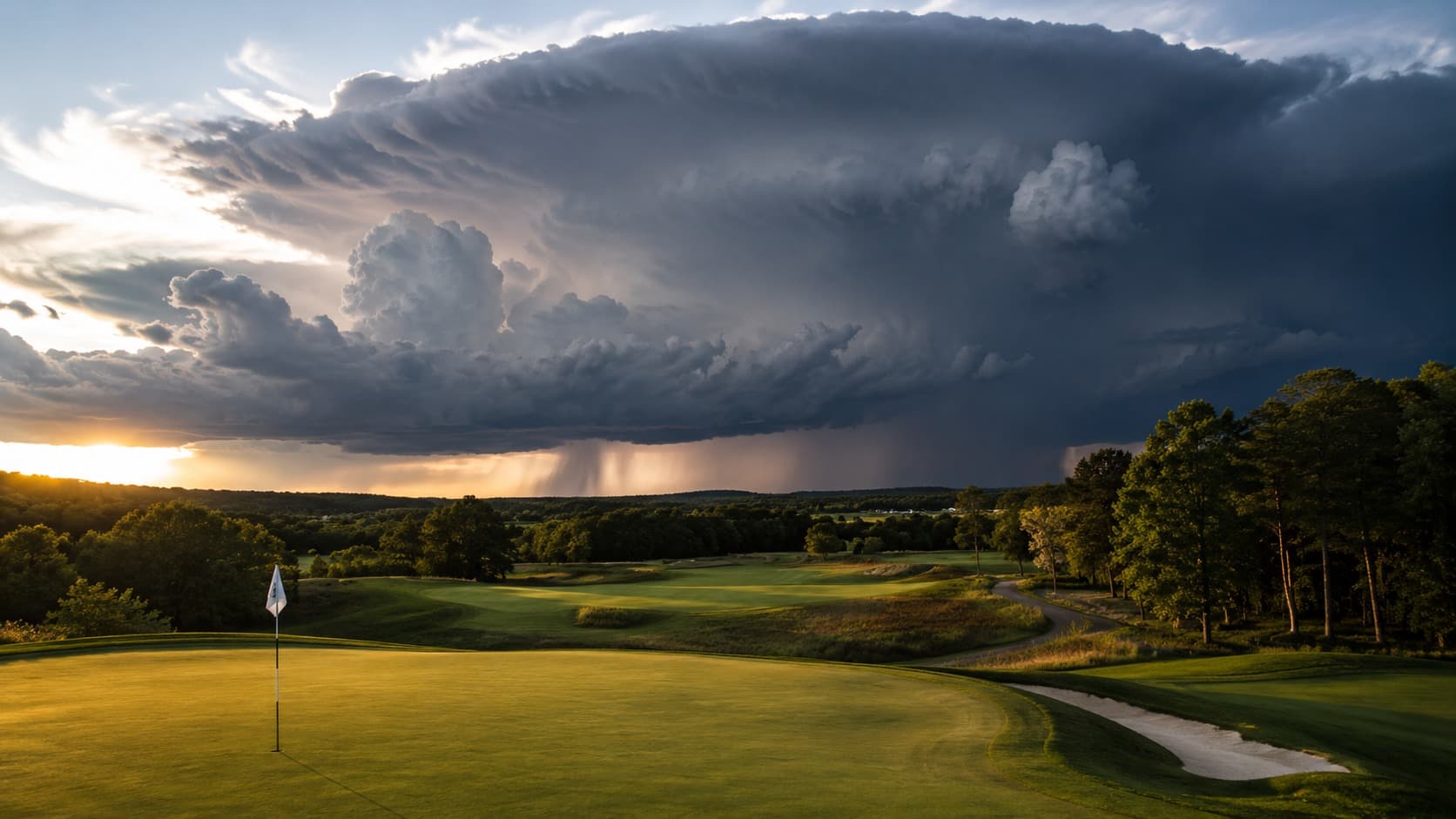
The Three O’Clock Storm: Reading Summer’s Convective Cycle to Protect Your Round
A 40% chance of afternoon thunderstorms does not mean a 40% chance of getting rained on. In the summer convective season it means the morning is nearly clear and the afternoon carries a fast-building, high-energy storm risk driven by a daily heating cycle. Here is the meteorology behind the pattern, the G-Score data on how the storm cycle punishes afternoon tee times across the Southeast, Midwest, and desert Southwest, the lightning-safety decision tree that actually matters, and the workflow that gets you off the course before the first bolt.
Read Story
The May 2026 G-Score Heatmap: Where American Golf Peaks This Spring
May is the most underrated month on the American golf calendar. Five regions hit their annual peak this spring, three turn quietly hostile, and the data tells a clearer story than the brochures. Here is where to play, where to avoid, and how to time your booking window.
Read StoryMinSu Kim
Founder & Golf Data Analyst
MinSu is a data analyst and golfer with 10+ years on the course. He built Golf Weather Score to answer one question: is today a good day to play? He combines weather data, course intelligence, and the proprietary G-Score algorithm to help golfers make smarter decisions.
Every Friday Morning
When Brook Hollow Golf Club plays best next weekend.
Friday 6am ET: peak G-Score windows for Brook Hollow Golf Club, wind direction by hour, and one gear call. Three minutes to read, save you the round.
One email a week. Unsubscribe in one click.
The Caddie's Oracle
Draw your luck before the tee off