
Caddie's Gear Advisor
Curated for today's 57°F · Clear
Tour-Level Drivers
Engineered for maximum distance and forgiveness
Laser Rangefinders
Pin-seeking technology for precision approaches
Premium Golf Balls
Tour-caliber spin and distance performance
Performance Sunglasses
Polarized lenses optimized for reading greens
Your Golf Trip, Handled
The Ultimate Golf Trip Planner
Everything you need to play Brook Tree Golf Course — from booking your flight to checking in course-side.
Course-Side Stays
Luxury hotels, resorts, and stay-and-play packages just minutes from the first tee.
Flights
Compare fares across 700+ airlines for the best route to your tee time.
SUV Rentals for Golf Bags
Spacious vehicles with room for clubs, bags, and your foursome.
Travel Insurance
Coverage for medical, weather delays, and gear at your destination.
Brook Tree Golf Course: Course Intelligence
Signature Setup
Straight answer first: I have not walked Brook Tree (Brooktree) Golf Course in Owatonna, so what follows leans on the course record, Steele County geography, and southern-Minnesota climate rather than a memory I'd be inventing if I claimed it. The course is a public 18-hole municipal layout in Owatonna, Minnesota, opened in 1976, routed along Maple Creek and bordering Mineral Springs Park at roughly 1,150 feet of elevation. The verifiable record doesn't attach a famous architect, so I'll leave that line blank instead of filling it with a name the course never carried. On a prairie muni like this, the defense isn't tournament length — it's the creek, the cold-season turf, and a wind that arrives off open farmland with nothing to slow it.
TL;DR: A 1976 city-owned 18 in Owatonna, MN, threaded along Maple Creek beside Mineral Springs Park. Cold-season turf, open prairie exposure, real water in play. No sea breeze to time — your scoring swing comes from frontal wind direction and, in shoulder season, frost delays. Smart play is reading the front, not booking the earliest slot.
Hole-by-Hole Wind & Playing Lines
Brook Tree doesn't publish a per-hole index I can independently confirm, so rather than invent hole numbers I'll map how southern-Minnesota wind rewrites the card:
- Holes that play into a post-front NW flow: behind a passing cold front the dry northwesterly runs 12–18 mph across open ground. A flushed 150-yard club lands like 170. Take two more clubs and a flatter trajectory instead of a high, ballooning carry the wind eats.
- Creek-side approaches along Maple Creek: water plus crosswind is the trap. When the breeze pushes toward the hazard, aim for the fat, dry side of the green and accept a 25-foot putt over a tucked pin that costs you a penalty stroke.
- Holes running downwind on a warm S/SW summer breeze: the air softens the landing and adds carry, but humidity holds the greens receptive. You can be more aggressive into a downwind pin here than the NW-flow holes allow.
Portable lesson: on the first open hole, decide whether you're playing a cold post-frontal NW wind or a warm humid southerly, and let that single read set your club selection for all 18.
Green & Fairway Characteristics
Expect the cool-season profile standard to a Minnesota muni: bentgrass or a bent/Poa mix on the greens, bluegrass-and-ryegrass fairways over gently rolling creek-bottom ground. At a course of moderate municipal length the difficulty isn't severe contour — it's how the surfaces swing with the weather. Under a July high-pressure ridge the fairways firm and start chasing within a few dry days; after the region's frequent summer thunderstorms they soften within hours and your stock yardages return. Greens sit on natural undulation rather than engineered tiers, so read slope and grain and expect honest mid-speed roll, not glassy tournament pace. Near Maple Creek, low-lying landing zones hold moisture longer — plan for less rollout on those holes early in the day.
Seasonal Weather Pattern
Owatonna sits in a humid continental climate with no ocean to blunt the extremes. Spring (Apr–May) opens the season late and gusty — frontal winds, big day-to-day temperature swings, and the genuine risk of a morning frost delay that pushes tee times back; it's the most disrupted scoring stretch. Summer (Jun–Aug) turns warm and humid, highs in the low-to-mid 80s°F, a steady S/SW breeze, and a real afternoon thunderstorm chance — soft, receptive greens but storm-watch golf after lunch. Fall (Sep–Oct) is the sweet spot: cool, dry NW air behind departing fronts, firm fairways, and the calmest, clearest golf of the year before the first hard freeze. Winter closes play entirely; for that gap I rely on NOAA upper-Midwest historicals, not firsthand notes.
Local Play Tips
The coastal instinct — tee off at dawn to beat the wind — doesn't transfer to the Minnesota prairie. Here the dawn problem in April and May isn't wind, it's frost: a clear, calm, cold morning means the pro shop holds the first groups until the surface thaws, so the literal earliest slot can be the one that sits and waits. In summer the genuine edge is the morning-to-midday window before afternoon storm cells build off the prairie heat. And on any creek-side hole, walk to the cart-path side and look at the treeline along Maple Creek — the wind down in the creek bottom often differs from what you feel on an exposed tee, and that read saves the penalty stroke a first-timer gives away.
Pre-Round Weather Workflow
Use golfweatherscore's 7-day G-Score and windExposure as decision tools, read for an exposed prairie layout:
- Three days out: track the G-Score curve for where fronts land. On open Minnesota ground a 9 sliding to a 4 almost always signals an incoming system and a wind shift, not just a cooler hour.
- The evening before: lock in wind direction plus the overnight low. A dry NW flow behind a front means firm, fast, club-up golf into the wind; a humid S/SW flow means softer greens and, in spring, a real frost-delay risk if the night goes clear and calm.
- Round morning: in April–May, if the forecast shows a clear, near-freezing dawn, call the pro shop about a frost delay before you leave and aim a little later rather than fighting an empty, frozen first tee. In summer, if windExposure shows sustained NW gusts past ~18 mph, accept that even moderate holes play a full club longer into the wind — and let placement away from Maple Creek, not aggression, hold your score together.
Related Reading
Before you tee off at Brook Tree Golf Course

Best Golf Weather by State: Ranking America by Average G-Score
We ranked all 50 US states by average G-Score golf playability. California tops the list, but the results beyond the top five may surprise you.
Read Story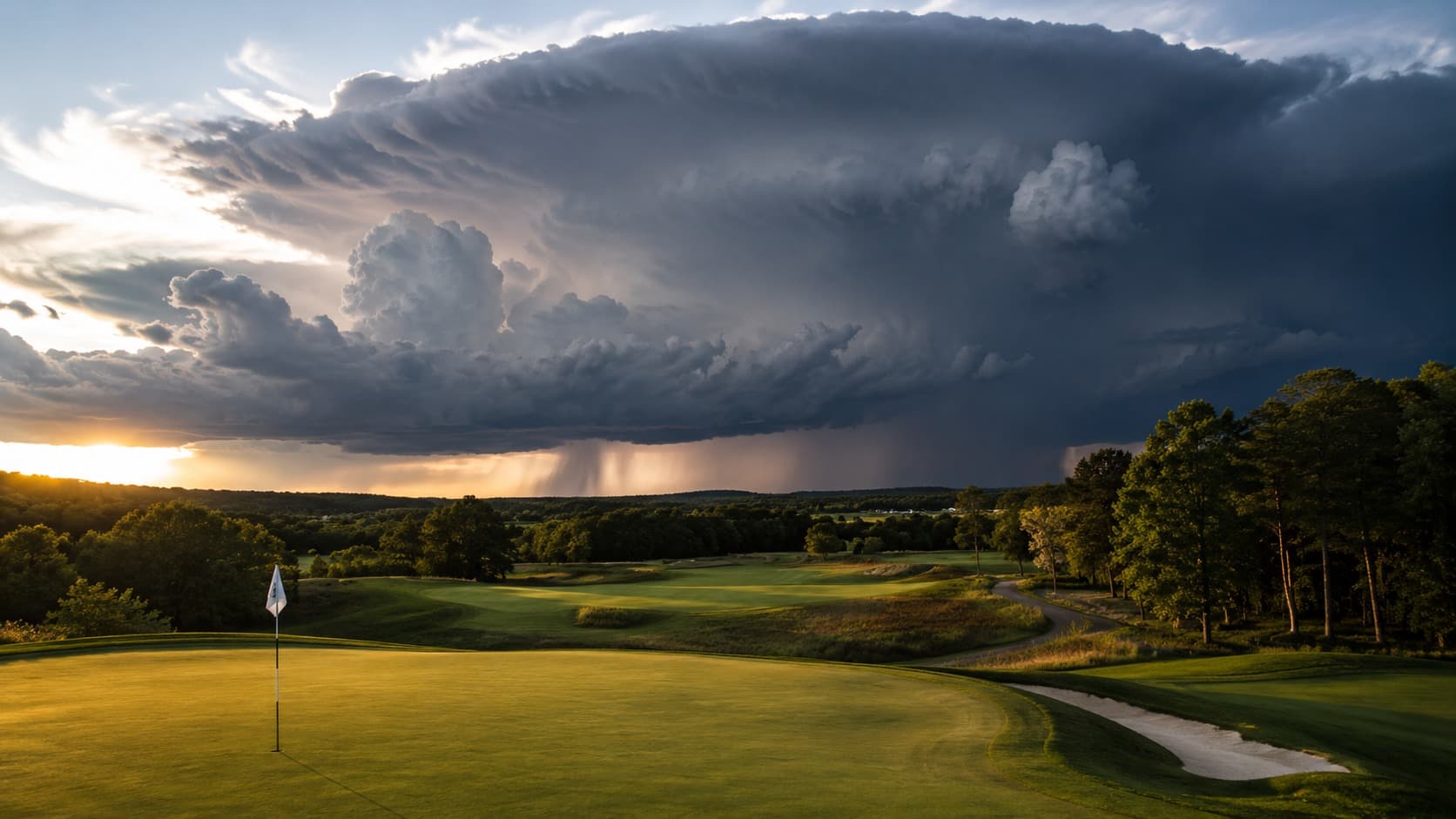
The Three O’Clock Storm: Reading Summer’s Convective Cycle to Protect Your Round
A 40% chance of afternoon thunderstorms does not mean a 40% chance of getting rained on. In the summer convective season it means the morning is nearly clear and the afternoon carries a fast-building, high-energy storm risk driven by a daily heating cycle. Here is the meteorology behind the pattern, the G-Score data on how the storm cycle punishes afternoon tee times across the Southeast, Midwest, and desert Southwest, the lightning-safety decision tree that actually matters, and the workflow that gets you off the course before the first bolt.
Read StoryMinSu Kim
Founder & Golf Data Analyst
MinSu is a data analyst and golfer with 10+ years on the course. He built Golf Weather Score to answer one question: is today a good day to play? He combines weather data, course intelligence, and the proprietary G-Score algorithm to help golfers make smarter decisions.
Every Friday Morning
When Brook Tree Golf Course plays best next weekend.
Friday 6am ET: peak G-Score windows for Brook Tree Golf Course, wind direction by hour, and one gear call. Three minutes to read, save you the round.
One email a week. Unsubscribe in one click.
The Caddie's Oracle
Draw your luck before the tee off