
Caddie's Gear Advisor
Curated for today's 61°F · Clear
Tour-Level Drivers
Engineered for maximum distance and forgiveness
Laser Rangefinders
Pin-seeking technology for precision approaches
Premium Golf Balls
Tour-caliber spin and distance performance
Performance Sunglasses
Polarized lenses optimized for reading greens
Your Golf Trip, Handled
The Ultimate Golf Trip Planner
Everything you need to play Brookings Country Club — from booking your flight to checking in course-side.
Course-Side Stays
Luxury hotels, resorts, and stay-and-play packages just minutes from the first tee.
Flights
Compare fares across 700+ airlines for the best route to your tee time.
SUV Rentals for Golf Bags
Spacious vehicles with room for clubs, bags, and your foursome.
Travel Insurance
Coverage for medical, weather delays, and gear at your destination.
Brookings Country Club: Course Intelligence
Signature Setup
Brookings Country Club opened in 1921, which makes it one of eastern South Dakota's older 18-hole layouts. The original routing is credited to Earl Bartling and Ward Waltz; the course was later updated, with that work commonly attributed to upper-midwest architect Don Herfort — I'd treat the redesign attribution as reported rather than confirmed, since the club's own history is thin online. It plays par 72 at roughly 6,548 yards from the back, rated 70.2 with a slope of 127. It is the home course of the South Dakota State Jackrabbits, which tells you it holds up to competitive college golf without being a brute on paper.
The defining hole is the 14th, a 567-yard par-5 carrying the #1 handicap. Three par-3s — holes 3, 7, and 18 — frame the round, ranging 153 to 191 yards, and a par-3 closer at 18 is an unusual, memorable way to finish.
Hole-by-Hole Wind & Playing Lines
On the prairie, wind is the real defense here, not length. Three holes decide your card:
- Hole 14 (par-5, 567y, #1 hcp): Into the prevailing NW wind that dominates spring and fall mornings, this stops being a reachable par-5 and becomes a strict three-shotter. Lay back to a full wedge number — 100 yards into wind holds better than a flighted 3-wood that balloons and comes up short-right.
- Hole 1 (par-5, 555y): A par-5 opener is rare. With an early SE summer breeze helping, it's gettable; cold-air NW mornings, treat it as a par.
- Hole 18 (par-3, up to 191y): A long par-3 finish. Crosswind off the open ground pushes a held shot; I'd club up one and aim at the fat side of the green rather than flag-hunt.
Green & Fairway Characteristics
I haven't walked these greens in person, so I won't pretend to know exact stimp readings. What I can say from the region: courses at this latitude run cool-season turf — bentgrass greens with bluegrass/rye fairways — which firms up in a dry July and stays receptive in a wet May. The 70.2 rating against a 127 slope says the trouble is real but fair: bogeys come from wind misjudgment, not tricked-up green complexes. Fairways here are exposed, so roll-out varies sharply with how recently it rained.
Seasonal Weather Pattern
Brookings sits in a continental prairie climate, and the playing season is short — realistically late April through October, with the course closed through the frozen winter. May and June bring the best scoring mornings: calm at 7 a.m., temps in the 50s°F, before the afternoon prairie wind builds to 15–25 mph. July and August run hot and firm. September is my pick for the trip — cooler air, slower wind days, and fairways still holding.
Local Play Tips
A specific one most tee-sheet sites won't tell you: the wind here is a clock, not a coin flip. Eastern South Dakota mornings are routinely calmest just after sunrise and stiffen by mid-morning, so the front nine and the back nine can feel like two different courses on the same day. Book the earliest slot you can stand. The facility has a five-tee practice range — use it to find your knockdown before the round, because you'll need it on 14 and 18.
Pre-Round Weather Workflow
Run the 7-day G-Score for Brookings the night before and the morning of. Two numbers matter most here: wind direction and the morning-to-afternoon wind ramp. If the forecast shows a NW wind over 15 mph, plan to play 14 as a lay-up par-5 and add a club on the long par-3s (7, 18). Check the windExposure rating for an early tee time — a high G-Score before 9 a.m. that drops by afternoon is your signal to play early and walk fast. On a calm, dry September morning, this course gives up its best scores; on a windy October afternoon, par is genuinely good golf.
Related Reading
Before you tee off at Brookings Country Club

Best Golf Weather by State: Ranking America by Average G-Score
We ranked all 50 US states by average G-Score golf playability. California tops the list, but the results beyond the top five may surprise you.
Read Story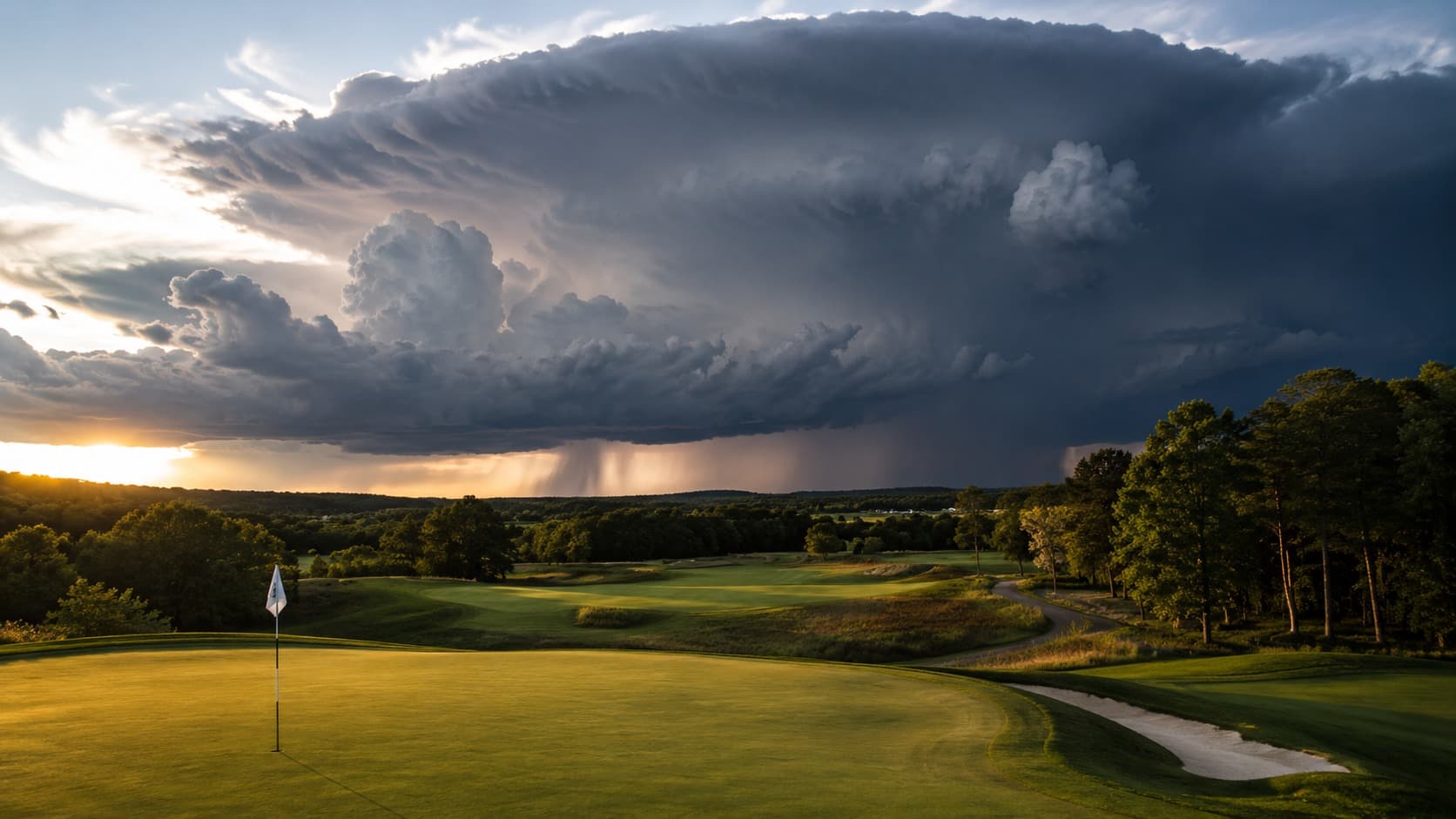
The Three O’Clock Storm: Reading Summer’s Convective Cycle to Protect Your Round
A 40% chance of afternoon thunderstorms does not mean a 40% chance of getting rained on. In the summer convective season it means the morning is nearly clear and the afternoon carries a fast-building, high-energy storm risk driven by a daily heating cycle. Here is the meteorology behind the pattern, the G-Score data on how the storm cycle punishes afternoon tee times across the Southeast, Midwest, and desert Southwest, the lightning-safety decision tree that actually matters, and the workflow that gets you off the course before the first bolt.
Read StoryMinSu Kim
Founder & Golf Data Analyst
MinSu is a data analyst and golfer with 10+ years on the course. He built Golf Weather Score to answer one question: is today a good day to play? He combines weather data, course intelligence, and the proprietary G-Score algorithm to help golfers make smarter decisions.
Every Friday Morning
When Brookings Country Club plays best next weekend.
Friday 6am ET: peak G-Score windows for Brookings Country Club, wind direction by hour, and one gear call. Three minutes to read, save you the round.
One email a week. Unsubscribe in one click.
The Caddie's Oracle
Draw your luck before the tee off