
Caddie's Gear Advisor
Curated for today's 80°F · Thunderstorm
Storm-Ready Outerwear
Waterproof layers built for 18 holes in the rain
Tour-Grade Umbrellas
68" double-canopy wind-resistant coverage
Wet-Weather Gloves
All-weather grip that performs in the rain
Waterproof Golf Shoes
Keep your feet dry through every fairway
Your Golf Trip, Handled
The Ultimate Golf Trip Planner
Everything you need to play Bryce Resort — from booking your flight to checking in course-side.
Course-Side Stays
Luxury hotels, resorts, and stay-and-play packages just minutes from the first tee.
Flights
Compare fares across 700+ airlines for the best route to your tee time.
SUV Rentals for Golf Bags
Spacious vehicles with room for clubs, bags, and your foursome.
Travel Insurance
Coverage for medical, weather delays, and gear at your destination.
Bryce Resort: Course Intelligence
Signature Setup
I teed off at Bryce on a mid-October morning with the ski slopes above the 18th still brown, no snow yet, and a thermometer reading 46°F at the first tee — cold enough that my opening drive came off the face dead and short. Bryce Resort sits in Basye, Virginia, in a pocket of the Shenandoah Valley with Bryce Mountain's ski runs rising directly behind the closing holes. Edmund Ault routed the 18-hole layout in 1972 as the golf half of a four-season resort, and it plays as a par 71 of roughly 5,940 yards from the back tees — short by modern standards, but the valley floor, the creek, and the wind do the defending. The finish along Stony Creek under the slope face is the postcard, and the only hole where I stopped to take a photo before hitting.
Hole-by-Hole Wind & Playing Lines
This is a narrow valley, and the wind here is not coastal gusting — it funnels up or down the valley axis, which runs roughly NW–SE. That single fact decides three holes.
- Hole 2 (#1 handicap, par-4 ~410y): Plays uphill, and on most mornings the air drains down-valley out of the NW, straight into you. That combination eats distance — I hit driver and still had a long iron in. Take one extra club to the green, which runs back-to-front; short and below the hole is the miss.
- Hole 18 (par-4, finishing along Stony Creek): The creek hugs the right side into the green. A down-valley NW breeze pushes the tee ball toward the water; aim up the left half and let the wind work it back rather than fighting it.
- A mid-round par-3 over a low corner of the creek: Into the same NW flow it is two clubs more than the yardage suggests. Downwind on a SE afternoon it shrinks fast — club by the flag, not the marker.
Green & Fairway Characteristics
The greens are bentgrass, true cool-season surfaces that on my October round were rolling about 9–10 on the Stimp — quick enough that the back-to-front tilt on the 2nd and several uphill greens punished any approach left above the hole. They are medium-sized and hold a well-struck iron because the valley air keeps them from baking out the way a Mid-Atlantic course at lower elevation would in August. Fairways are bluegrass and fescue, generous in the landing zones but framed tight by the valley walls and tree lines, so a push or pull leaves you blocked rather than just in rough. Slope sits in the low-120s — this is a course where position off the tee, not raw length, sets up your number.
Seasonal Weather Pattern
Basye sits well above the valley floor's lowest pockets, and the elevation matters: summer highs here run cooler than Washington or Richmond, often topping out in the mid-80s°F rather than the 90s, with afternoon thunderstorms building over the ridge in July and August. Mornings through the warm months bring Stony Creek fog that usually clears by 9 a.m. Fall — late September into October — is the prime window: crisp 45–55°F starts, firm turf, and the foliage on the slopes turning. Winter shuts the golf down entirely; the resort flips to skiing, so there is no off-season round to report. I haven't played Bryce in deep summer, so the storm-timing notes lean on the regional ridge pattern rather than a personal July card.
Local Play Tips
Two things the booking page will not tell you. First, the down-valley morning drainage wind is real and consistent enough to plan around — it stiffens, not calms, as the front nine goes on, so the holes that play into it are easier early. Second, because Bryce is a resort layout rather than a championship grind, the back-tee yardage flatters you into thinking it is easy; the cold-air distance loss on the uphill holes is what actually wrecks first-timers' cards. Play the tees that leave you full clubs into the elevated greens rather than the ones that match your ego.
Pre-Round Weather Workflow
Use the 7-day G-Score and windExposure here as a tee-time and club tool. Three steps before you book: (1) Check the morning low and fog window — a sub-50°F start plus creek fog means your first three holes play short and soft, so take the earliest slot only if you are willing to wait out the lift-off. (2) Read windExposure for the valley axis (NW–SE); a NW reading over ~10 mph means add a club on the uphill 2nd and the par-3 over the creek, and favor the left side on 18. (3) In summer, watch the afternoon storm probability over the ridge — G-Score will sag after midday in July/August, so an early loop beats a 2 p.m. tee. On this course the temperature and the valley wind, not the scorecard yardage, decide your number.
Related Reading
Before you tee off at Bryce Resort

The May 2026 G-Score Heatmap: Where American Golf Peaks This Spring
May is the most underrated month on the American golf calendar. Five regions hit their annual peak this spring, three turn quietly hostile, and the data tells a clearer story than the brochures. Here is where to play, where to avoid, and how to time your booking window.
Read Story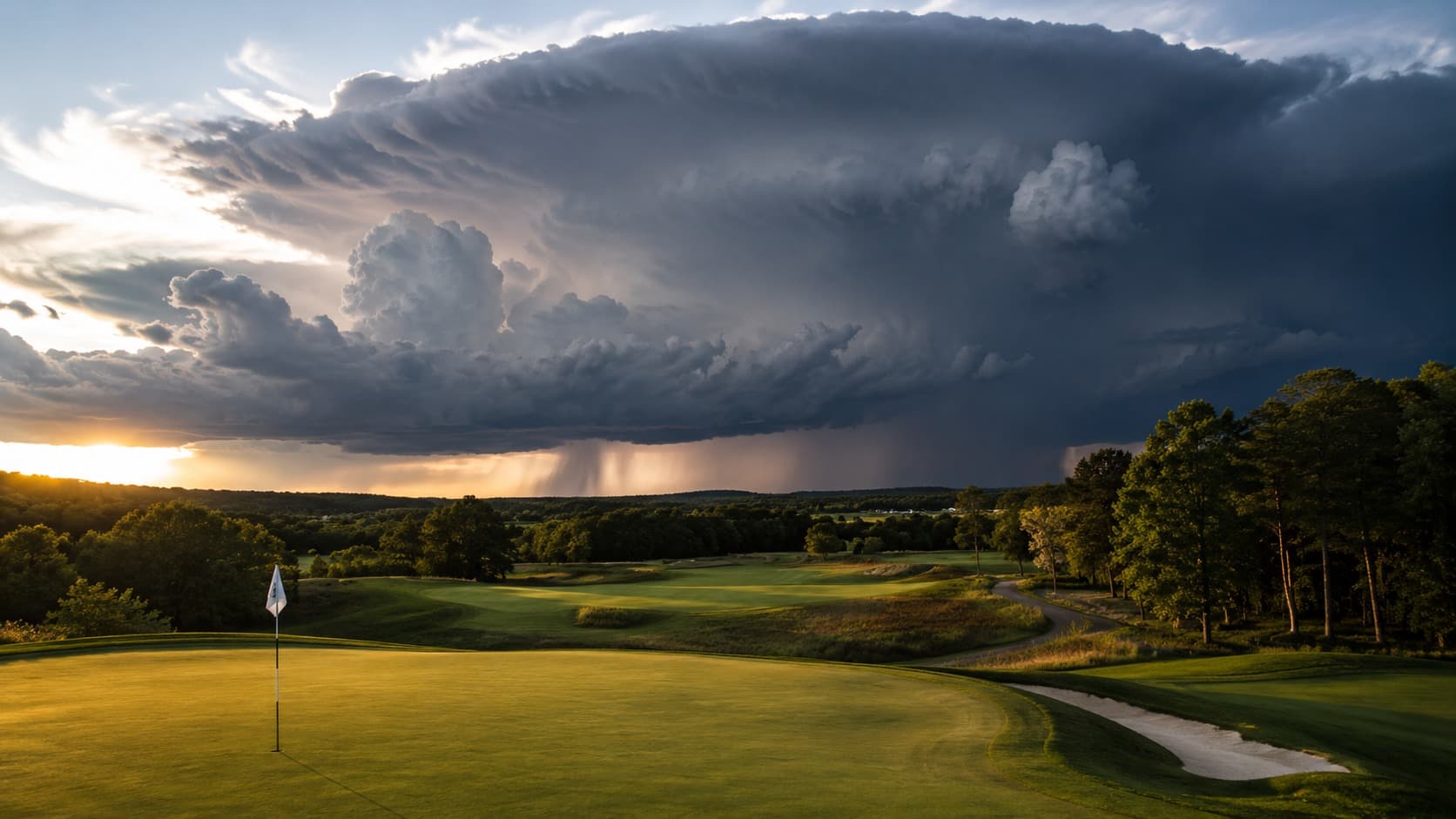
The Three O’Clock Storm: Reading Summer’s Convective Cycle to Protect Your Round
A 40% chance of afternoon thunderstorms does not mean a 40% chance of getting rained on. In the summer convective season it means the morning is nearly clear and the afternoon carries a fast-building, high-energy storm risk driven by a daily heating cycle. Here is the meteorology behind the pattern, the G-Score data on how the storm cycle punishes afternoon tee times across the Southeast, Midwest, and desert Southwest, the lightning-safety decision tree that actually matters, and the workflow that gets you off the course before the first bolt.
Read StoryMinSu Kim
Founder & Golf Data Analyst
MinSu is a data analyst and golfer with 10+ years on the course. He built Golf Weather Score to answer one question: is today a good day to play? He combines weather data, course intelligence, and the proprietary G-Score algorithm to help golfers make smarter decisions.
Every Friday Morning
When Bryce Resort plays best next weekend.
Friday 6am ET: peak G-Score windows for Bryce Resort, wind direction by hour, and one gear call. Three minutes to read, save you the round.
One email a week. Unsubscribe in one click.
The Caddie's Oracle
Draw your luck before the tee off