
Caddie's Gear Advisor
Curated for today's 77°F · Thunderstorm
Storm-Ready Outerwear
Waterproof layers built for 18 holes in the rain
Tour-Grade Umbrellas
68" double-canopy wind-resistant coverage
Wet-Weather Gloves
All-weather grip that performs in the rain
Waterproof Golf Shoes
Keep your feet dry through every fairway
Your Golf Trip, Handled
The Ultimate Golf Trip Planner
Everything you need to play Burnham Woods Golf Course — from booking your flight to checking in course-side.
Course-Side Stays
Luxury hotels, resorts, and stay-and-play packages just minutes from the first tee.
Flights
Compare fares across 700+ airlines for the best route to your tee time.
SUV Rentals for Golf Bags
Spacious vehicles with room for clubs, bags, and your foursome.
Travel Insurance
Coverage for medical, weather delays, and gear at your destination.
Burnham Woods Golf Course: Course Intelligence
Signature Setup
Burnham Woods sits in Burnham, Illinois, in the Calumet region south of downtown Chicago and only a few miles from Lake Michigan and the Indiana line. It is part of the Forest Preserve District of Cook County's golf system — a network of flat, tree-framed parkland tracks rather than a championship resort course. I haven't walked Burnham Woods myself, so I won't pretend to a hole-by-hole memory I don't have. The architect of the original routing isn't well documented publicly, which is common for the county's early-20th-century preserve courses; what's verifiable is the character — preserve timber, level ground, and a layout built for daily-fee play, not tournament theater.
Hole-by-Hole Wind & Playing Lines
Without a verified scorecard in hand, I'll write what the geography dictates instead of inventing yardages. On a parkland course this flat, the hazard isn't elevation — it's the trees and the wind that funnels between them. The defining variable here is Burnham's closeness to Lake Michigan. On a west or southwest day (Chicago's prevailing direction), the longer par-4s downwind shorten and the timber blocks much of the gust at ground level. But on an east-northeast lake breeze — frequent in spring and early summer — those same holes turn into the wind, and a 150-yard approach can play closer to 170. Club up, and on tree-pinched fairways aim for the open side rather than flirting with the timber line.
Green & Fairway Characteristics
This is northern Illinois, so expect cool-season turf: bentgrass-and-poa greens with rye-bluegrass fairways, the standard for Chicago-area municipal tracks. Forest-preserve greens like these are typically modest in size and speed compared to private clubs — true but not glassy. Total length on the county's mid-length courses runs roughly 6,000–6,400 yards from the back, which makes Burnham a course you score on with position and a steady wedge game, not raw distance. In the wet Midwest spring the flat fairways hold water and play soft with little roll; by the dry stretches of late summer they firm and the ball releases more off the tee.
Seasonal Weather Pattern
The Calumet/Chicago pattern is distinct and worth planning around. July highs average near 84°F and January highs sit around 32°F, with roughly 38 inches of precipitation a year — a genuinely seasonal course with a playable window from about April through October. The Lake Michigan effect is the local twist: in spring and early summer, the cold lake generates an east-to-northeast breeze that can hold shoreline-adjacent areas several degrees cooler than inland by late morning. Late-season cold fronts swing the wind from southwest to sharp northwest within an hour and end the comfortable golf quickly once October turns.
Local Play Tips
The edge at a lake-adjacent Chicago course is timing the lake breeze, not the air temperature. On clear, warm spring and early-summer days the morning is often calm and mild; the onshore east-northeast flow tends to build toward late morning, cooling the air and adding a crosswind that the open holes feel most. Tee off early to play your round before that flow fills in. As a county forest-preserve course, walk-on and daily-fee access is generally straightforward, but confirm seasonal hours — these courses close earlier in the year than Sun Belt tracks.
Pre-Round Weather Workflow
Check the 7-day G-Score the day before, then re-check the morning of. For Burnham Woods the two numbers that matter are wind direction and morning temperature. If the G-Score is strong at 7–9 a.m. and the forecast shows an east-northeast component building by late morning, that's the classic Lake Michigan breeze signature — take the early slot and expect the back half of the round to cool and stiffen up. Watch windExposure on the longer, more open holes: an east-northeast flow over about 12 mph is your cue to club up into it and aim for the wide side of every tree-lined fairway.
Related Reading
Before you tee off at Burnham Woods Golf Course

Tour Caddie Math: How Pros Adjust Yardages for Wind, Temperature, and Altitude on Every Shot
When a tour caddie hands over a club, the number on the bag is rarely the number on the bag. Wind, temperature, altitude, and air density all rewrite the math before the player ever takes a practice swing. Here is the calculation framework pros run on every shot, translated for serious amateurs.
Read Story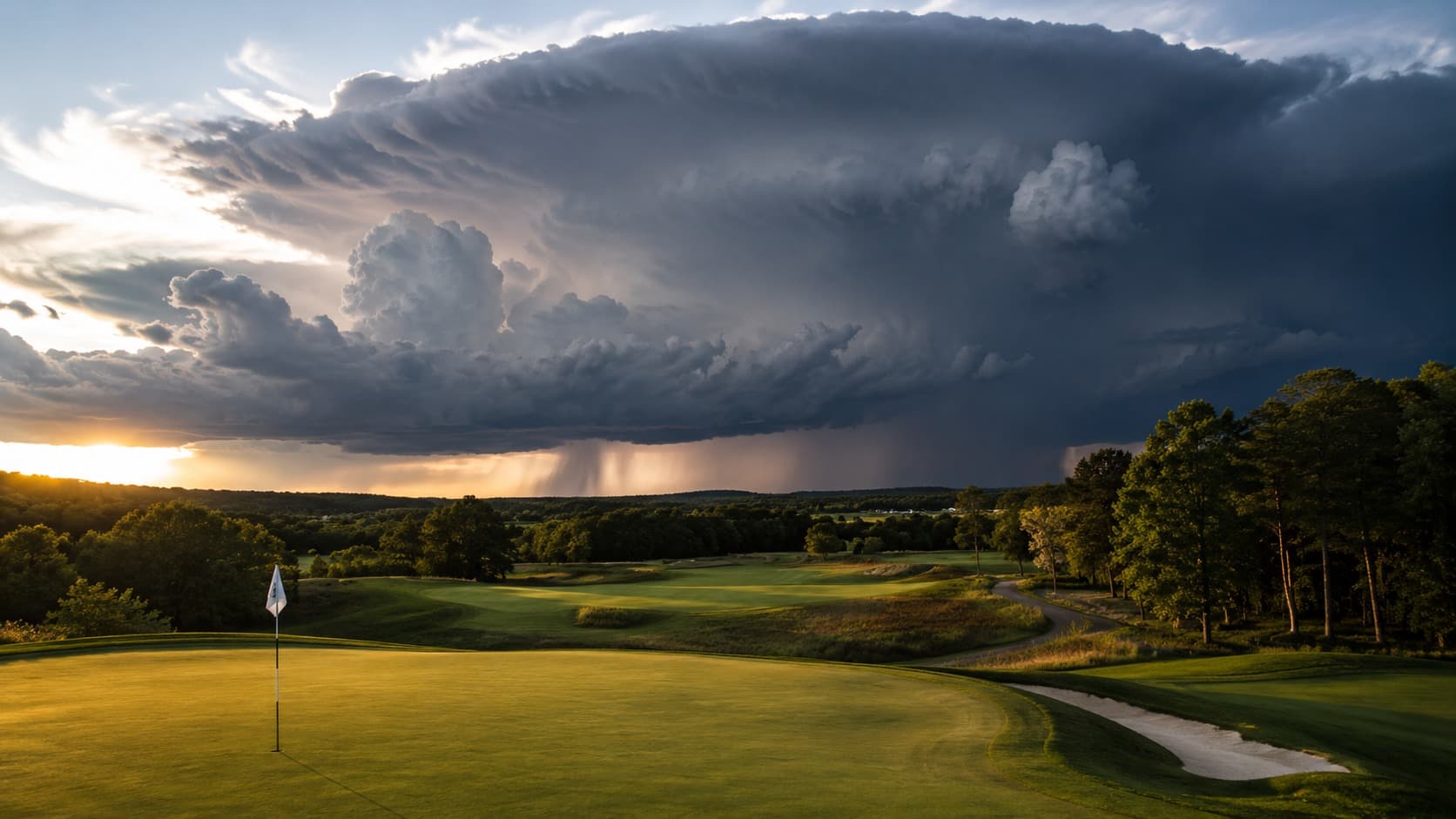
The Three O’Clock Storm: Reading Summer’s Convective Cycle to Protect Your Round
A 40% chance of afternoon thunderstorms does not mean a 40% chance of getting rained on. In the summer convective season it means the morning is nearly clear and the afternoon carries a fast-building, high-energy storm risk driven by a daily heating cycle. Here is the meteorology behind the pattern, the G-Score data on how the storm cycle punishes afternoon tee times across the Southeast, Midwest, and desert Southwest, the lightning-safety decision tree that actually matters, and the workflow that gets you off the course before the first bolt.
Read StoryMinSu Kim
Founder & Golf Data Analyst
MinSu is a data analyst and golfer with 10+ years on the course. He built Golf Weather Score to answer one question: is today a good day to play? He combines weather data, course intelligence, and the proprietary G-Score algorithm to help golfers make smarter decisions.
Every Friday Morning
When Burnham Woods Golf Course plays best next weekend.
Friday 6am ET: peak G-Score windows for Burnham Woods Golf Course, wind direction by hour, and one gear call. Three minutes to read, save you the round.
One email a week. Unsubscribe in one click.
The Caddie's Oracle
Draw your luck before the tee off