
Caddie's Gear Advisor
Curated for today's 93°F · Thunderstorm
Storm-Ready Outerwear
Waterproof layers built for 18 holes in the rain
Tour-Grade Umbrellas
68" double-canopy wind-resistant coverage
Wet-Weather Gloves
All-weather grip that performs in the rain
Waterproof Golf Shoes
Keep your feet dry through every fairway
Your Golf Trip, Handled
The Ultimate Golf Trip Planner
Everything you need to play Calusa Lakes Golf Club — from booking your flight to checking in course-side.
Course-Side Stays
Luxury hotels, resorts, and stay-and-play packages just minutes from the first tee.
Flights
Compare fares across 700+ airlines for the best route to your tee time.
SUV Rentals for Golf Bags
Spacious vehicles with room for clubs, bags, and your foursome.
Travel Insurance
Coverage for medical, weather delays, and gear at your destination.
Calusa Lakes Golf Club: Course Intelligence
Signature Setup
Let me be straight about my vantage before anything else: I haven't walked Calusa Lakes with a card in my hand, so I'm writing this from the course's own materials, Sarasota-County climate records, and a decade of playing this stretch of Florida's Gulf Coast — not dressing up a single round as memory. What I can give you cleanly is the pedigree and the shape. Calusa Lakes Golf Club sits in Nokomis, in Sarasota County, Florida, a few miles inland from the Gulf of Mexico. It's a Ted McAnlis design that opened in 1992, routed through wetlands, lakes, and stands of native oak and pine on a semi-private layout. It plays to par 72 and stretches to roughly 6,760 yards from the back tees — not long by modern standards, which is exactly the point: the trouble here is water, position, and the Gulf wind, not the scorecard.
TL;DR: Ted McAnlis design (1992) in Nokomis, Sarasota County FL. ~6,760y, par 72, slope in the mid-130s. Gulf-Coast Florida — the defense is water carries, oak-lined corridors, and the mid-morning-to-afternoon sea breeze, plus summer storm timing. Tee off early, play to the dry side, and let position beat power.
Hole-by-Hole Wind & Playing Lines
I won't assign hole numbers and yardages I can't verify from a card in front of me, so here is the wind logic that actually decides scoring on a water-and-oak layout this shape:
- The longer par-4s turning toward open lakes: Once the onshore Gulf breeze is up at 10–15 mph in the late morning, a flushed 150-yard club behaves like 165–170. Club up one, flight it low, and aim for the dry side away from the water — a ballooned approach into the breeze both comes up short and drifts toward the hazard.
- The par-3s over or beside water: A quartering W/SW breeze is the whole test here. Take the wind number, not the yardage number, and accept the front edge — short-and-dry beats long-and-wet every time on a forced carry.
- Oak-corridor holes: The trees knock the wind down at ground level but let it rip over the canopy, so your ball climbs into a breeze you can't feel at address. Trust the flags above the treeline, not the calm you feel on the tee.
The habit that travels: read the flag on the first exposed hole, decide whether the Gulf breeze has filled in yet, and re-club for the wind all the way in.
Green & Fairway Characteristics
The fairways and greens are Bermuda, managed through the usual Southwest-Florida winter transition, and they run firm and medium-quick — fast and bouncy in a dry late-winter spell, softer and more receptive after the summer afternoon rains. From the back tees the slope sits in the mid-130s, which tells you the difficulty lives in the angles, the water carries, and the putting surfaces, not in the card length. Approach these greens below the hole and favor the side away from the lakes. A short-sided miss toward water is a guaranteed dropped shot here, and on a firm, breezy afternoon a long-iron landing hot will release straight off the back into trouble.
Seasonal Weather Pattern
Nokomis is subtropical Gulf Coast, and the day's texture changes hard by season. Winter (Dec–Feb): the prime window — dry, mild, highs commonly in the low-to-mid 70s°F, calm mornings, firm fast surfaces, and the lowest wind of the year. This is when the course gives up its best scores. Spring (Mar–Apr): warming, breezier, with the Gulf sea breeze building earlier each day. Summer (Jun–Sep): hot and humid, highs in the low-90s°F with brutal dew points, and the defining feature — near-daily afternoon thunderstorms that fire up from roughly 1–4 p.m. as the sea breeze collides inland. Fall (Oct–Nov): the storm pattern fades, humidity eases, and conditions firm back toward the winter ideal, though peak hurricane season (through Nov) can park a wet, windy spell over the coast without much warning.
Local Play Tips
The one instinct a northern visitor gets wrong here is treating the morning like a luxury instead of a necessity. On the Gulf Coast in the warm months, the early tee time isn't about beating the heat — it's about finishing before the afternoon. The sea breeze fills in mid-morning and stiffens through the day, and in summer the thunderstorms are close to a daily appointment between about 1 and 4 p.m. A 7:30 round is calm, soft, and lightning-free; a 1 p.m. round is a coin flip on whether you finish at all. Book early, expect a little morning dew slowing the roll, and you'll catch the course at its most scorable. And in late summer and fall, glance at the tropical outlook before you drive over — a Gulf system can flip a calm forecast into wind and washouts inside a day.
Pre-Round Weather Workflow
Treat golfweatherscore's 7-day G-Score and windExposure as your go/no-go and your timing tool — read it as a Gulf-Coast course:
- Three days out: scan the G-Score trend, and in summer watch the afternoon storm probability as much as the temperature. A run of calm, dry winter mornings is your green light for low scores.
- The night before: lock in wind direction and timing. A standard W/SW onshore flow means calm mornings and a breezy afternoon — book the early slot. A pre-frontal or tropical pattern means wind and rain windows; plan around them, not through them.
- Round morning: if windExposure flags the Gulf breeze climbing past ~15 mph after mid-morning, accept that the water-running holes play a full club longer once it fills in — let position golf to the dry side, not heroics over the lakes, protect your number, and in summer have your last few holes done before the 1 p.m. storm window opens.
Related Reading
Before you tee off at Calusa Lakes Golf Club

Best Golf Weather by State: Ranking America by Average G-Score
We ranked all 50 US states by average G-Score golf playability. California tops the list, but the results beyond the top five may surprise you.
Read Story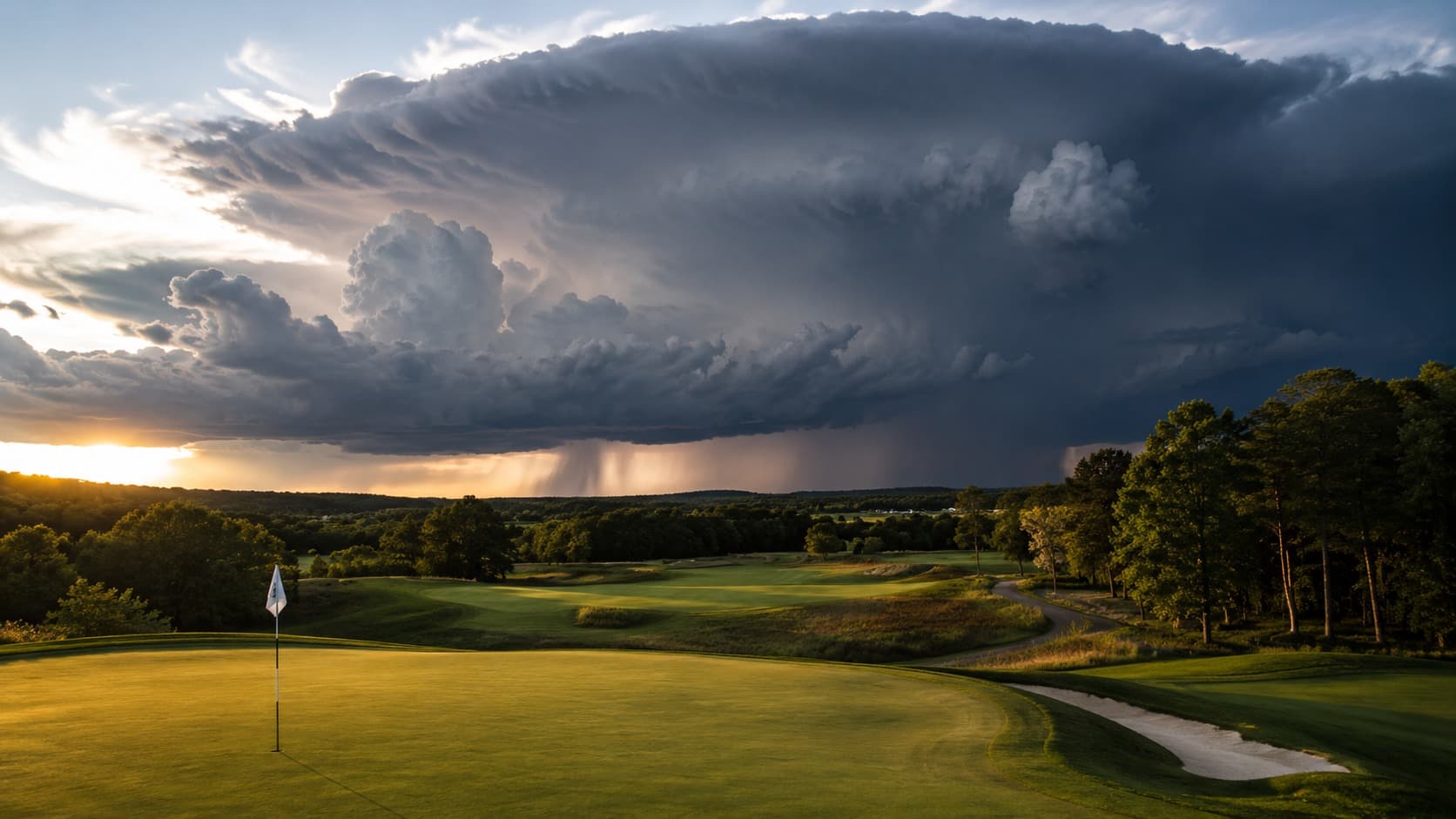
The Three O’Clock Storm: Reading Summer’s Convective Cycle to Protect Your Round
A 40% chance of afternoon thunderstorms does not mean a 40% chance of getting rained on. In the summer convective season it means the morning is nearly clear and the afternoon carries a fast-building, high-energy storm risk driven by a daily heating cycle. Here is the meteorology behind the pattern, the G-Score data on how the storm cycle punishes afternoon tee times across the Southeast, Midwest, and desert Southwest, the lightning-safety decision tree that actually matters, and the workflow that gets you off the course before the first bolt.
Read StoryMinSu Kim
Founder & Golf Data Analyst
MinSu is a data analyst and golfer with 10+ years on the course. He built Golf Weather Score to answer one question: is today a good day to play? He combines weather data, course intelligence, and the proprietary G-Score algorithm to help golfers make smarter decisions.
Every Friday Morning
When Calusa Lakes Golf Club plays best next weekend.
Friday 6am ET: peak G-Score windows for Calusa Lakes Golf Club, wind direction by hour, and one gear call. Three minutes to read, save you the round.
One email a week. Unsubscribe in one click.
The Caddie's Oracle
Draw your luck before the tee off