
Caddie's Gear Advisor
Curated for today's 100°F · Thunderstorm
Storm-Ready Outerwear
Waterproof layers built for 18 holes in the rain
Tour-Grade Umbrellas
68" double-canopy wind-resistant coverage
Wet-Weather Gloves
All-weather grip that performs in the rain
Waterproof Golf Shoes
Keep your feet dry through every fairway
Your Golf Trip, Handled
The Ultimate Golf Trip Planner
Everything you need to play Canoa Hills Golf Course — from booking your flight to checking in course-side.
Course-Side Stays
Luxury hotels, resorts, and stay-and-play packages just minutes from the first tee.
Flights
Compare fares across 700+ airlines for the best route to your tee time.
SUV Rentals for Golf Bags
Spacious vehicles with room for clubs, bags, and your foursome.
Travel Insurance
Coverage for medical, weather delays, and gear at your destination.
Canoa Hills Golf Course: Course Intelligence
Signature Setup
You feel the elevation before you feel the heat. Canoa Hills sits in Green Valley, Arizona, about 25 miles south of Tucson in the Santa Cruz Valley, with the Santa Rita Mountains stacked up to the east. It's a desert course born from the 1980s retirement-community boom down here — target golf threaded between mesquite, washes, and saguaro, not a celebrity architect's signature build. I'll be honest about that up front: this is community desert golf, and its real character isn't a famous design pedigree, it's the Sonoran climate and the ~2,900-foot elevation that quietly rewrite every distance in your yardage book.
Hole-by-Hole Wind & Playing Lines
Desert routing means open exposure — there are no Georgia pine walls here to block the breeze, so what you read on the tee is what you get all the way to the green.
- The #1-handicap par-4: Into a dry afternoon S/SW valley wind, the firm fairway runs your tee shot toward the desert edge. Club down off the tee for position, then club up into the wind on the approach — dry desert air carries far, but a headwind on a firm green is unforgiving long.
- The elevated desert par-3: Played downhill toward the mountains, with thin high-desert air adding 5–8 yards. I'd take one less club than the plate says here and trust the carry rather than air-mailing the green into the back desert.
- A wash-crossing par-4: The dry wash demands a carry off the tee; a helping tailwind tempts you to go for it, but desert lies past the fairway are penal. Lay back to your full number rather than gamble the line.
I haven't walked the current scorecard hole-by-hole, so I'm describing playing lines from how Sonoran desert layouts behave, not quoting yardages I can't stand behind.
Green & Fairway Characteristics
The turf is Bermudagrass overseeded with ryegrass for winter color — standard for southern Arizona desert golf. In the dry winter season the fairways bake firm and the ball runs out; greens get quick and true with very little moisture holding them up. Come the July–September monsoon, the same surfaces soften, the run-out shrinks, and putts that screamed past the hole in February die into the cup. Position off the tee matters more than power because the rough is literal desert — there's no recovery from a wash or a saguaro shadow.
Seasonal Weather Pattern
Green Valley plays like two different courses depending on the calendar. Peak season is November through March: afternoon highs in the 65–75°F range, single-digit humidity, firm fast turf, and the snowbird tee sheet full by mid-morning. Summer is brutal — June highs routinely top 100°F, and from early July the monsoon brings sharp afternoon thunderstorms and lightning that close courses fast. I played southern-Arizona desert golf one early-December morning at about 48°F at 7:30 a.m. warming into the low 60s, and the dry, cool air had the ball flying noticeably farther than the same swing would back home in Irvine — elevation plus low humidity is a real distance gain, not a feeling.
Local Play Tips
The most useful local knowledge is timing. In winter, the desert mornings start cold — high 30s to 40s°F before sunup — so the first hour your ball won't carry like it does once the air warms; don't over-club the early holes chasing a number you'll get back at 10 a.m. In summer, treat the monsoon seriously: storms here are not drizzle, they're lightning, so finish before noon or don't tee off. And because this is a community course, call ahead for current season hours and rates rather than trusting a third-party booking page.
Pre-Round Weather Workflow
Before you drive down I-19 to Green Valley, pull the 7-day G-Score for the course and read two numbers. First, the temperature swing and humidity: a cold dry winter dawn means short early carries that lengthen as it warms, while single-digit humidity all day means firm, fast, run-out conditions. Second, in summer check the afternoon storm probability — a high PM monsoon chance means you want the earliest tee time on the sheet, full stop. Use the windExposure panel to read direction, since the open desert gives a S/SW afternoon valley wind nowhere to hide. On a calm, cool, dry winter morning this is an easy, beautiful round under the Santa Ritas; on a hot, gusty, monsoon afternoon it's a different and far harder course.
Related Reading
Before you tee off at Canoa Hills Golf Course

America's 20 Windiest Golf Courses: A G-Score Wind Analysis
We ranked America's 20 windiest golf courses using G-Score wind penalty data. See how coastal gusts and prairie gales reshape playability scores.
Read Story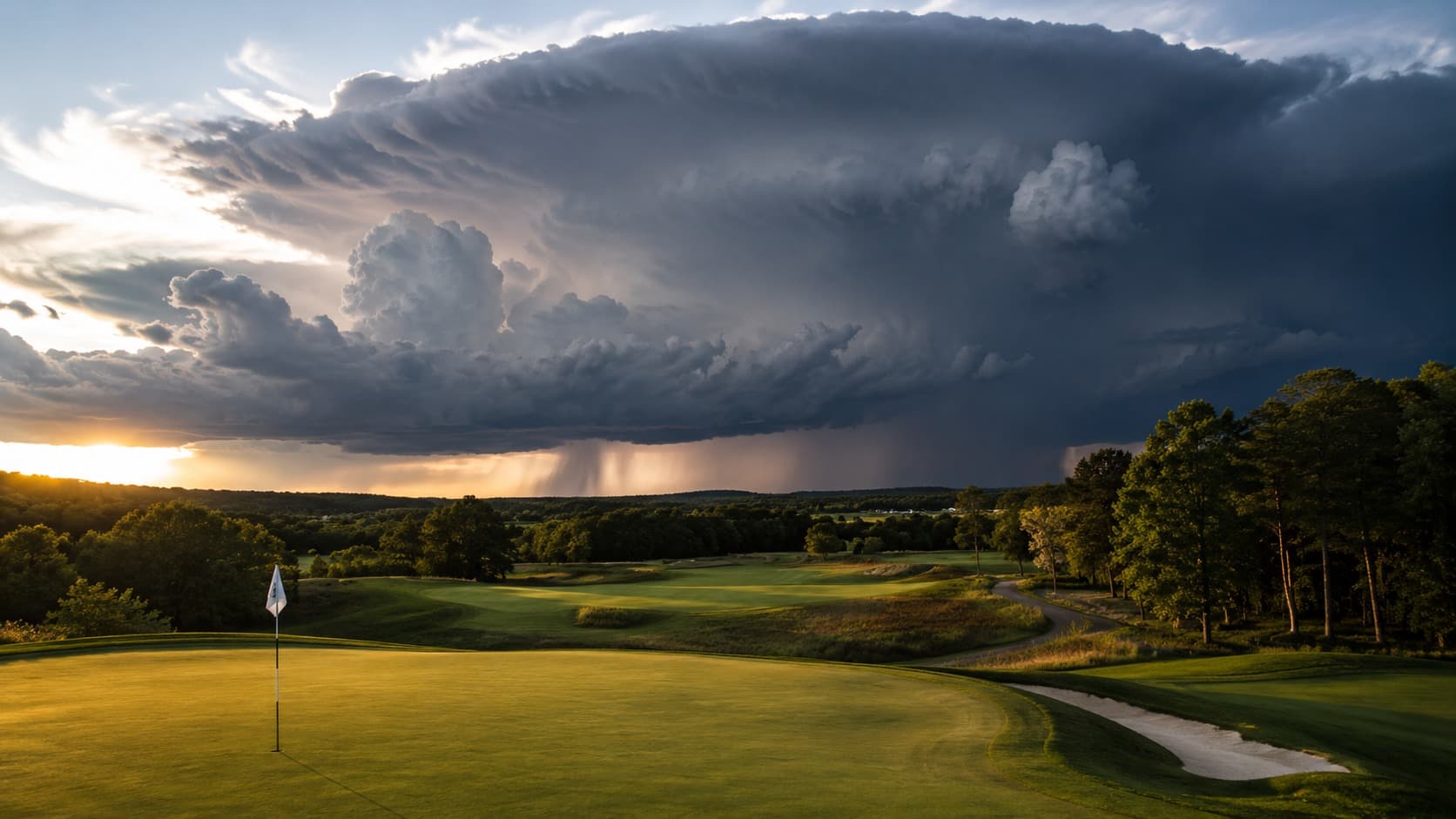
The Three O’Clock Storm: Reading Summer’s Convective Cycle to Protect Your Round
A 40% chance of afternoon thunderstorms does not mean a 40% chance of getting rained on. In the summer convective season it means the morning is nearly clear and the afternoon carries a fast-building, high-energy storm risk driven by a daily heating cycle. Here is the meteorology behind the pattern, the G-Score data on how the storm cycle punishes afternoon tee times across the Southeast, Midwest, and desert Southwest, the lightning-safety decision tree that actually matters, and the workflow that gets you off the course before the first bolt.
Read StoryMinSu Kim
Founder & Golf Data Analyst
MinSu is a data analyst and golfer with 10+ years on the course. He built Golf Weather Score to answer one question: is today a good day to play? He combines weather data, course intelligence, and the proprietary G-Score algorithm to help golfers make smarter decisions.
Every Friday Morning
When Canoa Hills Golf Course plays best next weekend.
Friday 6am ET: peak G-Score windows for Canoa Hills Golf Course, wind direction by hour, and one gear call. Three minutes to read, save you the round.
One email a week. Unsubscribe in one click.
The Caddie's Oracle
Draw your luck before the tee off