
Caddie's Gear Advisor
Curated for today's 71°F · Mist
Tour-Level Drivers
Engineered for maximum distance and forgiveness
Laser Rangefinders
Pin-seeking technology for precision approaches
Premium Golf Balls
Tour-caliber spin and distance performance
Performance Sunglasses
Polarized lenses optimized for reading greens
Your Golf Trip, Handled
The Ultimate Golf Trip Planner
Everything you need to play Congressional Country Club — from booking your flight to checking in course-side.
Course-Side Stays
Luxury hotels, resorts, and stay-and-play packages just minutes from the first tee.
Flights
Compare fares across 700+ airlines for the best route to your tee time.
SUV Rentals for Golf Bags
Spacious vehicles with room for clubs, bags, and your foursome.
Travel Insurance
Coverage for medical, weather delays, and gear at your destination.
Congressional Country Club: Course Intelligence
Signature Setup
I have not played Congressional — the Blue Course is members-and-guests only — but I spent a sticky June afternoon walking outside the ropes here, 89°F with a dew point near 70, the kind of mid-Atlantic soup where your grips never quite dry. What struck me was how little the property hides: big, open, muscular holes that give you the line and then dare you to hold your number in the heat.
The Blue Course traces to Devereux Emmet's 1924 layout in Bethesda, Maryland, about ten miles northwest of the U.S. Capitol. Robert Trent Jones Sr. rebuilt it for championship golf in the late 1950s, Rees Jones renovated it in 1989, and Andrew Green completed a full restoration in 2021. It has hosted three U.S. Opens (1964, 1997, 2011), the 1976 PGA Championship, and the 2022 KPMG Women's PGA. Ken Venturi won the 1964 Open while nearly collapsing from heat exhaustion during a 36-hole final day in triple-digit temperatures; Ernie Els took 1997; Rory McIlroy set the U.S. Open scoring record at 268 (−16) in 2011. Congressional is scheduled to host the 2030 PGA Championship and the 2037 Ryder Cup.
Hole-by-Hole Wind & Playing Lines
The lakeside finishing par-4 (~520y). Downhill to a peninsula green pressed against Tilghman Lake — the hole McIlroy closed out in 2011. A helping SW wind tempts you to chase the green, but anything pulled feeds toward the water on the left; favor the right two-thirds of the green and let the slope feed you back.
The Blue's longest par-4 (~480y). Into the prevailing southwest summer breeze this plays every inch of a sub-par-5. It is a driver-then-long-iron hole for most amateurs; aim at the wide left half of the fairway and lay the approach short-right of the green rather than forcing a knockdown the wind knocks down into a bunker.
The water par-3 (~210–220y). Congressional's dramatic one-shotter carries an arm of the lake. The hole sits low, so it is sheltered from a W wind but exposed to a S/SW push that turns a 7-iron into a 5-iron — take the extra club and aim at the center, never the flag.
Green & Fairway Characteristics
After Andrew Green's 2021 restoration the Blue's greens are bentgrass, large, and firmer than most members expect — they ran around 13 on the Stimp for the 2022 KPMG Women's PGA and get genuinely fast on the downhillers. Fairways are wide off the tee but the second-shot value is in distance control: this is a long course, listed near 7,569 yards at par 71 for the 2011 U.S. Open, with a slope in the low-150s from the Championship tees. The front nine and back both stretch past 3,700 yards on the tournament card, so club selection compounds — a half-club error early becomes a long-iron error late. The defining stretch is the closing run toward Tilghman Lake, where water guards the most memorable greens.
Seasonal Weather Pattern
Bethesda sits in the humid mid-Atlantic, well inland of the Chesapeake, so there is no reliable sea breeze to cool you — just heat and moisture. Spring (April–May) is the soft, generous window: 55–72°F, receptive greens, little roll. Summer (June–August) is the test the U.S. Opens exposed: regularly 86–95°F with a high dew point and near-daily afternoon thunderstorms that build after 1 p.m. — the exact 1964 conditions that put a doctor inside the ropes with Venturi. Autumn (late September–October) is prime: 56–72°F, firm turf, the steadiest air. NOAA's Washington-area records show summer afternoon winds commonly 5–11 mph out of the south and southwest, light by links standards but enough to lengthen the long par-4s.
Local Play Tips
Honest limitation first: I have not teed it up on the Blue Course, so these lines come from walking the property and from the championship record, not from my own scorecard. The thing no yardage book prints here is the humidity tax. Congressional plays its full 7,500-plus yards in July because the heavy, moisture-laden air kills carry — the ball simply does not fly the way it does in dry October. The same swing that flies a 7-iron 165 yards in fall can come up a full club short on a 92°F afternoon. Plan your number for the air you are in, not the air you remember, and treat every long approach as one club more than the book says.
Pre-Round Weather Workflow
Use the 7-day G-Score on this page the way I would here. Three days out, check whether your tee window lands before or after the afternoon thunderstorm and humidity build — on a 7,500-yard course that finishes against the lake, that single factor swings several strokes. The morning of, read the windExposure panel: an S/SW reading means the long par-4s and the water par-3 all play longer, so club up and aim at green centers. If the temperature reads above 88°F with a high dew point — the U.S. Open scenario — expect dead, heavy air that steals a full club of carry; commit to more club on every approach, hydrate harder than you think you need to, and get your round in before the storms stack up after lunch.
Related Reading
Before you tee off at Congressional Country Club
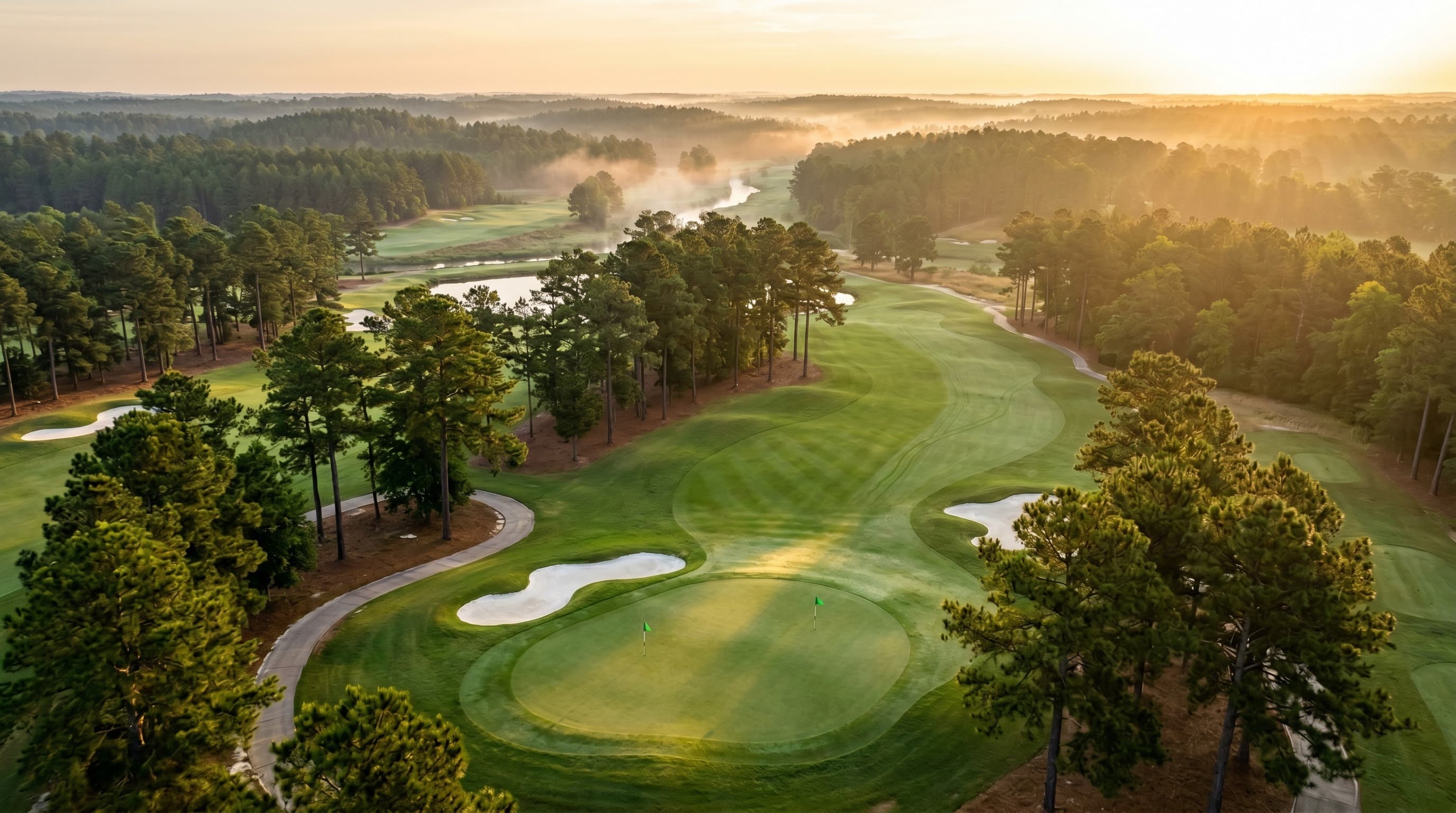
The May 2026 G-Score Heatmap: Where American Golf Peaks This Spring
May is the most underrated month on the American golf calendar. Five regions hit their annual peak this spring, three turn quietly hostile, and the data tells a clearer story than the brochures. Here is where to play, where to avoid, and how to time your booking window.
Read Story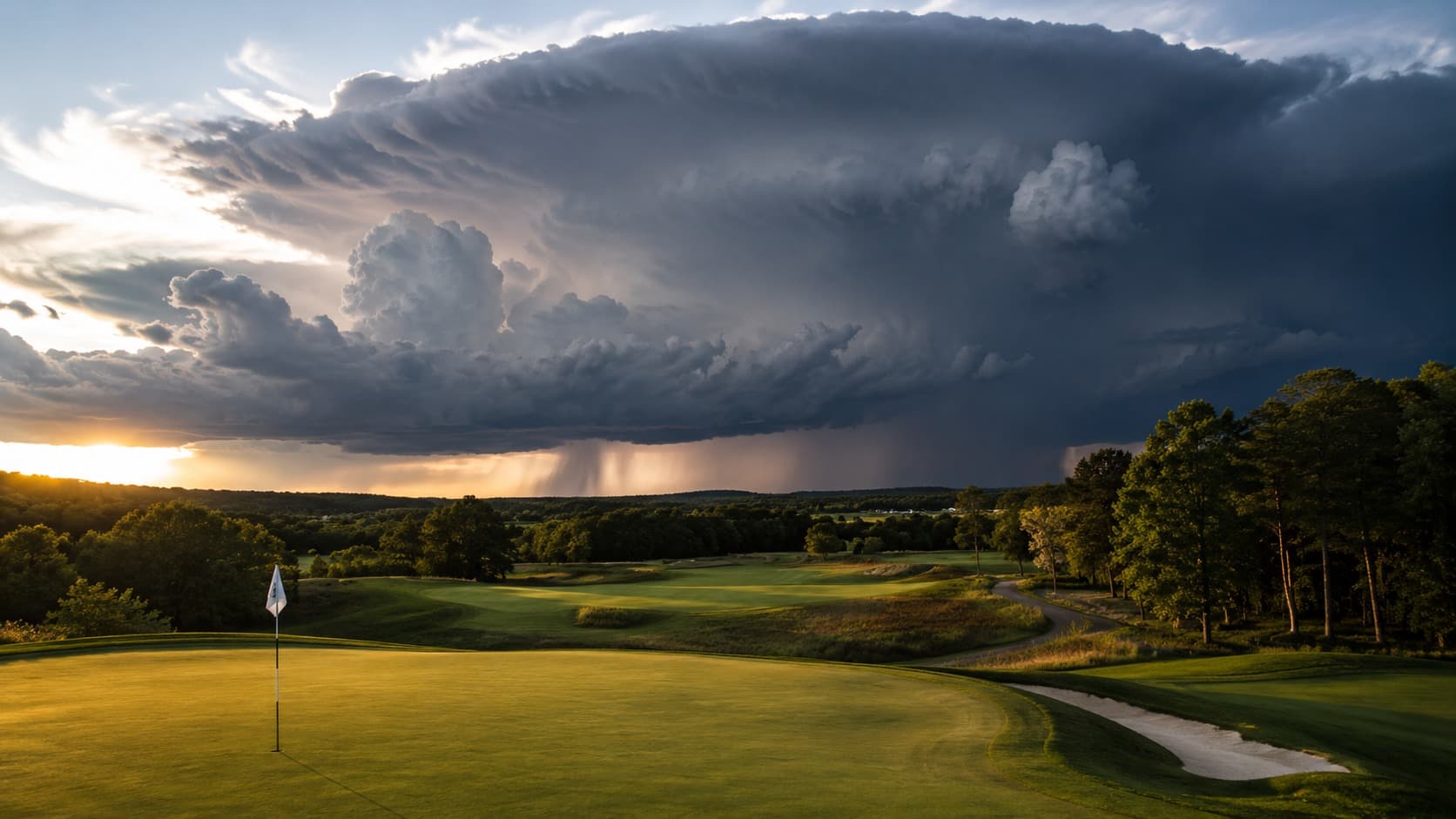
The Three O’Clock Storm: Reading Summer’s Convective Cycle to Protect Your Round
A 40% chance of afternoon thunderstorms does not mean a 40% chance of getting rained on. In the summer convective season it means the morning is nearly clear and the afternoon carries a fast-building, high-energy storm risk driven by a daily heating cycle. Here is the meteorology behind the pattern, the G-Score data on how the storm cycle punishes afternoon tee times across the Southeast, Midwest, and desert Southwest, the lightning-safety decision tree that actually matters, and the workflow that gets you off the course before the first bolt.
Read StoryDanorie
Editorial & Data
Golf Weather Score is built by Danorie. We compute the G-Score — our own playability rating — from live NOAA forecasts and published course scorecards, so any US course can be compared on any day with a single number. Methodology and data sources are documented on every page.
Every Friday Morning
When Congressional Country Club plays best next weekend.
Friday 6am ET: peak G-Score windows for Congressional Country Club, wind direction by hour, and one gear call. Three minutes to read, save you the round.
One email a week. Unsubscribe in one click.
The Caddie's Oracle
Draw your luck before the tee off