
Caddie's Gear Advisor
Curated for today's 69°F · Thunderstorm
Storm-Ready Outerwear
Waterproof layers built for 18 holes in the rain
Tour-Grade Umbrellas
68" double-canopy wind-resistant coverage
Wet-Weather Gloves
All-weather grip that performs in the rain
Waterproof Golf Shoes
Keep your feet dry through every fairway
Your Golf Trip, Handled
The Ultimate Golf Trip Planner
Everything you need to play Harbour Town Golf Links — from booking your flight to checking in course-side.
Best time to golf in South CarolinaCourse-Side Stays
Luxury hotels, resorts, and stay-and-play packages just minutes from the first tee.
Flights
Compare fares across 700+ airlines for the best route to your tee time.
SUV Rentals for Golf Bags
Spacious vehicles with room for clubs, bags, and your foursome.
Travel Insurance
Coverage for medical, weather delays, and gear at your destination.
Harbour Town Golf Links: Course Intelligence
Signature Setup
The 18th at Harbour Town is shorter on the card than it feels standing on the tee. I played it on an April morning, 61°F at 8 a.m. with a soft W breeze already lifting off Calibogue Sound, and the marsh down the left looked far closer than the yardage book suggested. The lighthouse sits behind the green like a target you can't quite trust.
Pete Dye routed Harbour Town Golf Links in 1969 inside the Sea Pines Resort on Hilton Head Island, South Carolina, with a young Jack Nicklaus consulting on the design. It broke from the era's power-course trend: par 71, roughly 7,121 yards from the tips, with tight tree-lined corridors and tiny greens that reward shot-shaping over raw distance. It has hosted the RBC Heritage every spring since its opening year — traditionally the week after the Masters — making it one of the most continuously televised venues on the PGA Tour.
Hole-by-Hole Wind & Playing Lines
Hole 18 (#1 handicap, par-4, 472y). The most exposed tee shot on the property. The fairway bends left along the Sound, and the prevailing W/SW breeze pushes everything toward the marsh. Into a 12–15 mph wind my 250-yard drive aimed at right-center still drifted, leaving 215 in. Club up one, aim at the right half of the green, and accept that par here is a strong score.
Hole 13 (par-4, 380y). Short but venomous. The green is one of the smallest on Tour, ringed by a sprawling waste bunker shaped like a Dye signature. The premium is on the wedge, not the drive — into an E wind I took an extra half-club and still landed short, where the firm Bermuda kicked it on.
Hole 14 (par-3, 192y). All carry, fully open to the Sound wind. On a NE morning it plays nearer 205; downwind it's a knockdown 170. The green is shallow front-to-back, so the wind read decides whether you're putting or chipping back up a bank.
Green & Fairway Characteristics
Harbour Town's greens are the defining test — most sit well under 4,000 square feet, low-profile and firm, rolling around 11 on the Stimp for the Heritage. They demand a steep, spinning approach; a low runner won't hold. Fairways are Bermudagrass, overseeded for the spring event, and tightly framed by live oaks and pines, so accuracy off the tee outweighs distance. The front nine plays slightly more open; the back tightens through the water holes from 13 onward, where the doglegs and waste areas leave almost no bailout. Slope sits in the mid-140s from the tips — high for a course this length, entirely because of the green size and the trees.
Seasonal Weather Pattern
Hilton Head is low-country coastal, and Calibogue Sound governs the playing conditions more than the calendar does. Spring (March–April), when the Heritage is played, runs 55–75°F with the calmest mornings of the year before the afternoon sea breeze builds. Summer (June–August) is humid and warm, often 82–90°F, with daily SW breezes of 10–15 mph and pop-up afternoon storms off the Atlantic. Fall (October–November) is my favorite window — 60–78°F, firm turf, and lighter wind. NOAA coastal-station records for the Hilton Head area show summer afternoon gusts routinely in the 12–18 mph range out of the southwest.
Local Play Tips
Something the scorecard won't tell you: the closing six holes are the only truly exposed stretch, and they all touch the water. If your tee time puts you on 13 through 18 after late morning, you'll meet the sea breeze head-on exactly when the holes are hardest. Lock in an early window and you play that stretch in near-calm air. The waste bunkers are also firmer and more playable than they look — you can take an iron cleanly off the crushed shell and sand rather than wedging out.
Pre-Round Weather Workflow
Use the 7-day G-Score on this page the way I do. Three days out, check whether your tee window lands before or after the late-morning Calibogue sea-breeze build — on the exposed back nine that single factor moves the score 8–12 points. The morning of, read the windExposure panel: a W or SW reading means holes 14 and 18 play directly into the breeze, so favor right-side targets and club up one into those greens. If the temperature reads below 60°F with overnight rain, expect firmer-than-usual greens that still won't release on a low ball — take the extra club, fly it in with spin, and let Harbour Town's small targets reward the precise shot they were built to demand.
Related Reading
Before you tee off at Harbour Town Golf Links

America's 20 Windiest Golf Courses: A G-Score Wind Analysis
We ranked America's 20 windiest golf courses using G-Score wind penalty data. See how coastal gusts and prairie gales reshape playability scores.
Read Story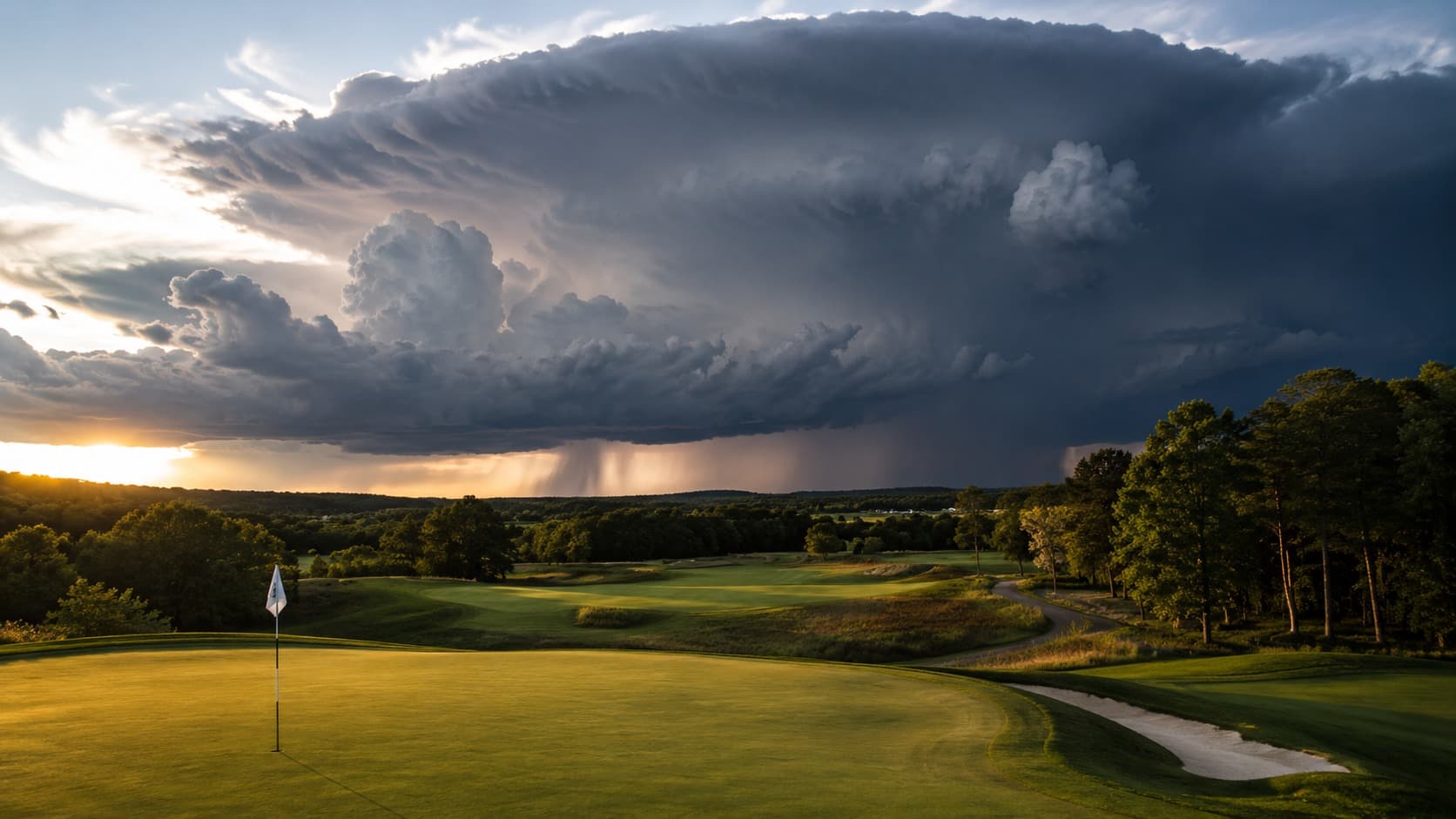
The Three O’Clock Storm: Reading Summer’s Convective Cycle to Protect Your Round
A 40% chance of afternoon thunderstorms does not mean a 40% chance of getting rained on. In the summer convective season it means the morning is nearly clear and the afternoon carries a fast-building, high-energy storm risk driven by a daily heating cycle. Here is the meteorology behind the pattern, the G-Score data on how the storm cycle punishes afternoon tee times across the Southeast, Midwest, and desert Southwest, the lightning-safety decision tree that actually matters, and the workflow that gets you off the course before the first bolt.
Read StoryDanorie
Editorial & Data
Golf Weather Score is built by Danorie. We compute the G-Score — our own playability rating — from live NOAA forecasts and published course scorecards, so any US course can be compared on any day with a single number. Methodology and data sources are documented on every page.
Every Friday Morning
When Harbour Town Golf Links plays best next weekend.
Friday 6am ET: peak G-Score windows for Harbour Town Golf Links, wind direction by hour, and one gear call. Three minutes to read, save you the round.
One email a week. Unsubscribe in one click.
The Caddie's Oracle
Draw your luck before the tee off