
Caddie's Gear Advisor
Curated for today's 94°F · Clouds
Ultralight Distance Drivers
Maximum carry in hot, low-drag conditions
UV Protection Apparel
UPF 50+ cooling fabrics for peak-sun rounds
Precision Rangefinders
Slope-adjusted yardage in any condition
Hydration & Cooling
Insulated bottles and cooling towels
Your Golf Trip, Handled
The Ultimate Golf Trip Planner
Everything you need to play Kiawah Island Club - River Course — from booking your flight to checking in course-side.
Course-Side Stays
Luxury hotels, resorts, and stay-and-play packages just minutes from the first tee.
Flights
Compare fares across 700+ airlines for the best route to your tee time.
SUV Rentals for Golf Bags
Spacious vehicles with room for clubs, bags, and your foursome.
Travel Insurance
Coverage for medical, weather delays, and gear at your destination.
Kiawah Island Club - River Course: Course Intelligence
Signature Setup
The Kiawah River carries the smell of pluff mud at dawn, and on a calm April morning the marsh sits flat as glass before the breeze arrives around nine. The River Course is Tom Fazio's 1995 design at the private Kiawah Island Club — the island's first members-only course, built five years before Watson's Cassique went in on the other side of the property. Where Cassique is a firm, open inland links, the River Course is the parkland counterpart: maritime forest, live oaks draped in Spanish moss, and a chain of tidal lagoons that Fazio routed straight into the line of play. It runs roughly 7,000 yards from the tips at par 72, but yardage is not the defense here. Water is. Lagoons, marsh fingers, and the river itself touch a large share of the holes, so the course rewards a player who can commit to a target over carry water rather than one who simply hits it far. The signature shot is a par-3 played entirely across a tidal lagoon, where there is no front bailout — you carry the water to the putting surface or you reload.
Hole-by-Hole Wind & Playing Lines
The River Course splits into two wind personalities: sheltered interior holes through the forest, and exposed holes that hug the marsh and river.
- The #1-handicap par-4 (~450y): When the southwest river breeze is up at 10–15 mph, a scratch-to-9 handicap is hitting driver and then a 3- or 4-iron here, not the comfortable mid-iron the scorecard suggests. The marsh runs down the entire left flank, so the only safe miss is to the right; take the longer second over any flirtation with the water line.
- The signature lagoon par-3: With water carry to the green and no short bailout, wind direction is everything. Into a SW breeze, take one to two extra clubs and aim at the center of the green, never the flag. Downwind off the northeast, the danger flips to long — the back edge falls toward more trouble.
- A river-side closing par-4: The holes that turn back along the Kiawah River are the most exposed on the property. A crosswind off the water pushes the ball toward the marsh, so I would aim into the wind side and let it drift back, rather than starting it at the pin.
Green & Fairway Characteristics
The fairways are paspalum, chosen because it tolerates the brackish, salt-laden air that blows in off the river and marsh better than older Bermuda strains. They sit lush and tend to hold rather than run, which is the opposite of Cassique's firm links turf a few hundred yards away — the same approach shot that releases at the links course stops quickly here. Greens are Bermuda, mid-sized, with gentle Fazio contouring that rewards a bold line into a slope rather than punishing it with tricked-up tiers, and members typically see them at a moderate 10.5 or so. Because so many greens are guarded short or long by water, the percentage miss is almost always to the dry side, even when that leaves a longer putt. The interior parkland nine plays a touch softer and more sheltered; the holes along the open marsh dry out faster in wind and sun.
Seasonal Weather Pattern
Kiawah Island lies on the South Carolina coast just below Charleston, and its weather is governed by the warm Atlantic at its doorstep. April through early May is the stretch I would chase: cool starts near 60°F, comfortable mid-70s by lunch, and a river wind that has not yet built to its summer strength. By July and August the air turns oppressive, with daytime readings flirting with 90°F and humidity so thick the afternoon storm cells stack up over the water almost every day from mid-afternoon onward — being on the closing holes before three o'clock matters. October is the quiet secret: the humidity breaks, the breeze softens, and the playing conditions are the steadiest of the calendar. January and February stay tolerable on paper in the 50s and 60s, yet the wind sweeping unobstructed across the marsh bites harder than the number admits, and the heavier winter sea air robs distance — expect to club up roughly one extra stick in deep winter versus early autumn.
Local Play Tips
Two things I will be straight about. First, the River Course is a private members' club, so unlike public Lowcountry tracks the day-to-day pin and setup detail comes from course data and member accounts rather than my own loop around it — what I can speak to with confidence is the island's weather and how Fazio's water-heavy routing interacts with it. Second — and this is the single read that decides club selection — recent rainfall reshapes the River Course far more than air temperature ever will. Following a dry week the paspalum gets crusty and approach shots scoot forward; in the day or two after a Lowcountry downpour the turf turns receptive and grabs the ball on landing. The same approach that bounded onto the green after a dry spell will plug its pitch mark a couple of days after rain, so glance at the recent precipitation before you commit to any aggressive carry over the lagoons.
Pre-Round Weather Workflow
Use the 7-day G-Score and the windExposure rating before you commit to a tee time. For the River Course, prioritize a spring or fall morning when the G-Score trends 8 or higher — that is when mild temperatures and a light river breeze line up against Fazio's water carries. Watch the windExposure flag for southwest direction: on high-SW mornings, add a club or two on the exposed marsh and river holes, and aim at the dry center of every water-guarded green rather than the flag. During summer, check the convective storm odds for the afternoon and reserve a slot early enough to be walking off the 18th before the three-o'clock cells fire. Last, look at how much rain has fallen in the past couple of days — receptive turf holds while crusty turf releases, and that single data point shifts your carry math over the lagoons further than any temperature reading.
Related Reading
Before you tee off at Kiawah Island Club - River Course

America's 20 Windiest Golf Courses: A G-Score Wind Analysis
We ranked America's 20 windiest golf courses using G-Score wind penalty data. See how coastal gusts and prairie gales reshape playability scores.
Read Story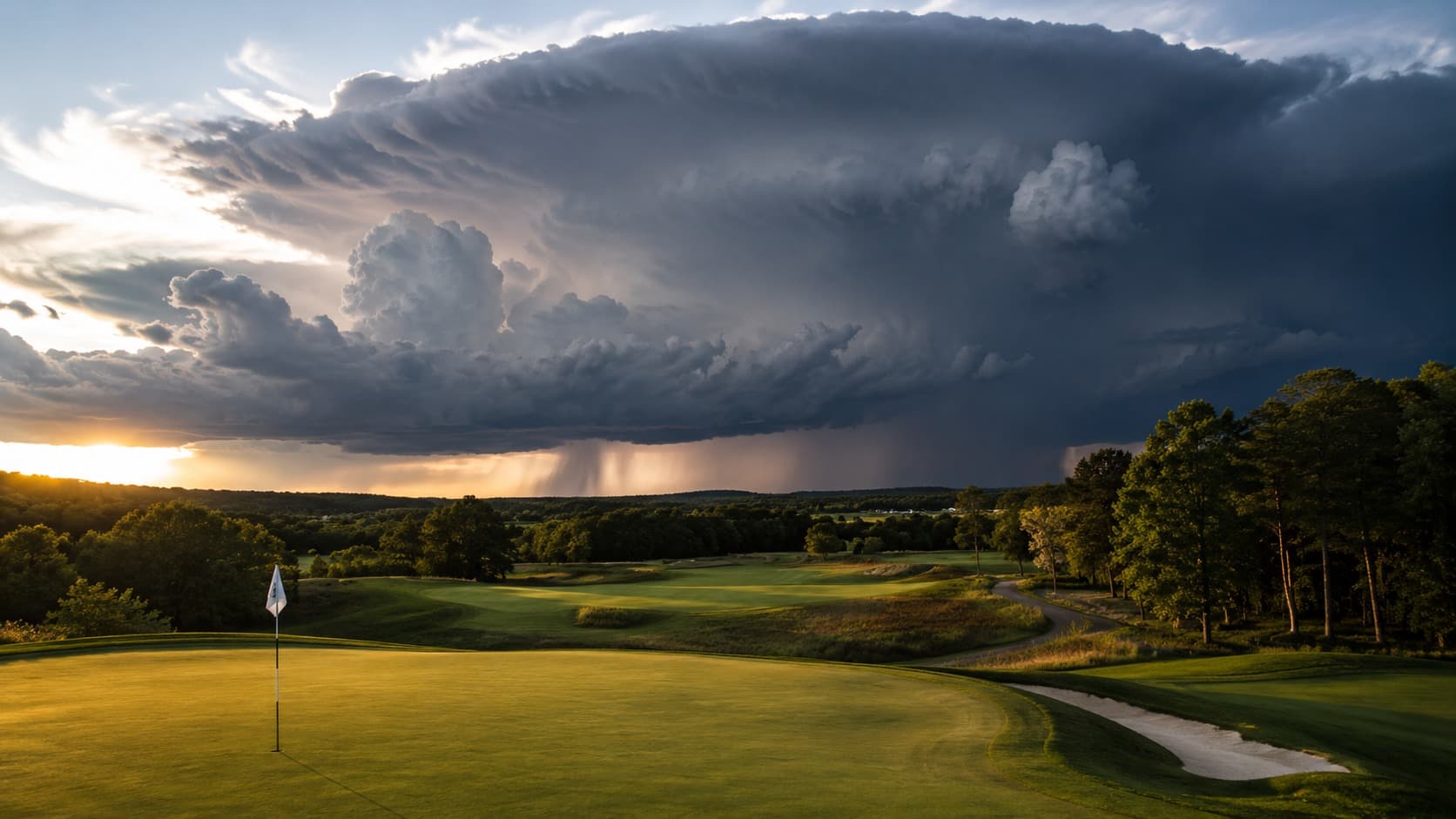
The Three O’Clock Storm: Reading Summer’s Convective Cycle to Protect Your Round
A 40% chance of afternoon thunderstorms does not mean a 40% chance of getting rained on. In the summer convective season it means the morning is nearly clear and the afternoon carries a fast-building, high-energy storm risk driven by a daily heating cycle. Here is the meteorology behind the pattern, the G-Score data on how the storm cycle punishes afternoon tee times across the Southeast, Midwest, and desert Southwest, the lightning-safety decision tree that actually matters, and the workflow that gets you off the course before the first bolt.
Read StoryMinSu Kim
Founder & Golf Data Analyst
MinSu is a data analyst and golfer with 10+ years on the course. He built Golf Weather Score to answer one question: is today a good day to play? He combines weather data, course intelligence, and the proprietary G-Score algorithm to help golfers make smarter decisions.
Every Friday Morning
When Kiawah Island Club - River Course plays best next weekend.
Friday 6am ET: peak G-Score windows for Kiawah Island Club - River Course, wind direction by hour, and one gear call. Three minutes to read, save you the round.
One email a week. Unsubscribe in one click.
The Caddie's Oracle
Draw your luck before the tee off